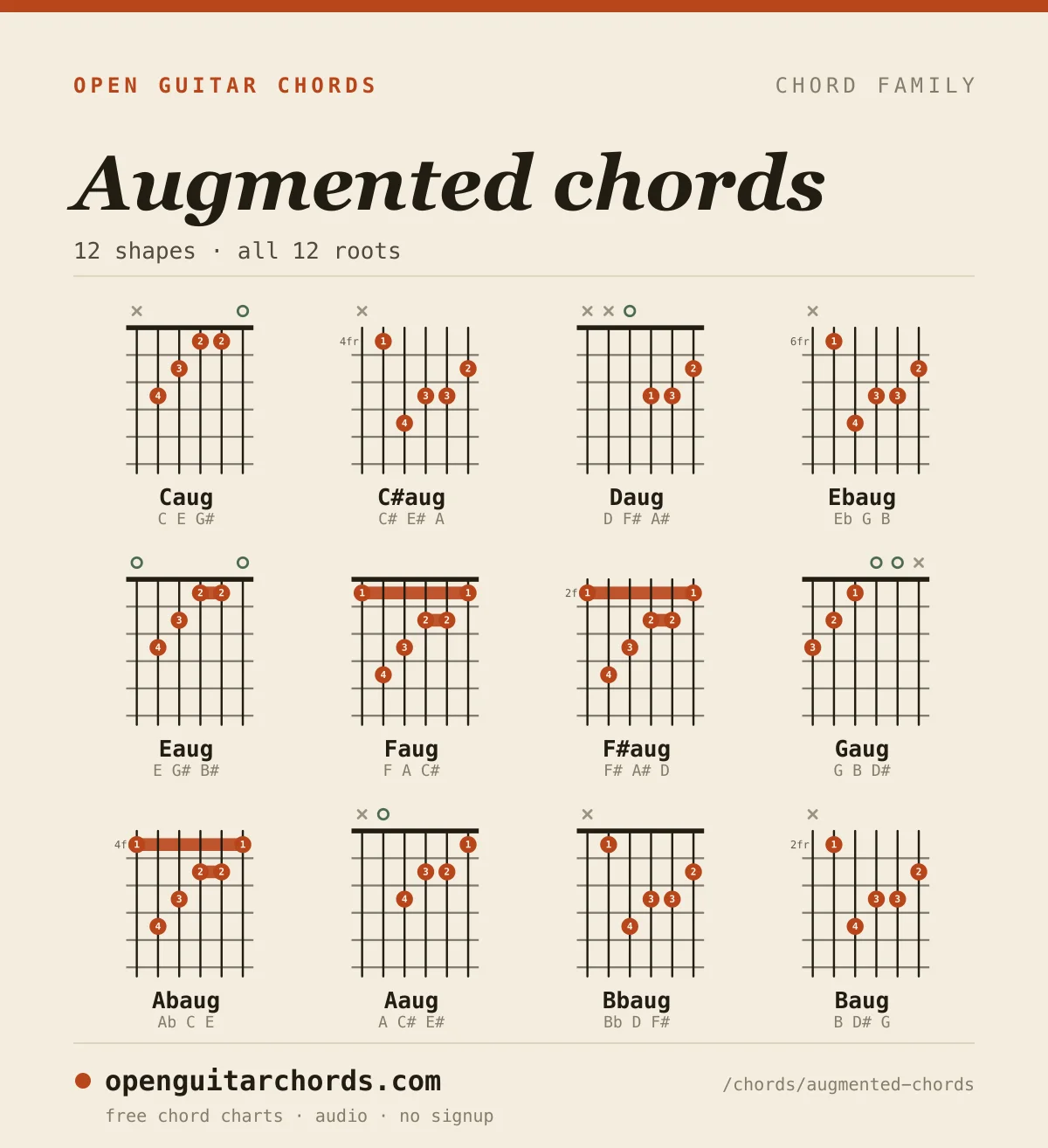
Chord family · 12 shapes
Augmented chords
An augmented chord takes a major triad and raises the fifth by one semitone. The result is a chord that sounds like it is leaning forward: it has no resting place, and it resolves most naturally upward by a half step.
Like the diminished family, augmented chords are symmetrical — this time in major thirds — so the same shape repeats every four frets and gives you three useful chords from one fingering.
Augmented
12 shapesHow to use augmented chords in a song
They behave like a dominant chord with a raised fifth, so they push hardest when they resolve up by a half step: Caug to F, or Eaug to A minor. If you have ever played a blues turnaround and wanted the last two bars to sound less predictable, an augmented shape in place of the dominant chord is the standard trick.
The symmetry is what makes the shapes economical. Any augmented fingering contains three notes spaced four frets apart in pitch, so moving the whole shape up four frets gives you the next inversion of the same chord with a different name underneath. Three chord names, one hand position.
You will meet them in jazz standards, bossa nova and musical theatre, and occasionally as a dramatic passing chord in rock. If a chord in a chart feels suddenly strange and bright, an augmented shape is usually the reason.
Four of the 12 shapes here are open-position and eight are movable, so the family is easier under the fingers than the name suggests. The hard part is hearing when one belongs: play Caug into F, then play plain C into F, and the difference between the two is the entire lesson.
If you only try two of the shapes on this page, try Caug and C#aug: both can be reached from shapes you already know, so the change stays playable at speed. Play them slowly enough that you hear the added note arrive, then speed the loop up without changing anything else.
How to practise augmented chords
- Play Caug at the 4th fret, then move the same shape to the 8th and 12th fret. Three names, one hand position. Say them out loud as you go.
- Loop C → Caug → F → C and listen for the lift on the augmented chord. Then play C → G7 → F, the ordinary version of the same move, and compare the two.
- Play Eaug into Am, then E7 into Am. Both resolve; only one sounds like it is leaning forward. That contrast is the entire reason the chord exists.
Augmented chords in real songs
As with diminished chords, none of the songs charted on this site uses an augmented chord. Learn the family when you start on standards; it will not come up in the songs you are playing now.
Printable family chart