Ed Sheeran
Perfect chords
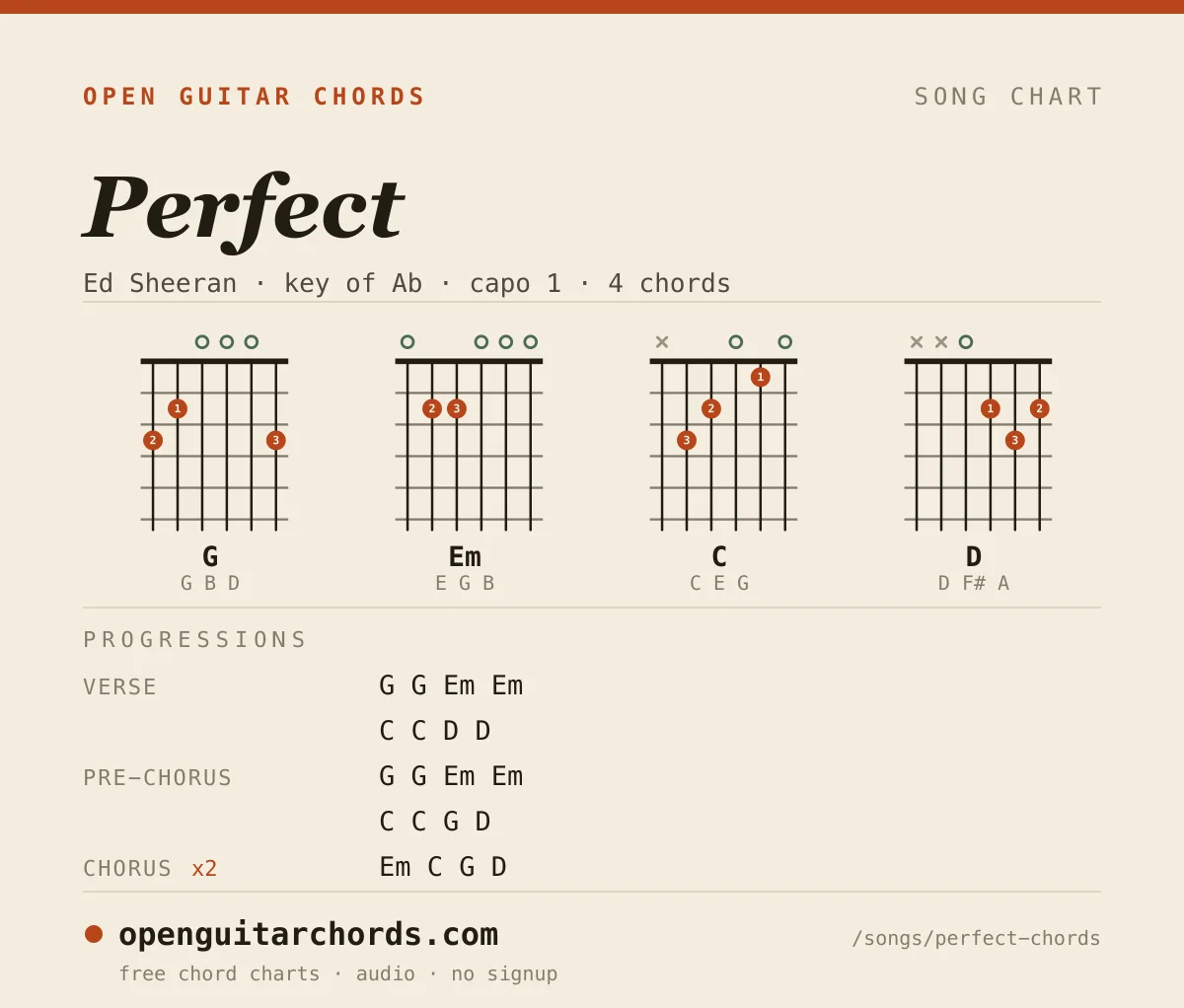
Perfect by Ed Sheeran is a beginner song in Ab, played with a capo on fret 1. The whole sheet is 4 chords (G, Em, C, D) across 3 sections: Verse → Pre-chorus → Chorus ×2. Every shape is an open chord, so nothing here needs barre strength. It sits at roughly 94.5 BPM.
By Chiye · Updated
Hardest change in the sheet: C → G, 2 times.
- Difficulty
- Beginnerno barre needed
- Key
- Abwith a capo on fret 1
- Tempo
- 94.5BPM
- Tuning
- Standard (E A D G B E)low to high
- Chords
- 4all open shapes
- Sections
- 3each with its own progression
Chords in Perfect
Frets read low E to high E, x means leave that string out.
Chord sheet
One chord per bar in this practice sheet. Follow the time signature shown beside each section; dots mark the remaining counts in the bar. Tap a bar to hear its chord, or loop the section to practise the changes.
Chord accompaniment only. Follow the section notes for this arrangement’s timing. Songs whose words are public domain →
Verse6/8 · ♩=94.5
Two 6/8 boxes equal one original 12/8 bar; count two compound beats per box
Pre-chorus6/8 · ♩=94.5
Chorus× 2 · 6/8 · ♩=94.5
Printable one-page chord chart
How to play Perfect
Play Perfect with G, Em, C and D shapes at capo 1, sounding in Ab. The main challenge is the flowing compound pulse and the faster chord changes in the chorus. This chart uses short 6/8 practice bars: two of its boxes make one original 12/8 bar. Keep that convention in mind before comparing the boxes with another chart or starting the player.
Count two groups of three in each box
The original 12/8 meter has four large dotted-quarter beats, each divided into three eighth notes. We split that into pairs of 6/8 boxes to show the quicker chorus changes clearly. Count ONE-two-three, TWO-two-three in each box. Two boxes together give four large pulses. The repeating groups of three are subdivisions; they do not make the song a three-beat waltz.
The six-slot grid D . . D . . places one gentle downstroke at the start of each group. Keep the two remaining eighth notes moving evenly in your count while the chord rings. This simple pulse helps you learn the harmony without attempting the recording’s individual picked notes. Once it is steady, let the second stroke stay lighter than the first instead of accenting every subdivision.
Change the order and the holding time
The verse goes G–G–Em–Em, then C–C–D–D. Repeated symbols mean another 6/8 box on the same chord: four large pulses on G before moving to Em. The pre-chorus begins in the same way, then finishes C–C–G–D. Those final G and D chords each last only one box, so prepare the D shape earlier than in the verse.
The chorus starts Em–C–G–D, with one box per chord. Practise Em into C first, then add G and D without inserting an extra hold. The verse and chorus share their chord set, but their starting point, order and harmonic pace differ. The page provides these main section exercises rather than the complete recorded sequence, instrumental passage or final slowdown.
Match the tempo unit to your count
The slow large pulse is about 63 dotted-quarter beats per minute. This player uses quarter-note BPM, displayed with a quarter-note symbol, so its equivalent setting is 94.5. Both produce 189 eighth notes per minute. One six-eighth-note box therefore lasts about 1.90 seconds, and a pair lasts about 3.81 seconds.
If you practise with a separate metronome clicking once per large pulse, use approximately 63 instead. At a slower practice pace, keep the same groups of three between clicks. Changing the number alone without checking which note value it represents can make an otherwise correct accompaniment feel too slow. Start by tapping the two large beats of a box before switching on the chord loop.
Keep the open shapes clean under the capo
All fret numbers in the diagrams are relative to the capo. Our Em is 0-2-2-0-0-0; it is already a small two-finger shape. Em7 adds a seventh to that harmony, so choosing it changes the colour rather than simply fixing a difficult Em. Begin with the plain triads printed here and compare alternatives deliberately later.
D is x-x-0-2-3-2, so start its sweep at the fourth string. C is x-3-2-0-1-0 and starts on the fifth. G and Em can use all six strings. Check the tuning again after fitting the capo. Removing it while retaining these shapes lowers the entire arrangement from Ab to G; move the whole progression if you choose another singing key.
The section orders and paired 6/8 notation follow Denis Davoren’s Music to my Ears teaching chart. The original meter and dotted-quarter tempo are also explained in Super Simple Piano’s Perfect lesson. The tempo conversion above applies those units to this page’s player.
How to practise Perfect
Four steps computed from this sheet: the order the shapes are easiest to learn in, the changes that really occur in the progressions above, where each chord turns up, and the tempo ladder up to the speed marked here.
Learn the shapes easiest first
G (3-2-0-0-0-3, beginner) → Em (0-2-2-0-0-0, beginner) → C (x-3-2-0-1-0, beginner) → D (x-x-0-2-3-2, beginner)
4 of the 4 shapes are open chords, so nothing here needs barre strength yet.
Drill the changes this sheet actually uses
C → G2×G → D2×G → Em2×C → D1×
These counts come from the progressions on this page, so they are the changes you will actually play, not a generic list of pairs to practise.
Know where each chord turns up
- Gevery section
- Emevery section
- Cevery section
- Devery section
Climb the tempo ladder
Start at 57 BPM and move up only when a full pass is clean: 57 → 71 → 85 → 95 BPM. The tempo marked on this sheet is 94.5 BPM, and the last step is the one that always feels like a jump. Stay at 85 for longer than feels necessary.
Practise each section's chord changes slowly, then play the sheet through at a steady tempo without pausing between sections.
Playing Perfect with a capo
This sheet is written with a capo on fret 1. Each card shows what you would finger at that capo position so the song still sounds exactly as written. Useful when the shapes above are awkward, or when you want to sing it higher without learning new chords.
No capo
Ab Fm C# Eb
no open shapes left, all barre
Fret 1as written
G Em C D
4 of 4 stay open
Fret 2
F# Ebm B C#
no open shapes left, all barre
Fret 3
F Dm Bb C
2 of 4 stay open
Fret 4
E C#m A B
2 of 4 stay open
Fret 5
Eb Cm Ab Bb
no open shapes left, all barre
Fret 6
D Bm G A
3 of 4 stay open
Fret 7
C# Bbm F# Ab
no open shapes left, all barre
Working out a different key? The capo calculatordoes the same arithmetic for any chord set.
More songs built on the same chords
If Perfect clicks, these use the closest set of shapes, so the chords you just learned keep working.
More beginner songs to learn after this one: Sweater Weather, Payphone, The Scientist, 505.
These chords across the songbookHow often each chord in Perfect turns up across all 104 songs on this site, and what it most often moves to next. The counts come from the sheet library itself, not from theory.
509bars of this chord across the songbook
77songs use this shape
Most often followed by D, 89×.
155bars of this chord across the songbook
43songs use this shape
Most often followed by C, 27×.
420bars of this chord across the songbook
70songs use this shape
Most often followed by G, 115×.
323bars of this chord across the songbook
58songs use this shape
Most often followed by G, 52×.