About
Chords should be
free and fast
Open Guitar Chords was built because looking up guitar chords online had become a chore: autoplay videos, cookie walls, paywalled diagrams and pages that take five seconds to load a single chord chart. The chords themselves are public knowledge — nobody should have to fight a website to read them.
- 172
- chord shapes
- 83
- in-depth chord pages
- 104
- song sheets
- 14
- browser tools
What you'll find here
Chords
172 chord shapes — every root in major, minor, seventh, suspended, sixth, diminished, augmented and power forms, each with a fingering diagram, note spelling and audio.
83 in-depth chord pages — for the chords people actually play, with step-by-step fingering, every position up the neck, and the songs in our library that use them. Rarer shapes are grouped into 8 family pages so every root can still be compared side by side.
All chords →Songs
Song sheets — key, capo, difficulty, section-by-section progressions and strumming, with every chord diagram linked inline.
All songs →Guides
Plain-English guides — basic chords, power chords, barre chords and how to read diagrams.
Guides →Tools
14 free browser tools with no install and no account: an
How the chord data is built
Every chord diagram is generated from string and fret data. The tools and audio use the same fingerings, so a correction can be applied throughout the site.
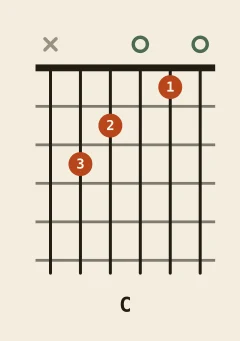
Generated, not drawn by hand. This C major diagram, the note spelling that sits beside it on its chord page, its note labels and its audio are generated from the same fingering data. If a fingering is corrected, all three update together.
Where the content comes from
- 01
No page on this site is written to a template and padded out. Every chord page has three things that are specific to that chord: the fingering for each position, the notes it contains, and — the part that cannot be copied — a count of where it appears in the 104 song sheets in this library, what chord it moves to next, and the progressions it sits inside. Those numbers are counted from the sheets in our song library at build time, so they change when the library changes and they describe real songs rather than a theory rule.
- 02
Chord fingerings are stored as string and fret data shared by the diagrams and audio. Playback uses acoustic guitar samples from the University of Iowa Musical Instrument Samples via tonejs-instruments, with each string transposed separately. A synthesizer provides a fallback while samples load.
- 03
Where a chord has no song in our library yet, the page says so instead of inventing an example. If you spot something that is wrong, the chord data is in one file and the corrections end up everywhere at once.
Who makes this site
Chiye is the guitarist and developer behind Open Guitar Chords. A self-taught player, he designs the chord database, maintains the audio engine and writes the guides. He keeps the fingerings, diagrams and explanations together so corrections can be applied across the site.
Every chord page carries his byline and a revision date, and the chord database he maintains is the single source behind the diagrams, the audio, the printed cards and the practice tools — when a fingering is corrected, everything on the site updates at once.
How the site is made
Pages are generated in advance, fonts are self-hosted, and the interactive tools run in your browser. Song sheets include a print layout for use on a music stand.
Guitar sound credits
Chord playback uses real acoustic guitar recordings from the University of Iowa Musical Instrument Samples (via the tonejs-instruments project), pitch-shifted per fret in your browser — no synthesized beeps.
About the song sheets
Song pages give chord progressions, structure and playing advice. Some public-domain songs also include lyrics; other sheets use chords alone or a few short chord cues. For complete lyrics to copyrighted songs, use official sources.