Guitar scale finder
Pick a root and a scale, and every note of it lights up across the whole fretboard with the root marked.
- roots
- 12
- scales
- 12
- frets shown
- 0 to 15
- diagrams
- SSR, no JS needed
C - D - E - F - G - A - B
root scale note · fret 0 = open string
How to practise a scale on the fretboard
- Pick the root. This is the key you are in, so match it to the song or chord progression you are playing over. Unsure of the key? The key finder works it out from the chords, and the circle of fifths shows what sits next to it.
- Pick the scale. Major for bright songs, natural minor for darker ones, minor pentatonic for soloing, blues when you want that extra grit. The highlighted notes are your safe zone: every one of them fits.
- Learn it in chunks. Do not try to swallow the whole neck at once. Master frets 0 to 4 first, then 5 to 8, then connect the two. The root markers are your landmarks, and they repeat every twelve frets.
- Play it in time. Set the metronome slower than feels comfortable and play the scale up and down, saying the note names out loud. Speed is a by-product of accuracy, never the other way round.
- Use it in a song. Take a song sheet whose key you know, and improvise with the highlighted notes over it for one chorus. A scale becomes music the moment you play it against a chord.
What is a guitar scale finder?
A guitar scale finder maps one scale across the whole neck, so you can see every place a note of that scale appears instead of memorising shapes one box at a time. Pick a root, pick a scale, and the notes light up from the open strings to the 15th fret, with the root of the scale in a separate colour so you never lose your place. Scales are built from a fixed pattern of whole and half steps. The major scale is the reference, seven notes at semitone steps 0, 2, 4, 5, 7, 9 and 11, and every other scale on this page is that pattern with one or two notes changed. The minor pentatonic drops two notes, so it has five. The blues scale adds one back. Turn the root to the key of the song you are learning, and the highlighted notes become the safe notes for a solo or a melody.
Learn & referenceExamples, charts and deeper explanation
Scale formulas in semitones
Every scale on this page is written as a recipe of semitone offsets from the root, starting at 0. Count the offsets and you can build any of them from any root without a diagram: G major starts on G and adds 0, 2, 4, 5, 7, 9, 11 semitones.
| Scale | Semitones from root | Degrees | Sound |
|---|---|---|---|
| Major (Ionian) | 0-2-4-5-7-9-11 | 1 2 3 4 5 6 7 | bright, resolved |
| Natural minor (Aeolian) | 0-2-3-5-7-8-10 | 1 2 ♭3 4 5 ♭6 ♭7 | darker mirror of major |
| Harmonic minor | 0-2-3-5-7-8-11 | 1 2 ♭3 4 5 ♭6 7 | raised 7th, tense pull home |
| Melodic minor | 0-2-3-5-7-9-11 | 1 2 ♭3 4 5 6 7 | jazz minor, smooth ascent |
| Pentatonic major | 0-2-4-7-9 | 1 2 3 5 6 | five notes, hard to play wrong |
| Pentatonic minor | 0-3-5-7-10 | 1 ♭3 4 5 ♭7 | first solo scale for most players |
| Blues | 0-3-5-6-7-10 | 1 ♭3 4 ♭5 5 ♭7 | pentatonic plus the blue note |
| Dorian | 0-2-3-5-7-9-10 | 1 2 ♭3 4 5 6 ♭7 | minor with a bright 6th |
| Phrygian | 0-1-3-5-7-8-10 | 1 ♭2 ♭3 4 5 ♭6 ♭7 | Spanish, flamenco colour |
| Lydian | 0-2-4-6-7-9-11 | 1 2 3 ♯4 5 6 7 | dreamy, raised 4th |
| Mixolydian | 0-2-4-5-7-9-10 | 1 2 3 4 5 6 ♭7 | major with a flat 7th |
| Locrian | 0-1-3-5-6-8-10 | 1 ♭2 ♭3 4 ♭5 ♭6 ♭7 | unstable, half diminished |
Want the same scale written out by key? The scale dictionary has a page for every root and scale with the note names, the step pattern and the chords that fit.
Five scales, seen across the neck
Each diagram below starts on C, so you can compare them note for note. Orange marks the root, cream marks the rest of the scale. Notice how few notes the two pentatonics use, and where the blues scale adds its extra one.
Still learning where the plain notes live on the neck? The fretboard notes chart shows all twelve names with nothing filtered out, and the fretboard notes guide explains how to memorise them.
Scales are the map, chords are the roads
Every chord you play lives inside a scale. Stack the 1st, 3rd and 5th notes of a scale and you get the chord built on that root, which is why the chords that appear together in songs come from one shared scale. The three diagrams below are the tonic chords of three of the scales above.
One scale, three chords
Take the C major scale and stack a different note on top each time and you get three different chords. The diagrams below show the same three shapes as dots on a neck.
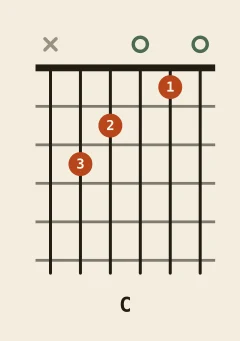
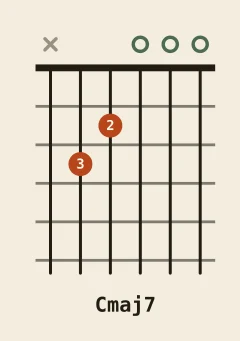
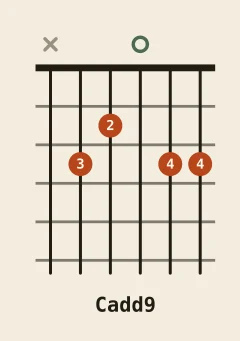
To see which seven chords sit inside one key, open the circle of fifths, or start from the full chord dictionary.
Scale finder FAQ
What is a guitar scale?
Which scale should I learn first?
What is the difference between a scale and a mode?
How do I practice a scale on the fretboard?
For more on how notes and shapes fit together, see the guitar chords chart and the guitar glossary.