Chord finder
Two taps to any of the 144 chord shapes, plus every voicing up the neck.
- chords
- 166 shapes
- grid
- 12 roots x 12 types
- neck
- frets 0 to 15
- audio
- strummed in browser
What is a guitar chord finder?
A guitar chord finder is a lookup tool that turns a chord name into the finger positions that produce it. You choose a root note (C through B) and a chord quality such as major, minor or seventh, and the tool returns the matching shape: a chord diagram, the note spelling, every playable voicing up the fretboard, and an audio preview you can hear. This finder covers 166 shapes. The core grid is 12 roots × 12 qualities = 144 combinations, and on top of that sit 25 slash, add9 and half-diminished voicings taken from the songs in our library. Every shape is checked against the same chord database that renders the 65 chord pages on this site, and each result links through to a full page with fingering tips and the songs that use it. If you are holding a shape and want its name instead, the chord identifier works in the opposite direction.
Learn & referenceExamples, charts and deeper explanation
How do I find a chord on this page?
- Tap a root, then a chord type. The first strip is the twelve roots, the second is the quality. Two taps reach any of the 144 grid shapes, no menus involved.
- Compare every voicing up the neck. The bright fret numbers on the board, or the pills below it, switch between every playable position of the same chord. Turn on All notes to see every chord tone across the whole fretboard.
- Listen, then go deeper. Hear the chord strummed, copy a link to share the exact shape, or open the full page for the theory and the songs that use it.
New to chord boxes? How to read a chord diagram walks through the dots, numbers and X marks in two minutes.
Which guitar chords should I learn first?
These eight open chords need no barre and between them cover thousands of songs. Each diagram opens the full page for that chord, with every voicing up the neck and the songs that use it.
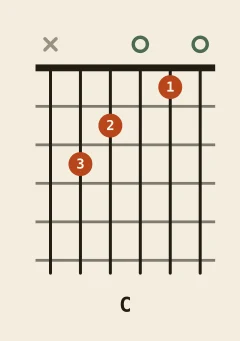
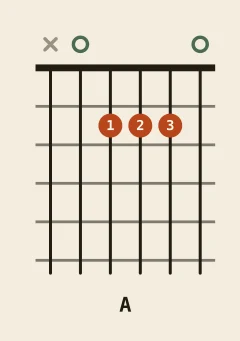
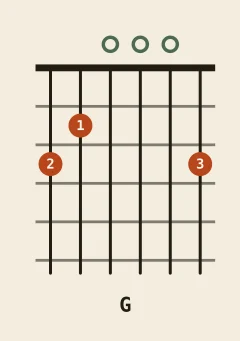
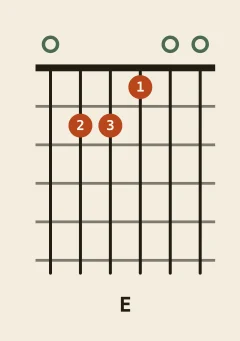
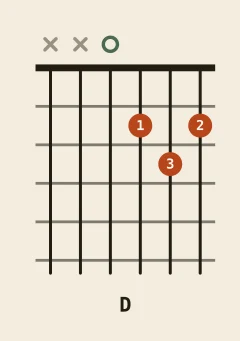
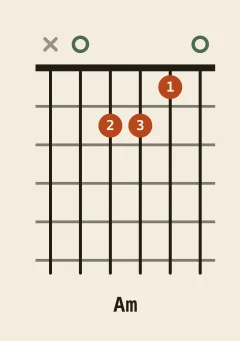
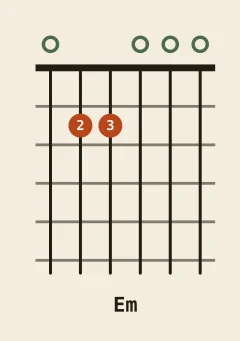
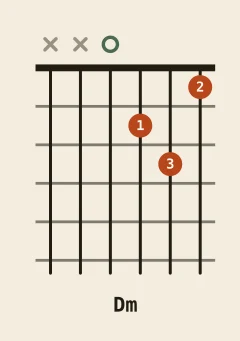
What are the different types of guitar chords?
Twelve chord qualities cover almost everything in a song sheet. The formula column shows the scale degrees each quality stacks on top of its root, so you can see why a minor chord sounds darker than a major one and what a seventh adds.
| Chord type | At C | Formula | How it sounds |
|---|---|---|---|
| Major | C | 1 - 3 - 5 | the bright, home-base sound that most songs resolve to |
| Minor | Cm | 1 - ♭3 - 5 | the darker, moodier counterpart of the major chord |
| Dominant 7th | C7 | 1 - 3 - 5 - ♭7 | a tense, bluesy chord that wants to resolve down a fifth |
| Major 7th | Cmaj7 | 1 - 3 - 5 - 7 | a soft, jazzy chord heard all over neo-soul and bossa |
| Minor 7th | Cm7 | 1 - ♭3 - 5 - ♭7 | the smooth workhorse of funk, R&B and lo-fi |
| Suspended 4thSuspended chords | Csus4 | 1 - 4 - 5 | an airy, unresolved sound that hangs before resolving to the major chord |
| Suspended 2ndSuspended chords | Csus2 | 1 - 2 - 5 | an open, ringing voicing with a modern folk flavour |
| SixthSixth chords | C6 | 1 - 3 - 5 - 6 | a warm, vintage chord that sits between major and minor moods |
| Minor 6thSixth chords | Cm6 | 1 - ♭3 - 5 - 6 | a noir-ish, jazzy colour straight out of film soundtracks |
| DiminishedDiminished chords | Cdim | 1 - ♭3 - ♭5 | an unstable, tense chord that repeats every three frets |
| AugmentedAugmented chords | Caug | 1 - 3 - ♯5 | a mysterious, floating chord with a raised fifth |
| Power ChordPower chord shapes | C5 | 1 - 5 | the root-and-fifth engine of rock, punk and metal: neither major nor minor |
Popular guitar chords
The shapes most players look up first. Each one opens a full page with every voicing up the neck, the theory, and real songs that use it.
Browse chord families
One page per chord type: all twelve roots side by side, with audio for every shape and the theory behind the family.