Chord family · 24 shapes
Suspended chords
A suspended chord replaces the third with either the second (sus2) or the fourth (sus4). With no third there is no major or minor quality, so the chord hangs in the air and waits to fall back to the plain triad.
This is why suspended chords are everywhere in acoustic music: hold a sus4 for a bar, then drop one finger and the resolution does the work for you. In a chart, a sus chord is an instruction to move a single finger, not to learn a new shape.
Suspended 2nd
12 shapes · 2 with their own pageSuspended 4th
12 shapes · 2 with their own pageHow to use suspended chords in a song
Suspensions are the cheapest way to make a two-chord song sound like a four-chord song. Hold the sus shape for a beat or two, then release the finger that makes it suspended; the listener hears movement without any new chord being introduced.
Two rules cover most situations. In a major key, a sus4 on the tonic chord (Dsus4 resolving to D) is the most common. On a dominant chord, a sus4 that resolves to the dominant seventh (A7sus4 to A7) produces the drone you hear in a lot of acoustic rock, because the fourth is the same note as the root of the chord a fifth below.
Sus2 and sus4 are not interchangeable. Sus4 is the older, more folk sound and the one that wants to resolve. Sus2 is the more modern, open sound and it can sit still for a whole bar without feeling unfinished, which is why it turns up in singer-songwriter strumming rather than in hymns.
Of the 25 shapes here, 6 are open-position. The four you actually need first — Asus2, Asus4, Dsus2 and Dsus4 — are all open and all one finger away from a chord you already play, which makes this the cheapest family on the site to start using.
If you only try two of the shapes on this page, try Csus2 and C#sus4: both can be reached from shapes you already know, so the change stays playable at speed. Play them slowly enough that you hear the added note arrive, then speed the loop up without changing anything else.
How to practise suspended chords
- Play D, then Dsus4, then D again, keeping the same three fingers and moving only the one that makes the suspension. Ten reps a day until the release is automatic.
- Hold Dsus4 for a full bar and release to D on beat 3. Then hold for three beats and release on beat 4. The second version is the folk strum you hear on every acoustic record.
- Play Dsus2 for a bar on its own without resolving it. It holds still; Dsus4 does not. That difference is why sus2 shows up in singer-songwriter parts and sus4 shows up in hymns.
Suspended chords in real songs
Suspended chords are all over the acoustic songs charted here. Five examples:
- Wonderwall: the verse loops on Dsus4 and A7sus4, and resolving back to the plain chords is the entire guitar part
- Fast Car: uses Dsus4 and Dsus2 as the two halves of a single repeated figure
- Ho Hey: holds a Csus4 for a bar before dropping to C
- What's Up?: A, Bm, D and Dsus4, with the sus4 doing the work of a fourth chord
- Peaceful Easy Feeling: opens on D and Dsus4 alternating, which is the folk strum in one line
Printable family chart
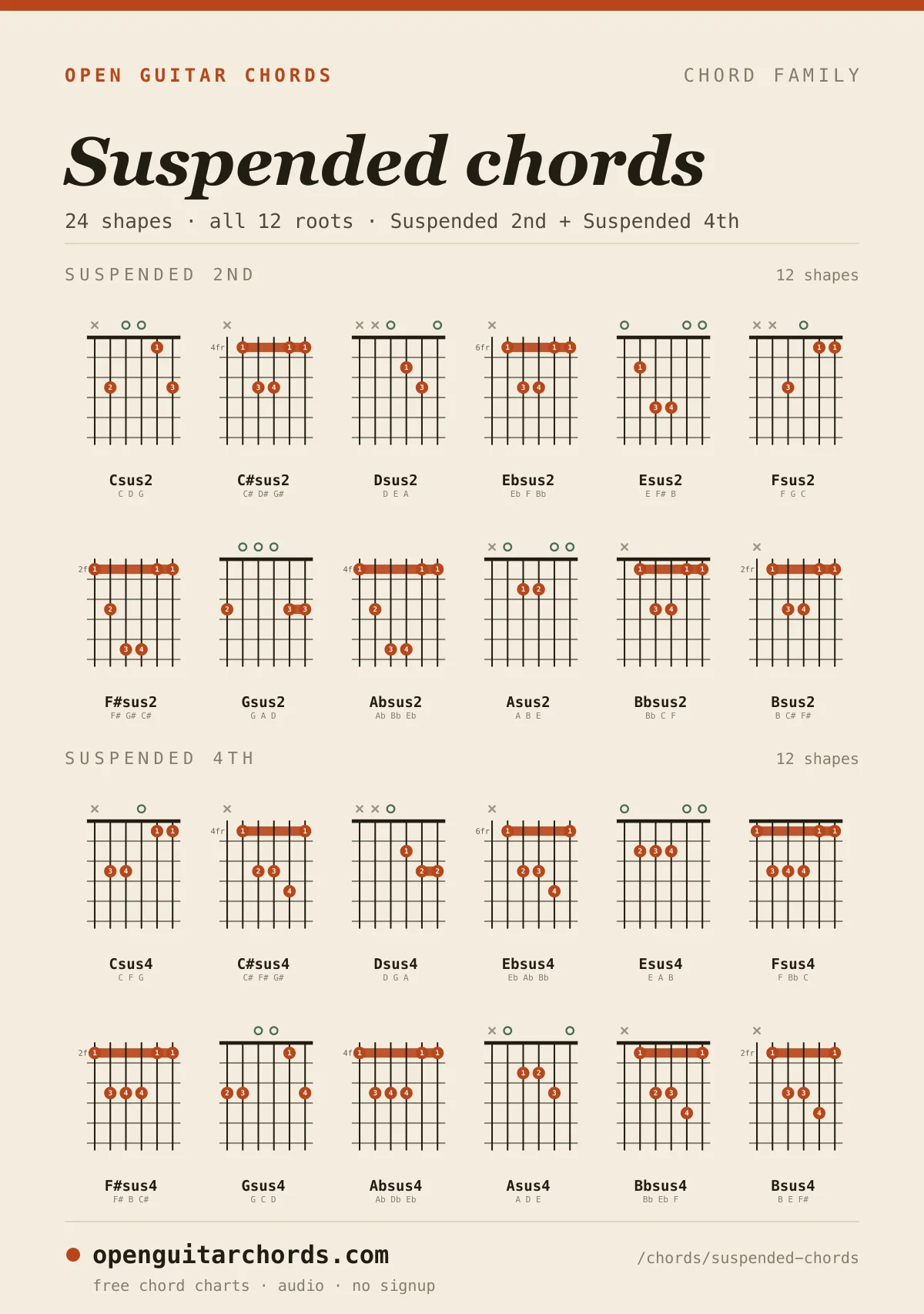
Suspended chords with their own pages
These are the ones that turn up often enough in songs to deserve a full page — fingerings in every position, real progressions, and the songs that use them.