Lessons
Guitar guides,
written like a person talks
No autoplay videos, no 40-minute intros. Each guide gets to the point with diagrams, drills and the exact songs to practise it on.
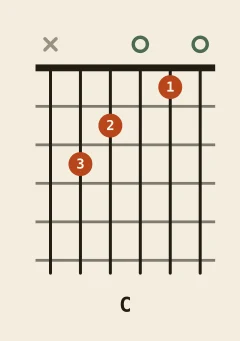
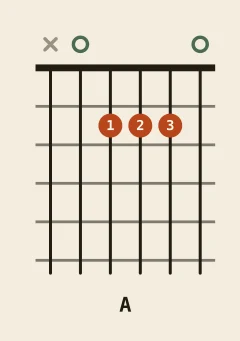
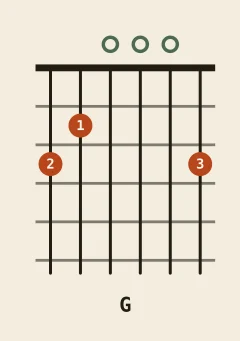
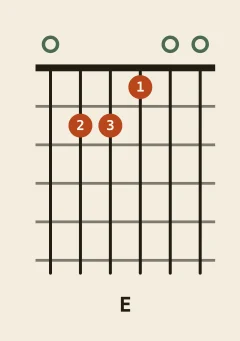
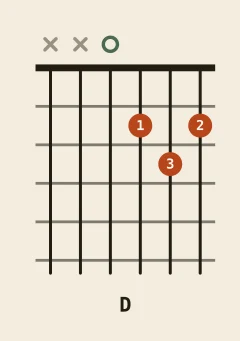
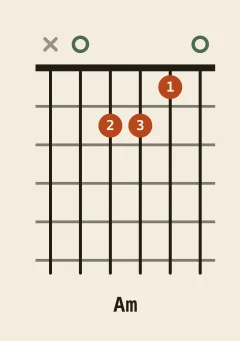
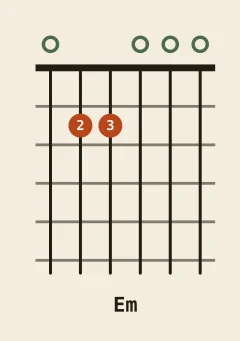
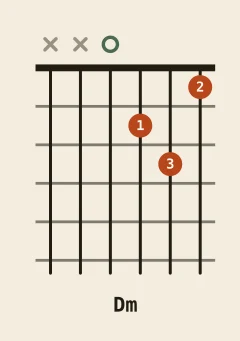
Basic Guitar Chords for Beginners
The 8 basic guitar chords every beginner should learn first — with diagrams, fingerings and practice tips.
- 02Easy Guitar Chords for BeginnersThe easiest guitar chords to learn first — two-finger chords, one-finger chords, and 10 simple songs that use them.
- 03Printable Guitar Chords Chart (PDF) — How to Use ItPrint the free guitar chords chart as a PDF, then learn how to read it — open chords, moveable shapes and the fastest way to use the chart in a song.
- 04Power Chords on Guitar: The Complete GuideHow to play power chords on guitar — root-6 and root-5 shapes, palm muting, and the 10 songs that define the sound. Includes diagrams for every power chord.
- 05Barre Chords (Bar Chords) on Guitar: E-Shape & A-ShapeHow to play barre chords on guitar — the E-shape and A-shape that unlock the whole fretboard, F major and B minor, common mistakes, and exercises.
- 06Major Chords on Guitar: All 12 Shapes & ProgressionsEvery major chord on guitar — open shapes, barre shapes, the theory behind them, and the progressions that use them.
- 07How to Read Guitar Chord Charts (Diagrams Explained)Learn to read guitar chord charts and diagrams — strings, frets, dots, finger numbers, X and O symbols, and barre notation, explained for complete beginners.
- 08Guitar Fretboard Notes Explained — Learn Every Note on the NeckGuitar fretboard notes explained: the open strings, the 12th-fret octave, the 5th-fret rule and a practice plan that makes the whole neck stick.
- 09Chord Progressions for Guitar: The Patterns Behind Every SongHow chord progressions work on guitar — Roman numerals, the diatonic chords of every key, the classic patterns (I-V-vi-IV, ii-V-I, 12-bar blues) and how to write your own.
- 10Guitar & Music Theory Glossary — Every Term in Plain EnglishA plain-English glossary of guitar and music theory terms — scale, interval, capo, diatonic, voicing and 30+ more, each explained in one or two sentences with guitar examples.
Which guide do I need?
Ten guides is enough that picking one becomes its own small problem. Find your goal in the left column and read across.
- 01Play a whole song this weekEasy Guitar Chords for Beginners
- 02Know which 8 chords to learn, and in what orderBasic Guitar Chords for Beginners
- 03Put something on the music standPrintable Guitar Chords Chart (PDF)
- 04Decode a diagram someone sent youHow to Read Guitar Chord Charts
- 05Stop avoiding the F chordBarre Chords: E-Shape & A-Shape
- 06Play rock rhythm partsPower Chords: The Complete Guide
- 07Understand why chords sound the way they doMajor Chords: All 12 Shapes
- 08Know where the notes are on the neckGuitar Fretboard Notes Explained
- 09Write your own progressionsChord Progressions: The Patterns Behind Every Song
- 10Look up a term someone usedGuitar & Music Theory Glossary
If two rows look like they fit, take the earlier one. Every guide assumes only what the guides above it teach, so reading out of order is the one reliable way to make them feel harder than they are.
The order that works
Learning guitar is not a ladder where each rung is a new chord. It is four stages, and most people quit in the middle of the second because they skipped the first.
- 01Four chords, one song. Pick up four shapes that share fingers, learn one song that uses only those four, and play it badly but end to end. This is the stage that decides whether you continue, and it is why the easy chords guide comes before the complete one.
- 02The full beginner set. Eight open chords, learned in order of finger count and stretch rather than alphabetically. The basic chords guide sequences them and gives each one a song to prove it works.
- 03Paper on the stand. Once you can play from memory, a printed chart changes how you practise: you stop hunting for shapes and start playing songs. The printable chart is 36 chords across three pages, and there is a section on how to actually use it rather than just own it.
- 04The moveable shapes. Two barre shapes give you every major and minor chord in every key. This is the stage where the neck stops being a set of separate positions. Barre chords first, then power chords if you want to play loud.
Two guides sit outside that sequence on purpose. Reading chord charts is worth doing on day one because it is the skill every other guide assumes, and chord progressions is the theory layer that makes sense once you have four chords under your fingers.
What these guides assume
Almost nothing. Every guide is written for someone holding a guitar in standard tuning who can press a string down and make a sound. Where a guide needs a shape from an earlier one, it links to that shape rather than assuming you already know it.
Two things are assumed throughout, and both are free on this site: that you can tune the guitar (online tuner, no app install) and that you can keep time with something (metronome, or the strumming patterns in any song sheet). Practising a chord change without either is practising the wrong thing at the wrong speed.
Beyond the guides
Guides teach the skill; the rest of the site is where you use it. Every song here has a full sheet with the key, the capo position, the section-by-section progression and a breakdown of the hardest change in it. The chord dictionary has a page for every chord you will actually play, each ending with the real songs it turns up in.
And when you want to check something rather than learn it, the tools are the fastest route: name a chord from its frets with the chord identifier, work out a capo position with the capo calculator, or find the key of a song you wrote with the key finder.
How these guides are written
Five rules, applied to every page here:
- Facts are checked against real songs. When a guide says a progression powers a lot of pop, it links to songs charted on this site that use it, not to a vague claim about "many hits".
- Every guide ends in music, not exercises. Each one closes with songs you can play right now with what you just learned. Drills exist to get you to the song, never instead of it.
- The diagrams are the same ones used everywhere else. A shape you learn in a guide is drawn identically in the chord dictionary and in every song sheet, so nothing has to be relearned when you move between them.
- Mistakes get their own section. Knowing what a buzzing chord sounds like and why it happens saves more time than another paragraph about how to do it right.
- Revision dates are real. The date at the top of each guide changes when the content changes, not when the site is rebuilt.