Capo calculator
Find what key you really sound in with the capo on, and which fret lets you play any song with easy shapes.
- shape keys
- C G D A E
- capo frets
- 0 to 9
- transposes
- both ways
- math
- 1 fret = 1 semitone
What am I really playing?
Pick the shapes you are using and the capo fret, and read the chords that actually sound.
G shapes + capo 2 = key of A
Where do I put the capo?
Pick the song's real key and the shapes you would rather play.
Capo on the 3rd fret
Playing C shapes with a capo on fret 3 sounds in Eb.
What is a capo calculator?
A capo calculator translates between the shapes your fingers make and the notes that actually sound. A capo is a clamp across all six strings at one fret, so it works like a movable nut: every open shape you play moves up with it. One fret up is one semitone, so the same G shape that sounds as G at the nut sounds as A with the clamp on the 2nd fret and as B flat on the 3rd. The calculator answers both directions. Give it your shapes and a fret, and it names the key you are really in and rewrites all seven diatonic chords for you. Give it the song's real key and your preferred shapes, and it tells you which fret to clamp and warns you when the answer sits too high up the neck to sound good.
Learn & referenceExamples, charts and deeper explanation
Why one shape sounds like a different chord
Worked example, and the default on this page: G shapes with the capo on the 2nd fret. The clamp holds every string down two frets, so the notes that were open strings come out two semitones higher, and everything your fingers fret moves up with them. The shape does not change at all, but the music arrives in A instead of G.
The six diagrams opposite are the open shapes of the G family and the chord each one sounds with the clamp on fret 2. G, C and D are the major shapes and they climb by two semitones. Am, Em and Dm are the relative minor shapes and they climb by three, which is exactly why G and Em sit in the same key yet sound so different.
The same trick runs in reverse. If a song is written in a hard key, you keep the easy shapes and put the capo at the fret that closes the gap. That is why a song in E flat can be played with the C, F and G shapes you already know, and the easy chords guide lists the shapes worth learning first.
The same shapes appear in the basic guitar chords lesson, and every voicing of each one lives in the chord dictionary.
Open shapes instead of harder ones
The practical reason a capo earns its place in the gig bag: it moves a song onto shapes you can already play. Each pair below shows the shape you hold with the clamp on, then the open-position chord you would have to reach for without it.
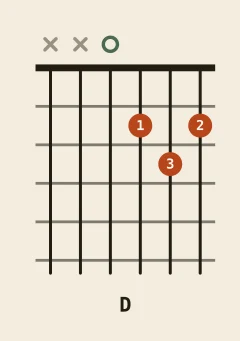
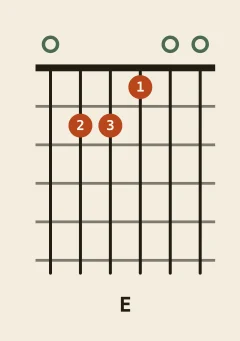
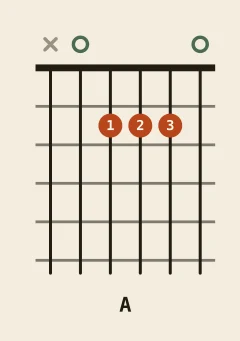
Capo fret to key, counted in semitones
The third column is the whole trick in one table. Read it with G shapes in mind, then count the same number of semitones up from any other shape key: a capo on fret 3 with E shapes sounds in G, because three semitones above E is G.
| Capo fret | Semitones up | G shapes sound in | When you would use it |
|---|---|---|---|
| no capo | 0 | G | Open G shapes. Any song already in G, or in a key you can reach with the shapes you know. |
| 1 | +1 | A♭ | A song sits a semitone above your shapes, or you want a slightly brighter, tighter feel from the shorter string length. |
| 2 | +2 | A | The most common capo position on record. G shapes with a capo on 2 sound in A, which is why so many acoustic songs use it. |
| 3 | +3 | B♭ | Horn and piano keys. Playing C shapes with a capo on 3 puts you in E♭ without a single barre chord. |
| 4 | +4 | B | G shapes up a major third. Useful when a singer moves a song up and you want to keep the same fingerings. |
| 5 | +5 | C | G shapes with a capo on 5 sound in C, so you can play in C while using shapes you already know. |
| 6 | +6 | D♭ | The top of the comfortable range. Past fret 5 the neck gets crowded and the frets get narrow. |
| 7 | +7 | D | A practical ceiling for most players, and usually a sign that a different set of shapes would sound fuller. |
When to use a capo, and when not to
A capo is a trade, not a free upgrade. It buys easy shapes and open strings that ring, and it costs you reach and low notes. Three situations where the trade is clearly worth it, and the sum that decides every one of them.
the sum
- capo on fret
- 1 semitone each
- G shapes, capo 2
- sounds in A
- C shapes, capo 3
- sounds in E♭
- E shapes, capo 1
- sounds in F
use it when
- singing range
- song sits too low or too high
- horn keys
- B♭, E♭, A♭ with open shapes
- ringing parts
- open strings beat barre chords
- matching a record
- the sheet says capo 2 or 4
skip it when
- you need frets 12+
- the clamp is in the way
- you need low E
- the capo takes the bass away
- lead playing
- positions above the clamp narrow
- barre is fine
- F shapes already work up there
How to use a capo (and why pros love it)
- Clamp just behind the fret wire. Not on top of it, not halfway back. Right behind the fret, firm enough that every string rings cleanly. Too much tension pulls the tuning sharp before you play a note.
- Re-check your tuning. A capo pulls strings slightly sharp, especially on acoustic guitars. A quick pass with the online guitar tuner after clamping saves a lot of confusion.
- Think in shapes, not letters. With a capo on, "C shape" no longer means "C chord". The calculator above does the translation, and after a few songs it becomes second nature. The chord chart guide explains how shapes are written down.
- Match the shapes to the song. Many song sheets print the capo fret at the top, so you play along with the recording using shapes you already know. If the sheet says capo 2 and you have no capo, the power chords guide shows the movable shapes that need no clamp.
Capo FAQ
What does a capo actually do?
Why do song sheets say "capo 2" instead of just writing harder chords?
How do I find the capo position for a song?
Does a capo work on electric guitar?
More on how chords are put together, and where a song is likely to go next, is in the chord progressions guide and the key finder.