Eagles
Hotel California chords
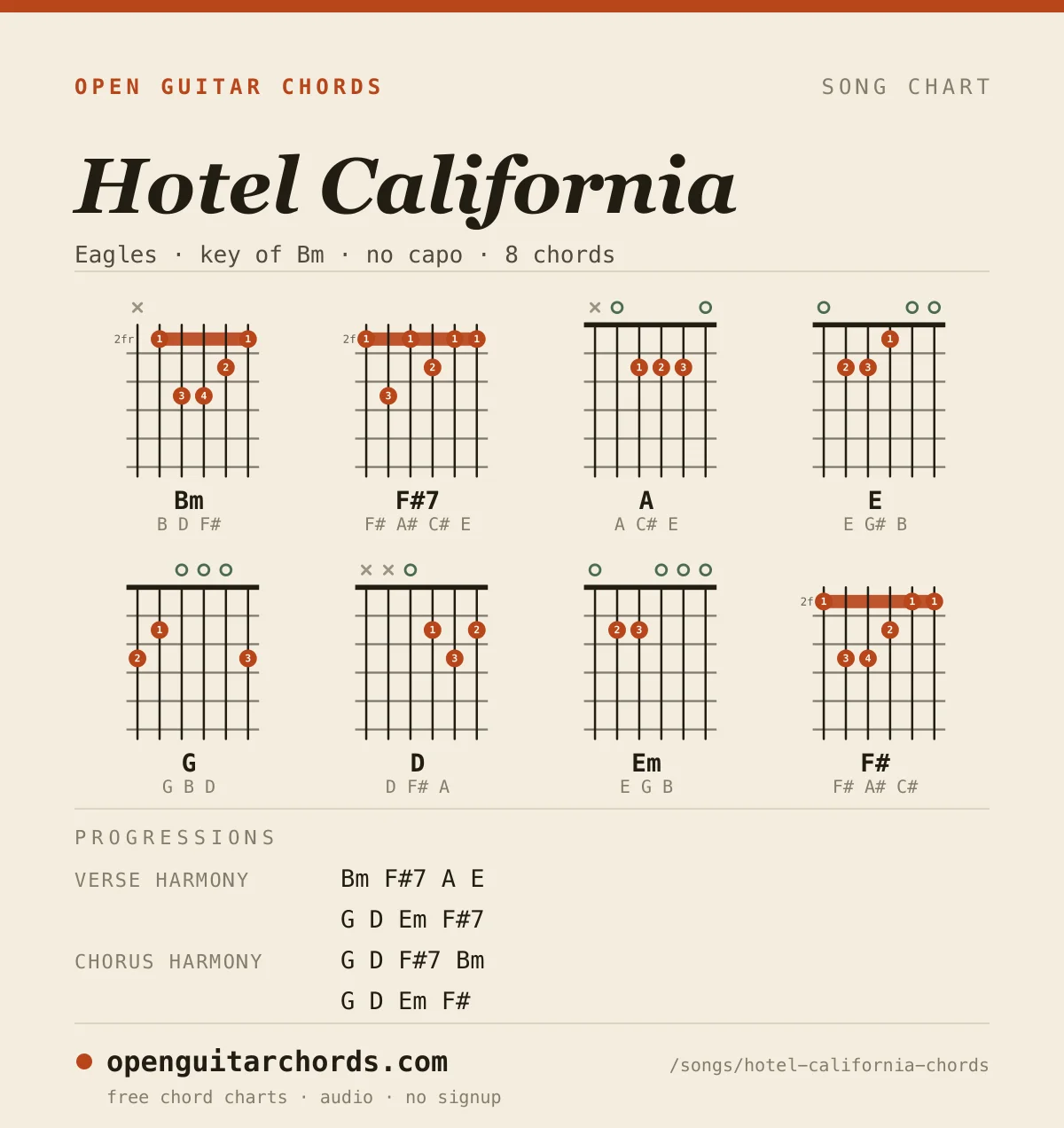
Hotel California by Eagles is an intermediate song in Bm, played with no capo. The whole sheet is 8 chords (Bm, F#7, A, E, G, D, Em, F#) across 2 sections: Verse harmony → Chorus harmony. 5 of the 8 shapes are open chords. Shapes that use a barre: Bm, F#7, F#. It sits at roughly 73 BPM.
By Chiye · Updated
Hardest change in the sheet: Bm → F#7, once.
- Difficulty
- Intermediatebarre shape Bm
- Key
- Bmwith no capo
- Tempo
- 73BPM
- Tuning
- Standard (E A D G B E)low to high
- Chords
- 85 open, 3 with a barre
- Sections
- 2each with its own progression
Chords in Hotel California
Frets read low E to high E, x means leave that string out.
Chord sheet
One chord per bar in this practice sheet. Follow the time signature shown beside each section; dots mark the remaining counts in the bar. Tap a bar to hear its chord, or loop the section to practise the changes.
Chord accompaniment only. Follow the section notes for this arrangement’s timing. Songs whose words are public domain →
Verse harmony4/4 · ♩=73
One bar per chord; isolate the changes before adding a personal strum
Chorus harmony4/4 · ♩=73
Printable one-page chord chart
How to play Hotel California
Play this Hotel California practice chart in B minor, with standard tuning and no capo. The verse and chorus use different eight-bar orders. Learn each line separately before joining them: starting the chorus on Bm because the verse began there would put you in the wrong place. The chart concentrates on the main harmony, with one four-beat bar per printed box.
Separate the verse from the chorus
The verse runs Bm–F#7–A–E, followed by G–D–Em–F#7. The chorus begins G–D–F#7–Bm, then G–D–Em–F#. Notice both differences: the chorus starts on G, and its last symbol here is the F# triad. It is not simply another pass through the verse loop.
These orders follow the basic-chord section of the linked teaching score. The page does not reproduce its individual introduction notes, bass-line variations or solo. The player keeps the existing 73 BPM setting for slow-count practice. Start with one quiet attack per box to hear the harmonic changes, then use the loop as a steady exercise rather than assuming it includes every recorded repeat and ending.
Hear why the F sharp chord is major
Bm contains B, D and F#. F# major contains F#, A# and C#. That A# is important: it sits a semitone below B and helps the harmony pull back to the minor tonic. F#m would use A natural instead and would change that pull. A minor key does not mean every chord in it must be minor.
F#7 adds E natural to the F# major triad. Keep the distinction between the chord root F# and the added seventh E; F#7 does not mean to play F7. In this practice version, the seventh colours the verse’s return to Bm and the first half of the chorus. Compare the final chorus F# with F#7 slowly rather than treating their diagrams as interchangeable shapes.
Change the root string under the barre
Our Bm diagram is x-2-4-4-3-2, rooted on the fifth string. F# is 2-4-4-3-2-2, rooted on the sixth. Both begin with an index barre at fret 2, but the remaining fingers must move. Holding the barre while leaving the other fingers in the Bm positions will not produce F#.
F#7 is 2-4-2-3-2-2. Compared with F#, release the fourth-string fret 4 back to the barre at fret 2. Keep the third-string fret 3 pressed: that note is A#, the major third. Practise Bm to F#7 as a two-chord change, then add the following A. On the return to Bm, stop the low sixth string from sounding so the bass reaches B cleanly.
Let the open chords reset your hand
The middle of the verse gives you A, E, G and D before Em returns to F#7. Use those open shapes to release unnecessary pressure. A is x-0-2-2-2-0; E is 0-2-2-1-0-0. Keep the fourth-string second-fret E as a reference, then set the whole E grip, including its third-string G# and open B string. Check the complete shape before trying to move faster.
D begins at the fourth string and Em can include all six. Keep the picking hand aware of those changing bass-string starts. If you prefer a capo-2 version, the corresponding shape family is Am, E7, G, D, F, C, Dm and E. Those shapes are measured from the capo and preserve the sounding pitches; placing a capo on this no-capo chart without changing its shapes would raise everything instead.
The verse/chorus orders and major-versus-seventh choices were checked against Skegness Guitar Teacher’s basic-chord score. Song Notes’ lesson independently confirms the no-capo B-minor setup and alternative capo families. The grip exercises above use this page’s diagrams.
How to practise Hotel California
Four steps computed from this sheet: the order the shapes are easiest to learn in, the changes that really occur in the progressions above, where each chord turns up, and the tempo ladder up to the speed marked here.
Learn the shapes easiest first
A (x-0-2-2-2-0, beginner) → E (0-2-2-1-0-0, beginner) → G (3-2-0-0-0-3, beginner) → D (x-x-0-2-3-2, beginner) → Em (0-2-2-0-0-0, beginner) → Bm (x-2-4-4-3-2, intermediate, needs a barre) → F#7 (2-4-2-3-2-2, intermediate, needs a barre) → F# (2-4-4-3-2-2, intermediate, needs a barre)
5 of the 8 shapes are open chords, so start there and leave Bm until the others change cleanly.
Drill the changes this sheet actually uses
G → D3×D → Em2×A → E1×Bm → F#71×
These counts come from the progressions on this page, so they are the changes you will actually play, not a generic list of pairs to practise.
Know where each chord turns up
- Bmevery section
- F#7every section
- AVerse harmony
- EVerse harmony
- Gevery section
- Devery section
- Emevery section
- F#Chorus harmony
Climb the tempo ladder
Start at 44 BPM and move up only when a full pass is clean: 44 → 55 → 66 → 73 BPM. The tempo marked on this sheet is 73 BPM, and the last step is the one that always feels like a jump. Stay at 66 for longer than feels necessary.
Practise each section's chord changes slowly, then play the sheet through at a steady tempo without pausing between sections.
Playing Hotel California with a capo
This sheet needs no capo. Each card shows what you would finger at that capo position so the song still sounds exactly as written. Useful when the shapes above are awkward, or when you want to sing it higher without learning new chords.
No capoas written
Bm F#7 A E G D Em F#
5 of 8 stay open
Fret 1
Bbm F7 Ab Eb F# C# Ebm F
no open shapes left, all barre
Fret 2
Am E7 G D F C Dm E
7 of 8 stay open
Fret 3
Abm Eb7 F# C# E B C#m Eb
1 of 8 stay open
Fret 4
Gm D7 F C Eb Bb Cm D
3 of 8 stay open
Fret 5
F#m C#7 E B D A Bm C#
3 of 8 stay open
Fret 6
Fm C7 Eb Bb C# Ab Bbm C
2 of 8 stay open
Fret 7
Em B7 D A C G Am B
7 of 8 stay open
Working out a different key? The capo calculatordoes the same arithmetic for any chord set.
More songs built on the same chords
If Hotel California clicks, these use the closest set of shapes, so the chords you just learned keep working.
More intermediate songs to learn after this one: Father and Son, 500 Miles, The One That Got Away, Treat You Better.
These chords across the songbookHow often each chord in Hotel California turns up across all 104 songs on this site, and what it most often moves to next. The counts come from the sheet library itself, not from theory.
84bars of this chord across the songbook
17songs use this shape
Most often followed by A, 13×.
3bars of this chord across the songbook
1songs use this shape
Most often followed by A, 1×.
134bars of this chord across the songbook
24songs use this shape
Most often followed by D, 19×.
69bars of this chord across the songbook
11songs use this shape
Most often followed by Eadd9, 6×.
509bars of this chord across the songbook
77songs use this shape
Most often followed by D, 89×.
323bars of this chord across the songbook
58songs use this shape
Most often followed by G, 52×.
155bars of this chord across the songbook
43songs use this shape
Most often followed by C, 27×.
1bars of this chord across the songbook
1songs use this shape
Nothing else follows it in our sheet library.