Peter, Paul and Mary
500 Miles chords
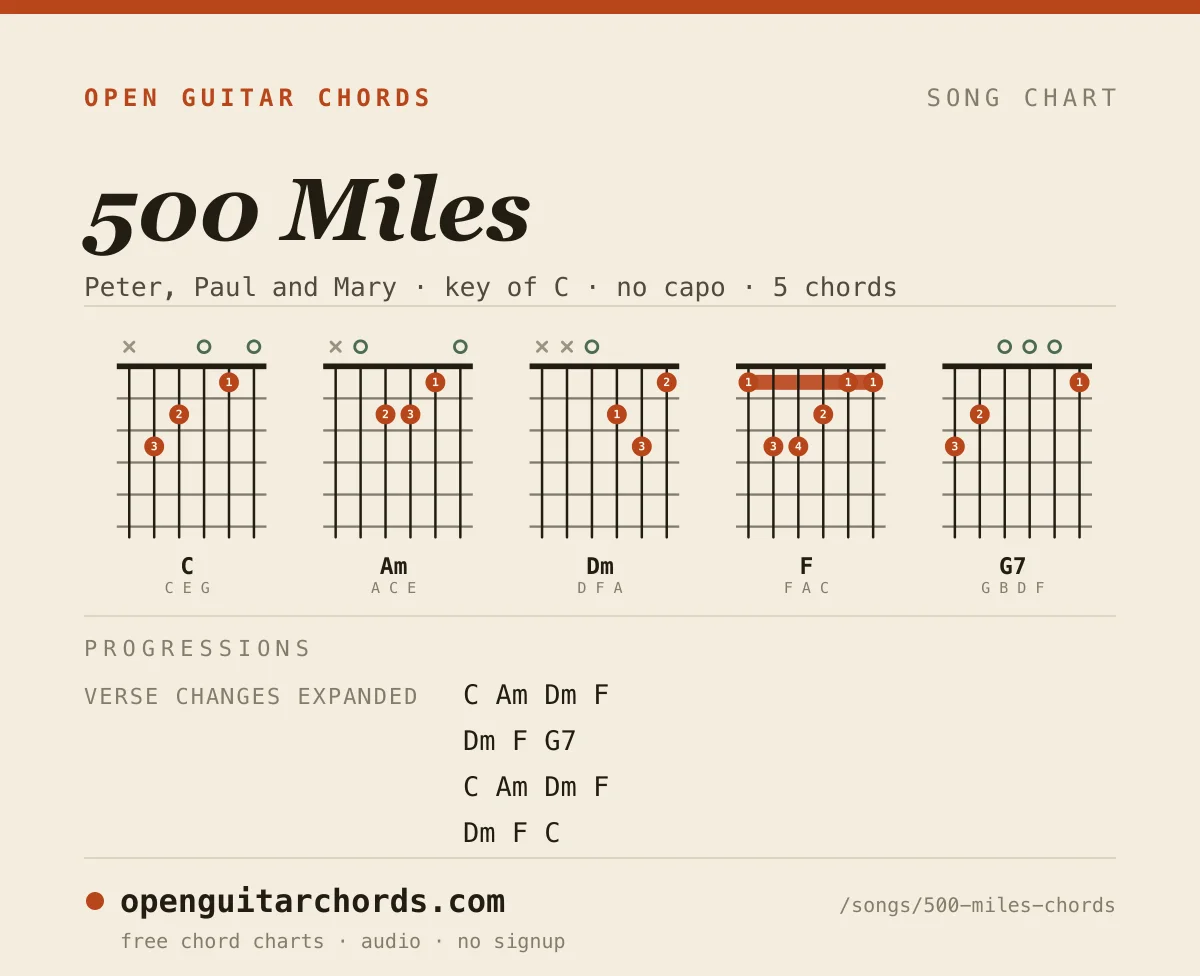
500 Miles by Peter, Paul and Mary is an intermediate song in C, played with no capo. The whole sheet is 5 chords (C, Am, Dm, F, G7) across 1 sections: Verse changes expanded. 4 of the 5 shapes are open chords. Shapes that use a barre: F. It sits at roughly 80 BPM.
Simplified practice arrangement. Section repetitions are practice cues rather than a verified transcription of the recording.
By Chiye · Updated
Hardest change in the sheet: Dm → F, 4 times.
- Difficulty
- Intermediatebarre shape F
- Key
- Cwith no capo
- Tempo
- 80BPM
- Tuning
- Standard (E A D G B E)low to high
- Chords
- 54 open, 1 with a barre
- Sections
- 1each with its own progression
Chords in 500 Miles
Frets read low E to high E, x means leave that string out.
Chord sheet
One chord per bar in this practice sheet. Follow the time signature shown beside each section; dots mark the remaining counts in the bar. Tap a bar to hear its chord, or loop the section to practise the changes.
Chord accompaniment only. Follow the section notes for this arrangement’s timing. Songs whose words are public domain →
Verse changes expanded4/4 · ♩=80
Printable one-page chord chart
How to play 500 Miles
500 Miles by Peter, Paul and Mary uses C, Am, Dm, F and G7 in this C-major guitar study. This is Hedy West’s folk song, distinct from The Proclaimers’ similarly titled song. Keep standard tuning and leave the capo off. The chart gives each change four beats at 80 BPM, letting you practise the complete verse’s harmonic movement before coordinating it with a singer.
Choose the folk song and the C-major arrangement
Bruce Watson’s own teaching chart names Hedy West as writer and Peter, Paul and Mary as the performing group. It provides the C–Am–Dm–F harmony used here. His sheet is arranged for ukulele; this page supplies guitar fingerings in standard tuning. Its four-string diagrams and picked notes are not guitar instructions, and they are not reproduced here.
The C-major setting belongs to this selected arrangement. A singer may need a different key, so test the comfortable high and low notes before choosing a capo position. Moving the same shapes up two frets would make them sound in D. Changing the key should move all five chords together; choosing one easier grip in isolation can change the harmony rather than transpose it.
Hear the different endings of the two halves
Read the fourteen boxes as two groups of seven changes. The first group is C–Am–Dm–F–Dm–F–G7. The second begins the same way but ends on C. The first ending leaves a pull toward home; the second arrives there. Stop after each group while learning, then connect both without inserting an extra beat at the row break.
Here each symbol gets a complete four-beat practice bar. These expanded durations help you prepare Dm and F, but they do not indicate where every sung syllable falls. The source also offers an optional G7 after the final C as a turnaround. Leave it out for the displayed ending; add it only when everyone has agreed to begin another verse. Do not let that optional chord replace the C arrival.
Prepare the Dm–F change without dragging the count
Dm begins on the open fourth string; keep strings 6 and 5 silent. F uses the displayed full barre, so check each string individually before adding a broad stroke. Move between Dm and F without relying on a shared finger that your chosen F fingering cannot retain. Land the grip quietly, test the top string, then return to the four-beat pulse.
If the full F is not ready, a separate upper-string exercise can use xx3211, with both bass strings silent. That grip still contains F, A and C, but it is a different voicing from the six-string diagram. Fmaj7 introduces E and changes the harmony. Practise the actual F sound first rather than treating every chord with an F in its name as interchangeable.
Make G7 lead back to C
G7 contains G, B, D and F. Hear the B rise to C and the F fall to E when it resolves to C; those small movements help explain the stronger pull compared with plain G. Play one light downstroke on each numbered beat, keeping the return motion relaxed between attacks. The last beat belongs to the current chord even while the fretting hand prepares the next one.
Try three passes: count both seven-change groups aloud, play them without looking at the fretting hand, then have a partner signal either a final C or another verse. Settle that signal before playing with vocals. The exercise develops changes and an agreed ending; it does not supply the original picking, a melody transcription or a recording-specific verse count.
How to practise 500 Miles
Four steps computed from this sheet: the order the shapes are easiest to learn in, the changes that really occur in the progressions above, where each chord turns up, and the tempo ladder up to the speed marked here.
Learn the shapes easiest first
C (x-3-2-0-1-0, beginner) → Am (x-0-2-2-1-0, beginner) → Dm (x-x-0-2-3-1, beginner) → G7 (3-2-0-0-0-1, beginner) → F (1-3-3-2-1-1, intermediate, needs a barre)
4 of the 5 shapes are open chords, so start there and leave F until the others change cleanly.
Drill the changes this sheet actually uses
Dm → F4×Am → Dm2×C → Am2×F → C1×
These counts come from the progressions on this page, so they are the changes you will actually play, not a generic list of pairs to practise.
Know where each chord turns up
- Cevery section
- Amevery section
- Dmevery section
- Fevery section
- G7every section
Climb the tempo ladder
Start at 48 BPM and move up only when a full pass is clean: 48 → 60 → 72 → 80 BPM. The tempo marked on this sheet is 80 BPM, and the last step is the one that always feels like a jump. Stay at 72 for longer than feels necessary.
Practise each section's chord changes slowly, then play the sheet through at a steady tempo without pausing between sections.
Playing 500 Miles with a capo
This sheet needs no capo. Each card shows what you would finger at that capo position so the song still sounds exactly as written. Useful when the shapes above are awkward, or when you want to sing it higher without learning new chords.
No capoas written
C Am Dm F G7
4 of 5 stay open
Fret 1
B Abm C#m E F#7
1 of 5 stay open
Fret 2
Bb Gm Cm Eb F7
no open shapes left, all barre
Fret 3
A F#m Bm D E7
3 of 5 stay open
Fret 4
Ab Fm Bbm C# Eb7
no open shapes left, all barre
Fret 5
G Em Am C D7
5 of 5 stay open
Fret 6
F# Ebm Abm B C#7
no open shapes left, all barre
Fret 7
F Dm Gm Bb C7
2 of 5 stay open
Working out a different key? The capo calculatordoes the same arithmetic for any chord set.
More songs built on the same chords
If 500 Miles clicks, these use the closest set of shapes, so the chords you just learned keep working.
More intermediate songs to learn after this one: Father and Son, Shallow, The One That Got Away, Treat You Better.
These chords across the songbookHow often each chord in 500 Miles turns up across all 104 songs on this site, and what it most often moves to next. The counts come from the sheet library itself, not from theory.
420bars of this chord across the songbook
70songs use this shape
Most often followed by G, 115×.
125bars of this chord across the songbook
35songs use this shape
Most often followed by F, 23×.
23bars of this chord across the songbook
9songs use this shape
Most often followed by F, 5×.
114bars of this chord across the songbook
29songs use this shape
Most often followed by C, 38×.
33bars of this chord across the songbook
13songs use this shape
Most often followed by C, 11×.