Scale library
Guitar scales
Every scale that carries Western popular music, in all twelve keys. Notes, step formulas and a full-neck diagram you can hear.
Which one first
- Minor PentatonicFirst solos, blues and rock lead. 5 notes, step pattern m3-W-W-m3-W.
- Major (Ionian)Melody, songwriting, everything else. 7 notes, step pattern W-W-H-W-W-W-H.
- Major PentatonicCountry, pop and classic-rock solos. 5 notes, step pattern W-W-m3-W-m3.
- The seven modesSame seven notes as the major scale, started from a different one. No new shapes to learn.
Print or save a C major chart
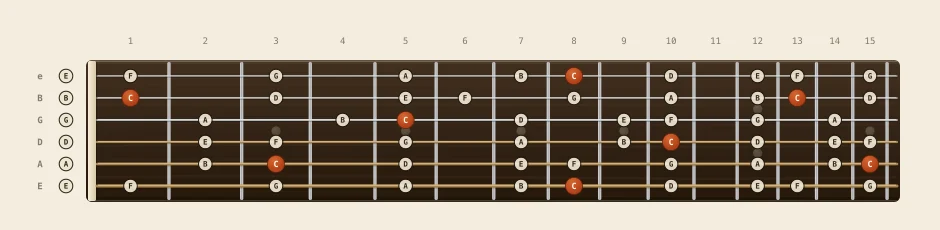
940 × 230 px bitmap of the chart above, sized for a phone screen or a printed handout. Tap the image to save it.
The five scale types, compared
This is the whole library in one table. Every scale below is charted in all 12 keys, so the notes change but the shape of the pattern does not.
| Scale | Notes | Degrees | Step pattern | Sound | Used for | Learn |
|---|---|---|---|---|---|---|
| Major (Ionian) | 7 | 1 2 3 4 5 6 7 | W-W-H-W-W-W-H | Bright, resolved | Melody, songwriting, everything else | Second |
| Natural Minor (Aeolian) | 7 | 1 2 ♭3 4 5 ♭6 ♭7 | W-H-W-W-H-W-W | Dark, serious | Ballads, rock, minor-key pop | Later |
| Major Pentatonic | 5 | 1 2 3 5 6 | W-W-m3-W-m3 | Open, friendly | Country, pop and classic-rock solos | Third |
| Minor Pentatonic | 5 | 1 ♭3 4 5 ♭7 | m3-W-W-m3-W | Gritty, vocal | First solos, blues and rock lead | First |
| Blues | 6 | 1 ♭3 4 ♭5 5 ♭7 | m3-W-H-H-m3-W | Bluesy, tense | Blues, rock and country lead lines | Later |
The seven modes, and what each one changes
Every mode uses the same seven notes as one major scale, just starting from a different note. Play C major from D to D and you have D Dorian. That is why learning the major scale in every key teaches you all seven modes at once.
| Mode | Starts on | Degrees | Changes from the major scale | Sound |
|---|---|---|---|---|
| Ionian | 1st | 7 notes | Identical to the major scale. | Bright and settled, because it is simply the major scale. Everything. It is the reference, not a colour. |
| Dorian | 2nd | 7 notes | Flat 3rd and flat 7th, natural 6th kept. | Minor, but with a lifted 6th that stops it sounding sad. Modal rock, funk, folk and jazz vamps. |
| Phrygian | 3rd | 7 notes | Flat 2nd, 3rd, 6th and 7th. | Spanish and flamenco, from the half step right above the root. Flamenco, metal and film-score menace. |
| Lydian | 4th | 7 notes | Only the 4th is raised. | Dreamy and floating, because the 4th is raised and never resolves down. Film scores, ambient and prog intros. |
| Mixolydian | 5th | 7 notes | Only the 7th is flattened. | Major with a flat 7th, which is why it works over dominant chords. Blues, rock and Celtic tunes. |
| Aeolian | 6th | 7 notes | Identical to the natural minor scale. | The natural minor scale under its modal name. Any minor-key song that stays diatonic. |
| Locrian | 7th | 7 notes | Flat 2nd, 3rd, 5th, 6th and 7th. | Unstable, because the root chord is half diminished. Passing colour over m7♭5 chords, rarely a whole song. |
Two of the seven already have full charted pages here: Ionian is the major scale and Aeolian is the natural minor scale. The other five share the same notes, so the scale finder is where you map them on the neck.
Every scale in every key
60 charts, 12 roots, five scale types. Type a note or a scale name to narrow the list, or pick a scale type.
60 charts shown
Major (Ionian) scale
The bright, resolved sound at the centre of Western music, and the reference every other scale is measured against. Step pattern W-W-H-W-W-W-H, degrees 1 2 3 4 5 6 7.
Natural Minor (Aeolian) scale
The darker mirror of the major scale, and the home sound of rock ballads, folk and minor-key pop. Step pattern W-H-W-W-H-W-W, degrees 1 2 ♭3 4 5 ♭6 ♭7.
Major Pentatonic scale
The major scale with the two notes that clash removed, leaving five notes that almost never sound wrong. Step pattern W-W-m3-W-m3, degrees 1 2 3 5 6.
Minor Pentatonic scale
The first scale most guitarists solo with, and the backbone of blues, rock and metal lead playing. Step pattern m3-W-W-m3-W, degrees 1 ♭3 4 5 ♭7.
Blues scale
The minor pentatonic plus the blue note (♭5), one extra semitone carrying all the tension and release of the blues. Step pattern m3-W-H-H-m3-W, degrees 1 ♭3 4 ♭5 5 ♭7.
No scale matches . Try a note name like F#, or a scale type like pentatonic.
Scales are the map, chords are the roads
Every chord lives inside a scale. A C major chord is the 1st, 3rd and 5th notes of the C major scale played together, which is why the chords of a song in C major are almost always C, Dm, Em, F, G and Am. They are all hiding inside one shared scale. Learn the scale of the song you are playing and its chord progression stops being a mystery.