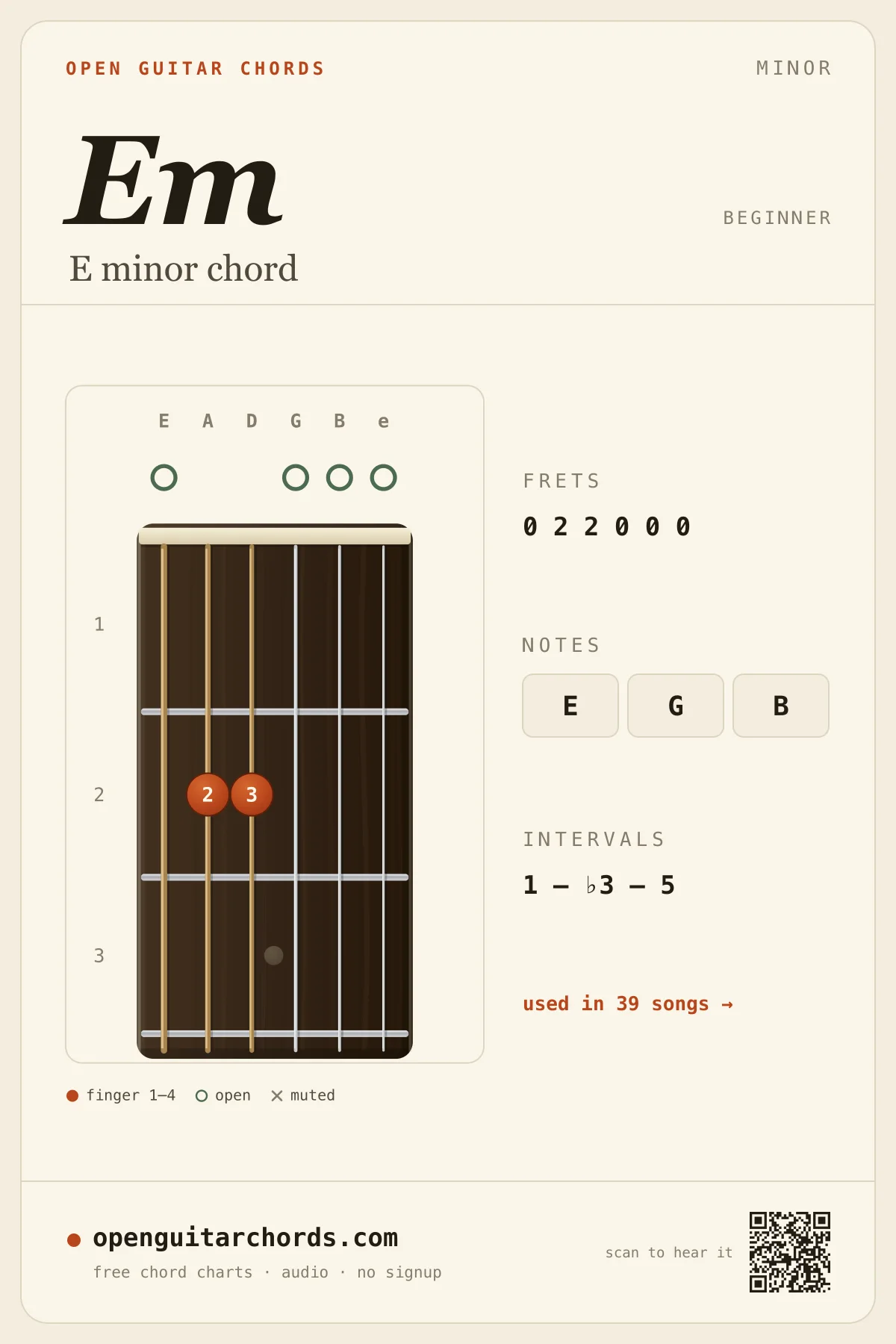
Minor chord · E root
Em chord
- E1
- G♭3
- B5
The E minor chord is built from the notes E, G, B. It turns up 155 times in the 104 songs on this site, including 505 and A Horse with No Name.
By Chiye · Updated
What is the Em chord?
The Em chord (E minor) is a minor chord built from three notes: E, G, B — the 1–♭3–5 of the E scale, 3 semitones and 7 semitones above the root. On guitar it is most often played in open position (0-2-2-0-0-0) with 2 fretted strings while 4 strings ring open. It is rated beginner — most players learn it in their first weeks. The darker, moodier counterpart of the major chord. Across the 104 song sheets in this site's library, Em appears 155 times in 43 songs, most often in the keys of Em and G, and the chord it most often moves to is C. Below you will find step-by-step fingering, 4 positions up the neck, audio of every shape, and the real progressions this chord lives inside.
How do you play the Em chord on guitar?
Open position — the easiest version of Em on the guitar.
- Press the A string at fret 2 with your middle finger.
- Press the D string at fret 2 with your ring finger.
- Strum all six strings and let every one ring.
If it buzzes, the usual cause is a fingertip sitting in the middle of the fret space instead of just behind the wire. Move the whole hand a few millimetres toward the bridge and the buzz usually disappears without any extra pressure. 0-2-2-0-0-0
How do you make Em sound clean?
Pressing too hard — Em needs the lightest touch of any open chord. If your fingertips hurt on Em, you are squeezing.
Loop Em to G slowly. Keep the A string at fret 2, release the D string, and prepare the two outside strings at fret 3 before the next strum.
In real songs
What songs use the Em chord?
- chord changes
- 155
- songs
- 43
- common keys
- Em · G
Across the 104 chord sheets on this site, Em appears 155 times in 43 songs — most often in the keys of Em and G.
All 43 songs that use Em— key, capo and a link to every sheet
Chord flow
What chord comes after Em?
Those figures are counted from the 104 chord sheets on this site, so they describe what songwriters actually played rather than what theory says should come next.
Three-chord moves
Three-chord moves are where a chord really shows its character. These are the ones that actually happen in this library, counted from the sheets:
What other ways can you play Em up the neck?
3 more positions below. Learn one of these well and the rest become optional. The value of a second position is practical: it keeps your fretting hand near where the song is already heading.
Position 2 · Fret 2
Because nothing rings open, you can move this whole shape to any fret and it keeps the same quality — only the letter name changes.
Position 3 · Fret 7 barre
No open strings, so this is a movable shape: slide it up or down and the same fingering gives you a different chord name.
One bar does most of the work. Roll that finger onto its bony edge and pull the elbow slightly in — a barre that buzzes is almost always a position problem, not a strength problem.
Position 4 · Fret 8
Because nothing rings open, you can move this whole shape to any fret and it keeps the same quality — only the letter name changes.
Up at fret 8 the frets are close together, so use a lighter touch than you would in the open position — squeezing here pulls the notes sharp.
Watch the Em chord
Video: JustinGuitar on YouTube — embedded with the official player; credit and views belong to the creator.
The theory behind Em
Em is spelled E – G – B — the 1 – ♭3 – 5 of the E scale, which is the root plus 3 semitones, 7 semitones. The darker, moodier counterpart of the major chord.
The flattened third is what makes it minor, so if Em sounds wrong the third is almost always the note being muted — check the string carrying it before you change anything else.
What key is the Em chord in?
Em is the i chord in E minor, the ii chord in D major and the vi chord in G major — the three keys where Em appears naturally.
the home chord of the minor key
the gentle predominant — often before the V
the relative minor — the major key’s shadow
Em on other instruments
0 4 3 2
The same chord on four strings in standard tuning. Because the uke is tuned higher, this shape sits at a different place on the neck than its guitar equivalent — useful when arranging for both instruments.
E – G – B — all white keys, so you can find the shape by counting up from C.
Take it to the practice room