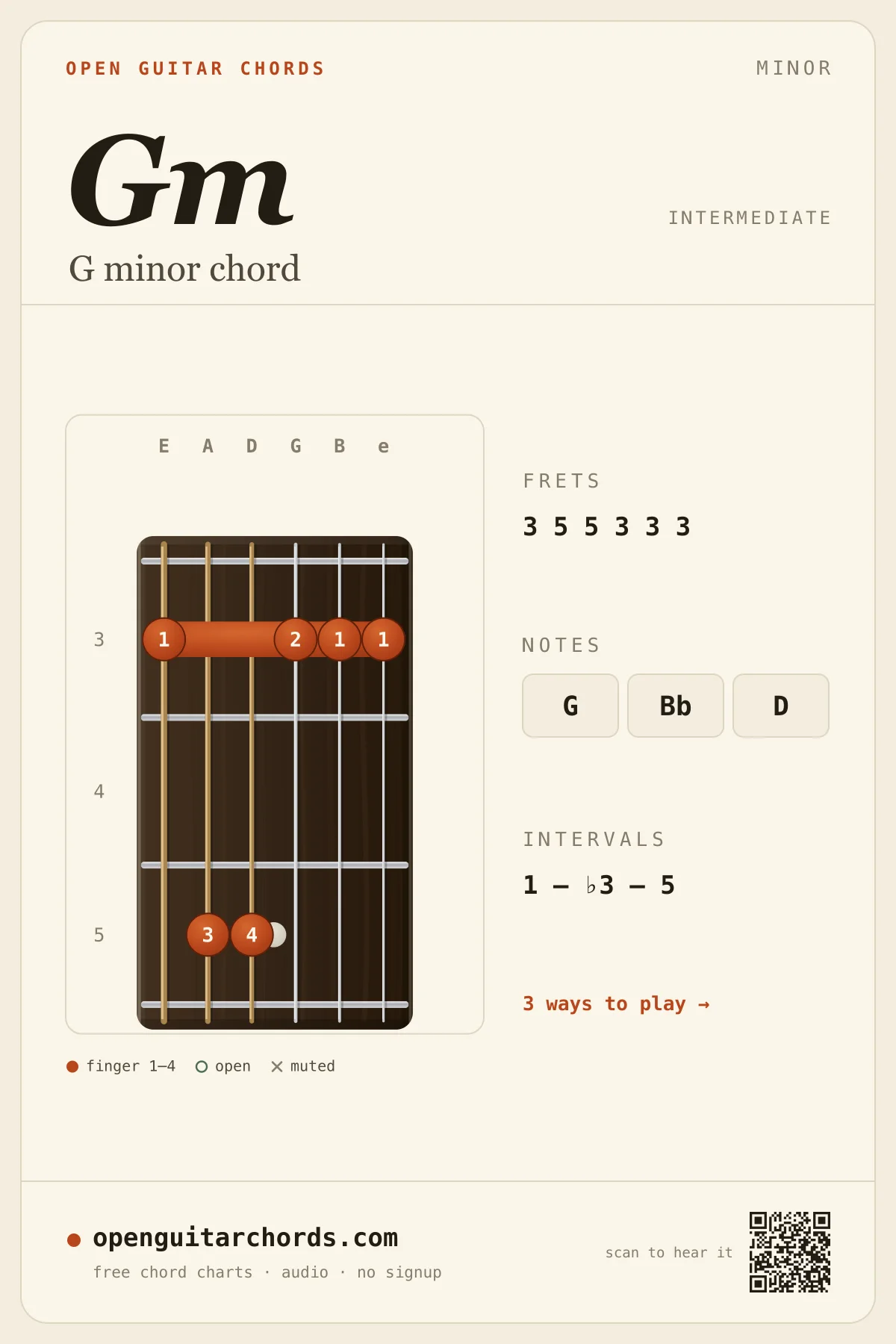
Minor chord · G root
Gm chord
- G1
- Bb♭3
- D5
The G minor chord is built from the notes G, Bb, D. A minor shape you will meet in barre-chord territory.
By Chiye · Updated
What is the Gm chord?
The Gm chord (G minor) is a minor chord built from three notes: G, Bb, D — the 1–♭3–5 of the G scale, 3 semitones and 7 semitones above the root. On guitar it is most often played as a movable shape from fret 3 (3-5-5-3-3-3), so the same fingering works at any fret. It is rated intermediate. The darker, moodier counterpart of the major chord. Below you will find step-by-step fingering, 3 positions up the neck, audio of every shape, and the real progressions this chord lives inside.
How do you play the Gm chord on guitar?
Fret 3 barre — a movable shape, so this same fingering works for every root note.
- Lay your index finger flat across the low E to high E strings at fret 3, rolled slightly onto its bony edge.
- Press the A string at fret 5 with your ring finger.
- Press the D string at fret 5 with your pinky finger.
- Strum all six strings and let every one ring.
Drop the lowest fretted note (low E string) and play the rest as a four- or five-string shape. You lose the bass note but keep every note that gives the chord its name, and there is no barre left to fight. x-5-5-3-3-3
How do you make Gm sound clean?
The 3rd-fret barre on Gm gets played with the index flat and the hand rotated the wrong way, deadening the G string.
Gm → Bb → Eb: the i–III–VI of G minor, all three shapes movable from the E-form.
In real songs
Gm in songs
None of the 80 songs charted on this site use Gm yet — it is a colour chord rather than a songwriting staple.
1 song on this site sounds in Gm
No sheet here fingers the Gm shape, but the key itself is not rare.
| Song | Artist | Key | Capo |
|---|---|---|---|
| Autumn Leaves | Jazz Standard | Gm | — |
What other ways can you play Gm up the neck?
2 more positions below. Learn one of these well and the rest become optional. The value of a second position is practical: it keeps your fretting hand near where the song is already heading.
Position 2 · Fret 5
Because nothing rings open, you can move this whole shape to any fret and it keeps the same quality — only the letter name changes.
At fret 5 the neck is still wide enough to keep your thumb behind it, which gives the fingers more reach than a thumb-over grip.
Position 3 · Fret 10 barre
No open strings, so this is a movable shape: slide it up or down and the same fingering gives you a different chord name.
One bar does most of the work. Roll that finger onto its bony edge and pull the elbow slightly in — a barre that buzzes is almost always a position problem, not a strength problem.
The theory behind Gm
Gm is spelled G – Bb – D — the 1 – ♭3 – 5 of the G scale, which is the root plus 3 semitones, 7 semitones. The darker, moodier counterpart of the major chord.
The flattened third is what makes it minor, so if Gm sounds wrong the third is almost always the note being muted — check the string carrying it before you change anything else.
What key is the Gm chord in?
Gm is the i chord in G minor, the ii chord in F major and the vi chord in Bb major — the three keys where Gm appears naturally.
the home chord of the minor key
the gentle predominant — often before the V
the relative minor — the major key’s shadow
Gm on other instruments
G – Bb – D — the highlighted black keys are the sharps or flats; play each note once, then move them into one hand position.
Take it to the practice room