Guitar fretboard notes
Every note on the guitar neck across frets 0 to 15 in standard tuning. Highlight one note name and every position lights up.
- strings
- E A D G B E
- frets
- 0-15
- notes
- 12 per octave
- spelling
- sharps or flats
All 12 notes, frets 0 to 15, where fret 0 is the open string. Tap a note name above to highlight every position of it.
What is a guitar fretboard chart?
A guitar fretboard chart maps every note on the neck to the string and fret that produce it. This one covers frets 0 to 15 in standard tuning, where the six open strings are E, A, D, G, B and E from the thickest to the thinnest. A guitar has twelve pitches in an octave, and every fret moves a string up by exactly one semitone, so each string carries the same twelve note names starting from a different place. That is why the board looks complicated and is not: fret 12 repeats the open strings an octave higher, which means the whole neck is the first twelve frets over again. The chart is interactive. Tap a note name and every position of that note lights up at once, which is the fastest way to see the repeating shapes instead of memorising sixty separate cells.
Learn & referenceExamples, charts and deeper explanation
The notes on the guitar fretboard, explained
Six strings, four anchor frets each. Learn these rows and you have the skeleton of the whole neck: the spaces between the anchors are filled with sharps and flats, and the twelfth fret hands you back the open strings an octave higher.
| String | Open | Fret 3 | Fret 5 | Fret 7 | Fret 12 | Landmark |
|---|---|---|---|---|---|---|
| 6th | low E | G | A | B | E | 5th fret = the open A string |
| 5th | A | C | D | E | A | 5th fret = the open D string |
| 4th | D | F | G | A | D | 5th fret = the open G string |
| 3rd | G | A# | C | D | G | 4th fret, not 5th, = the open B string |
| 2nd | B | D | E | F# | B | 5th fret = the open high e string |
| 1st | high e | G | A | B | E | 12th fret = the open low E two octaves down |
The 3rd, 5th, 7th and 9th frets carry the pearl inlays on a real guitar, and the 12th carries two, which is exactly why those are the frets worth memorising first. The same notes appear on the fretboard trainer as a timed game, and the fretboard notes guide goes through the method in prose.
Octave anchors across the whole neck
This is the same neck drawn from the real chord data, with every fret labelled. Pick any note, count twelve frets up, and you land on the same note name: that is the whole secret of the board, and it is why fret 12 starts the pattern again.
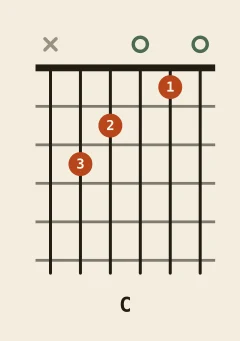
Chords are just a few of these dots at once. Once you can find the root of a shape on the neck, any movable chord becomes available: the chord finder shows every voicing of a chord up the board, and the barre chords guide explains why those shapes keep working as you slide them.
How to memorise the neck
Anchor first, fill in later. Nobody memorises seventy-eight positions one at a time; you learn a handful of landmarks and derive the rest.
- Learn the six open strings. E A D G B E, thickest to thinnest. Say them out loud as you play them, one at a time, until the order is automatic. Every anchor below is measured from these six notes.
- Use the inlays as signposts. Frets 3, 5, 7 and 9 carry a single pearl dot and fret 12 carries two. Learn the natural notes at those five frets first; the sharps and flats squeeze into the gaps afterwards.
- Cross-check with the 5th fret rule. The 5th fret of any string is the next string played open, except between G and B, where the 4th fret is the match. One rule lets you verify any note against a string you already know.
- Count in twelfths. Fret 12 repeats the open string an octave higher, and fret 12 plus 5 repeats the 5th fret. Above fret 12 you are reading notes you have already met, only higher, so stop treating the dusty end as new information.
- Drill one note a day. Pick a note name, find it on every string, then play the chords that use it. A minute a day sticks far better than an hour once a week.
Why the neck repeats the way it does
string to string
- Low E to A
- 4 semitones
- A to D
- 4 semitones
- D to G
- 4 semitones
- G to B
- 3 semitones
- B to high e
- 4 semitones
fret to fret
- One fret
- 1 semitone
- Twelve frets
- 1 octave
- Twelfth fret
- open string repeated
- Fifth fret rule
- next string open
- Exception
- 4th fret on G gives B
inlays
- Single dot
- frets 3 5 7 9
- Double dot
- fret 12
- Natural notes
- A B C D E F G
- Sharps and flats
- 5 per octave
- Enharmonic pairs
- C# and Db
The G to B pair is the one place the pattern breaks. Every other pair of adjacent strings is tuned a perfect fourth apart, four semitones, but G to B is a major third, three semitones. That single missing semitone is why the 5th fret rule becomes the 4th fret on that one pair, and it is also why barre chord shapes need adjusting when they cross the second string. Practise the spelling both ways: sharp keys such as G, D and A use sharps, flat keys such as F, Bb and Eb use flats, and the fret is identical either way.