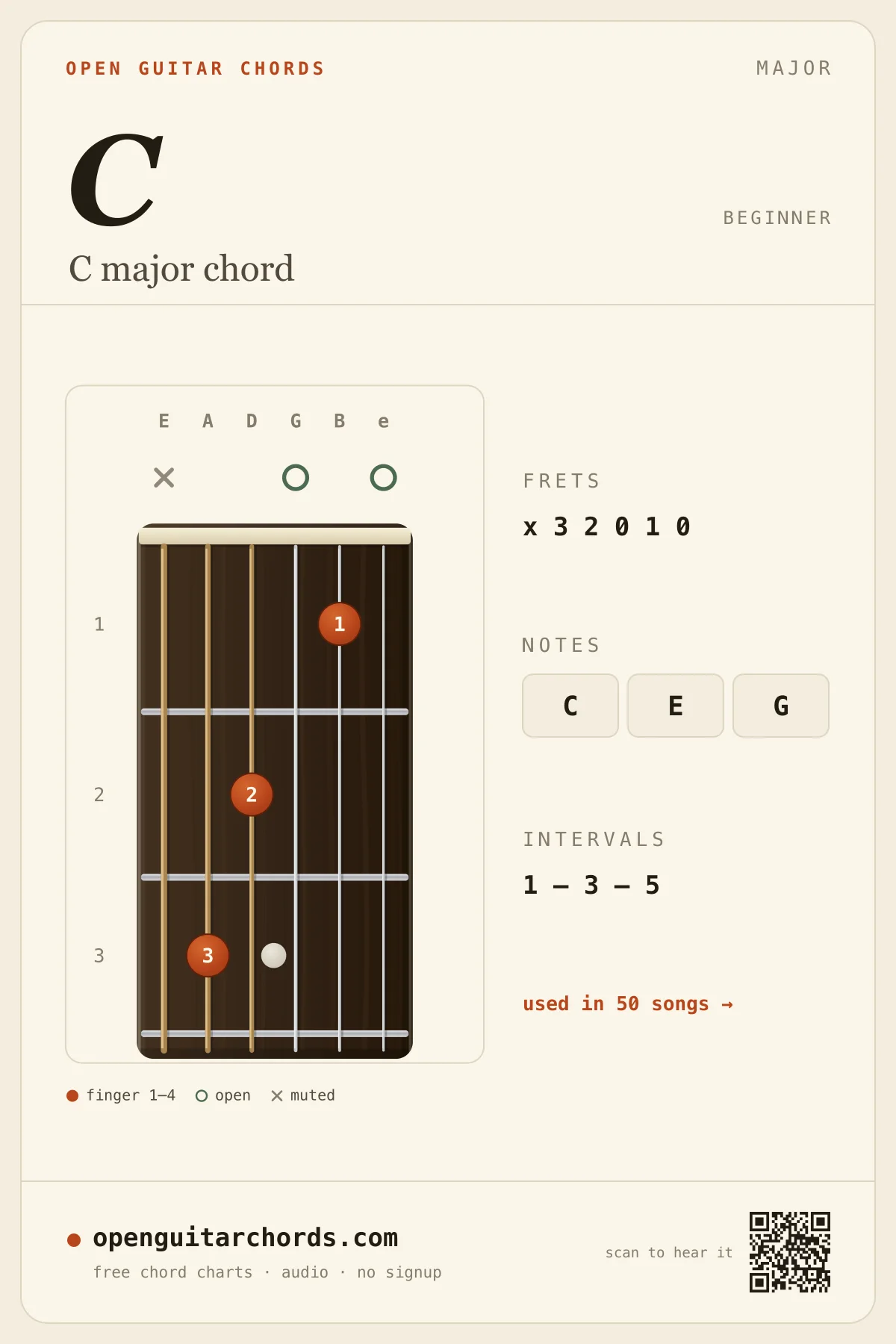
Major chord · C root
C chord
- C1
- E3
- G5
The C major chord is built from the notes C, E, G. It turns up 363 times in the 80 songs on this site, including (Sittin' On) The Dock of the Bay and A Thousand Years.
By Chiye · Updated
What is the C chord?
The C chord (C major) is a major chord built from three notes: C, E, G — the 1–3–5 of the C scale, 4 semitones and 7 semitones above the root. On guitar it is most often played in open position (x-3-2-0-1-0) with 3 fingers while 2 strings ring open and the low E string stays silent. It is rated beginner — most players learn it in their first weeks. The bright, home-base sound that most songs resolve to. It is one of the most-used chords in this site's library: across the 80 song sheets charted here, C appears 363 times in 54 songs, most often in the keys of C and G, and the chord it most often moves to is G. Below you will find step-by-step fingering, 5 positions up the neck, audio of every shape, and the real progressions this chord lives inside.
How do you play the C chord on guitar?
Open position — the easiest version of C on the guitar.
- Press the A string at fret 3 with your ring finger.
- Press the D string at fret 2 with your middle finger.
- Press the B string at fret 1 with your index finger.
- Start your strum on the A string and do not play the low E string at all.
The x mark is part of the shape, not an accident: the chord only sounds right when low E stays silent. Instead of aiming your pick around that string, let the string next to it rest on it and damp it. x-3-2-0-1-0
The one-finger C — easiest version for day one
Put your index finger on fret 1 of the B string and strum only the thinnest three strings. The open G and high E strings fill in the rest of the triad — thinner than the full shape, but it is a real C chord you can play on your very first day.
frets x-x-x-0-1-0
How do you make C sound clean?
The classic C mistake is an angled wrist collapsing the ring finger onto the high E string. Keep your elbow slightly in and your wrist straight so every fingertip lands vertical.
Switch between C and G without looking — they share the same finger spread. Thirty slow switches a day, cleanly, beats two hundred fast ones.
In real songs
What songs use the C chord?
- chord changes
- 363
- songs
- 54
- common keys
- C · G
Across the 80 chord sheets on this site, C appears 363 times in 54 songs — most often in the keys of C and G.
GB7CA7
GDCG
GDEmC
All 54 songs that use C— key, capo and a link to every sheet
Chord flow
What chord comes after C?
Those figures are counted from the 80 chord sheets on this site, so they describe what songwriters actually played rather than what theory says should come next.
Three-chord moves
Three-chord moves are where a chord really shows its character. These are the ones that actually happen in this library, counted from the sheets:
What other ways can you play C up the neck?
4 more positions below. A chord is a set of notes, not a shape — every position below sounds like C, and each one puts your hand somewhere different, which is what makes them useful in different songs.
Position 2 · Fret 3 barre
Every note here is fretted, which means the shape transposes anywhere on the neck without changing your fingers.
It needs 2 separate bars, one of them a partial bar across the inner strings — the hardest part of this shape.
Position 3 · Fret 5 barre
Every note here is fretted, which means the shape transposes anywhere on the neck without changing your fingers.
The barre is the only hard part of this shape. Keep the bar finger straight and use the weight of your arm rather than the grip of your thumb.
Position 4 · Fret 8 barre
Every note here is fretted, which means the shape transposes anywhere on the neck without changing your fingers.
The barre is the only hard part of this shape. Keep the bar finger straight and use the weight of your arm rather than the grip of your thumb.
Position 5 · Fret 10
Every note here is fretted, which means the shape transposes anywhere on the neck without changing your fingers.
Up at fret 10 the frets are close together, so use a lighter touch than you would in the open position — squeezing here pulls the notes sharp.
Watch the C chord
Video: JustinGuitar on YouTube — embedded with the official player; credit and views belong to the creator.
The theory behind C
C is spelled C – E – G — the 1 – 3 – 5 of the C scale, which is the root plus 4 semitones, 7 semitones. The bright, home-base sound that most songs resolve to.
The third is the note that makes it major, so it decides the character: keep it on top and C sounds bright, drop it below the fifth and the same notes sound rounder. On guitar that is a matter of which string you put it on, which is exactly what the different positions on this page do.
What key is the C chord in?
C is the I chord in the key of C major, the IV chord in G major and the V chord in F major — the three major keys where C appears naturally.
the home chord — songs resolve here
the subdominant — the chord that leaves home
the dominant — the chord that pulls back home
C on other instruments
0 0 0 3
The same chord on four strings in standard tuning. Because the uke is tuned higher, this shape sits at a different place on the neck than its guitar equivalent — useful when arranging for both instruments.
C – E – G — all white keys, so you can find the shape by counting up from C.
Take it to the practice room