The Cranberries
Linger chords
Linger by The Cranberries is a beginner song in D, played with no capo. The whole sheet is 4 chords (D, A, C, G) across 1 sections: Main accompaniment. Every shape is an open chord, so nothing here needs barre strength.
By Chiye · Updated
- Difficulty
- Beginnerno barre needed
- Key
- Dwith no capo
- Tuning
- Standard (E A D G B E)low to high
- Chords
- 4all open shapes
- Sections
- 1each with its own progression
Chords in Linger
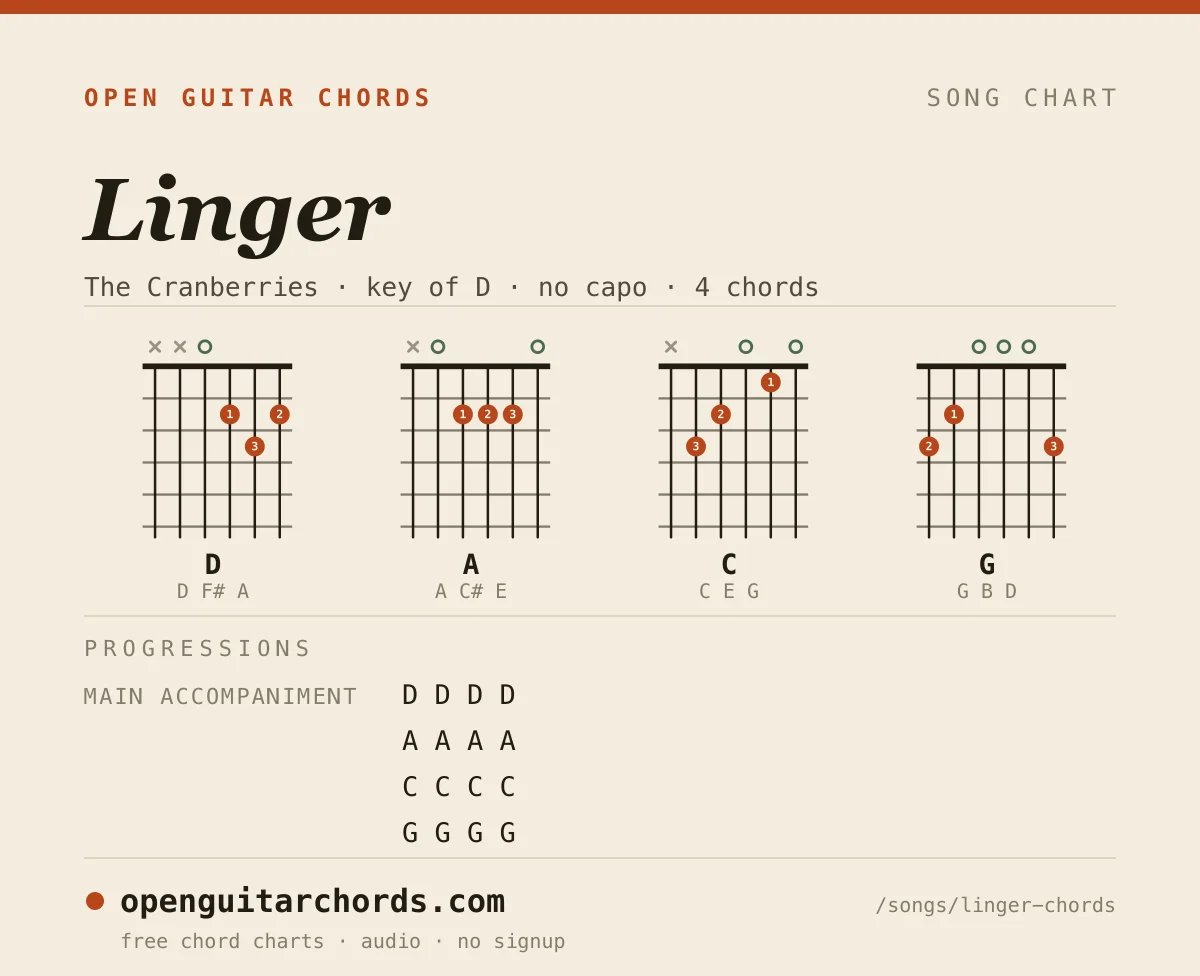
Frets read low E to high E, x means leave that string out.
Chord sheet
One chord per bar in this practice sheet. Follow the time signature shown beside each section; dots mark the remaining counts in the bar. Tap a bar to hear its chord, or loop the section to practise the changes.
Lyrics are not reproduced for this song: they are still in copyright and this site has no licence to publish them. The chords, structure, strumming and sing-along timing are all here. Songs whose words are public domain →
Main accompaniment4/4 · ♩=90
Four bars per chord in this teaching arrangement; start with quarter-note downstrokes
Printable one-page chord chart
How to play Linger
Play Linger with D, A, C and G, using standard tuning and no capo. The chart provides a steady open-chord accompaniment with a simple downstroke pulse. The long holds are part of the exercise: keep counting through all four boxes of a chord before changing. Knowing the four shapes is only half the task; you also need to know when the next one arrives.
Count the repeated boxes
Each box on this page lasts one four-beat bar. Play D for four bars, A for four, C for four and G for four before returning to D. Count the first beat of each bar as one, two, three and four in turn, while keeping the remaining beats even. That helps you remember where you are without adding an extra bar at the end of a line.
This follows the long-hold accompaniment in Jo Bywater’s teaching arrangement. Her two-bar rhythm is played twice on each chord; the chart here uses a simpler one-bar pulse four times instead. The main loop supports section practice. It does not replace the distinct picking introduction and ending, and the page does not label one pass of the loop as the complete song.
Start the strum on the right bass string
Our D diagram is x-x-0-2-3-2. Begin the sweep at the fourth string so that an accidental low E does not sit underneath it. A is x-0-2-2-2-0, starting on the fifth string. Leave the sixth string silent for C as well; its diagram is x-3-2-0-1-0. G uses 3-2-0-0-0-3 and can include all six strings.
Pick through each shape once before strumming. On C, an angled third finger can accidentally touch the open fourth string. On D, the second finger can brush the second string. Small changes in fingertip angle often solve a dull note more effectively than squeezing harder. Then alternate just G and D: that return changes both the hand shape and the lowest string you should strike.
Keep the simple pulse through the changes
The grid D . D . D . D . means four downstrokes per bar, one on each numbered beat. The dots are the intervening eighth-note positions. Keep your hand moving back up between attacks without touching the strings. Tap your foot at the same pace so a difficult left-hand change does not stretch the last beat.
Use quiet, narrow sweeps while learning the loop. Let a chorus grow through a wider sweep and a little more weight, while keeping the count unchanged. The linked lesson also teaches a longer rhythm with changing accents; this page deliberately starts with its easiest downstroke option. The loop plays at a 90 BPM practice speed because this chart does not specify a recording tempo. If that is too quick, practise more slowly with a separate metronome before using the loop.
Hear the C natural before changing key
The C major chord contains C, E and G. Its C natural differs from the C# found in the ordinary D major scale. In relation to D, its root is the lowered seventh degree, which is why the chord can be described as flat-seven. Keep C major in the loop rather than replacing it with a diatonic chord just because the song is D-centred.
If the vocal range feels awkward, move the complete four-chord sequence with the transpose control. Reset before comparing the result with the open shapes above. Adding a capo at fret 2 while keeping these fingerings raises the sequence to E–B–D–A; it changes the sounding pitch even though your fingers make familiar shapes.
The chord order, four-bar holds and easiest strum were checked against Jo Bywater’s Linger lesson. The fingering checks and counting exercise above refer to this page’s accompaniment.
How to practise Linger
Four steps computed from this sheet: the order the shapes are easiest to learn in, the changes that really occur in the progressions above, where each chord turns up, and the tempo ladder up to the recorded speed.
Learn the shapes easiest first
D (x-x-0-2-3-2, beginner) → A (x-0-2-2-2-0, beginner) → C (x-3-2-0-1-0, beginner) → G (3-2-0-0-0-3, beginner)
4 of the 4 shapes are open chords, so nothing here needs barre strength yet.
Drill the changes this sheet actually uses
These counts come from the progressions on this page, so they are the changes you will actually play, not a generic list of pairs to practise.
Know where each chord turns up
- Devery section
- Aevery section
- Cevery section
- Gevery section
Climb the tempo ladder
This sheet does not list a tempo, so pick one where every change is clean and use the metronome to move up in 4 BPM steps.
Every section here uses the same set of shapes, so there is no section to single out. Whatever you can play once, you can play all the way through.
Playing Linger with a capo
This sheet needs no capo. Each card shows what you would finger at that capo position so the song still sounds exactly as written. Useful when the shapes above are awkward, or when you want to sing it higher without learning new chords.
No capoas written
D A C G
4 of 4 stay open
Fret 1
C# Ab B F#
no open shapes left, all barre
Fret 2
C G Bb F
2 of 4 stay open
Fret 3
B F# A E
2 of 4 stay open
Fret 4
Bb F Ab Eb
no open shapes left, all barre
Fret 5
A E G D
4 of 4 stay open
Fret 6
Ab Eb F# C#
no open shapes left, all barre
Fret 7
G D F C
3 of 4 stay open
Working out a different key? The capo calculatordoes the same arithmetic for any chord set.
More songs built on the same chords
If Linger clicks, these use the closest set of shapes, so the chords you just learned keep working.
More beginner songs to learn after this one: The Scientist, 505, Teardrops on My Guitar, Wonderwall.
These chords across the songbookHow often each chord in Linger turns up across all 90 songs on this site, and what it most often moves to next. The counts come from the sheet library itself, not from theory.
274bars of this chord across the songbook
51songs use this shape
Most often followed by G, 41×.
132bars of this chord across the songbook
23songs use this shape
Most often followed by D, 24×.
384bars of this chord across the songbook
59songs use this shape
Most often followed by G, 122×.
458bars of this chord across the songbook
67songs use this shape
Most often followed by C, 80×.