Pink Floyd
Wish You Were Here chords
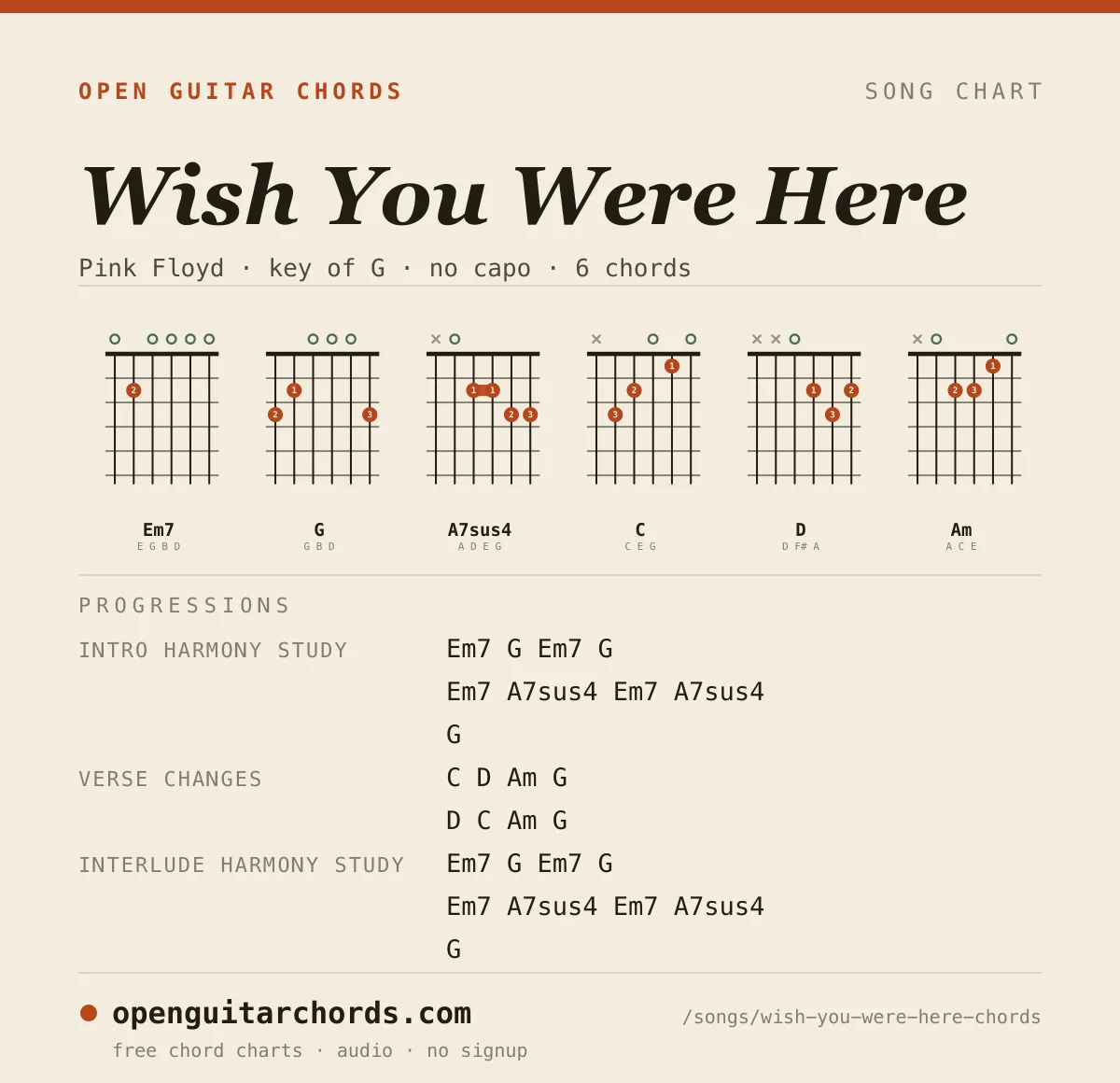
Wish You Were Here by Pink Floyd is an intermediate song in G, played with no capo. The whole sheet is 6 chords (Em7, G, A7sus4, C, D, Am) across 3 sections: Intro harmony study → Verse changes → Interlude harmony study. 5 of the 6 shapes are open chords. Shapes that use a barre: A7sus4. It sits at roughly 72 BPM.
Simplified practice arrangement. Section repetitions are practice cues rather than a verified transcription of the recording.
By Chiye · Updated
Hardest change in the sheet: Em7 → A7sus4, 4 times.
- Difficulty
- Intermediatebarre shape A7sus4
- Key
- Gwith no capo
- Tempo
- 72BPM
- Tuning
- Standard (E A D G B E)low to high
- Chords
- 65 open, 1 with a barre
- Sections
- 37 steps in the song form
Chords in Wish You Were Here
Frets read low E to high E, x means leave that string out.
Chord sheet
One chord per bar in this practice sheet. Follow the time signature shown beside each section; dots mark the remaining counts in the bar. Tap a bar to hear its chord, or loop the section to practise the changes.
Chord accompaniment only. Follow the section notes for this arrangement’s timing. Songs whose words are public domain →
Intro harmony study4/4 · ♩=72
Verse changes4/4 · ♩=72
Interlude harmony study4/4 · ♩=72
Printable one-page chord chart
How to play Wish You Were Here
Wish You Were Here uses two different groups of guitar chords: Em7, G and A7sus4 for the intro harmony, then C, D, Am and G for the verse. Play this accompaniment in standard tuning without a capo. The 72 BPM boxes are chord-only studies, each lasting four beats; they preserve the selected changes without pretending to transcribe the intro riff or its original durations.
Keep the verse out of the intro
JustinGuitar’s five-level lesson separates the intro’s three-chord vocabulary from the later verse progression. The verse first moves C–D–Am–G, then returns D–C–Am–G. That second line starts on D, not on another C. Learn the full eight-entry route before repeating it.
The earlier chart mixed the verse changes into its intro and placed extra intro harmony inside the verse. Those are now separate studies. To hear the boundary clearly, play the last G of the intro, pause deliberately, and start the verse on C. Remove that pause only when the two sections feel distinct under the fingers. A clean boundary is more useful than an unbroken loop through the wrong section.
Hear why A7sus4 is not A major
Lauren Bateman’s chord chart agrees on Em7, G and A7sus4 for the opening harmony. A7sus4 contains A, D, E and G. An ordinary A major contains A, C# and E instead. Replacing the suspended seventh chord with A therefore changes two parts of the harmony; it is not merely an easier spelling of the same sound.
The diagram used here is x-0-2-2-3-3. Start on the open fifth string and leave the sixth string silent. The fretted second and first strings add D and G above the A-and-E foundation. Check them individually before strumming. Keep their notes clear when moving toward G, and release any finger that the next diagram no longer needs rather than forcing every grip to share the same anchors.
Treat the diagrams as accompaniment voicings
Our Em7 is 0-2-0-0-0-0: its open fourth string supplies D, the minor seventh above E. The source lesson also demonstrates a different Em7 grip with two fingers retained on the high strings. Both can contain the same chord tones, but the upper melody and movement differ. The supplied generic chord diagram is not a promise to reproduce that recorded voicing.
Em7 and G can include the lowest string; C and Am begin on string 5, and D begins on string 4. Keep those different bass entries audible while you learn the verse. The picked lead line, hammer-ons, twelve-string texture and solo are outside this chord study. Follow the linked lesson for those details instead of trying to recover them from a row of chord names.
Use the section route with an honest practice clock
The route follows Lauren’s printed arrangement: intro, three verses separated by interludes, then a final interlude. Here the intro and interlude each have nine chord entries, while the verse has eight. Every entry receives four practice beats. Those counts describe this exercise; they do not independently establish how many original bars or vocal syllables belong to each change.
Start the downstroke loop at 72 BPM and finish a whole section before stopping. Keep the final G distinct from the G you may reach on the next pass. Once the left hand is reliable, return to the source for its finer strumming and timing. Credits to Roger Waters and David Gilmour are listed in the published lead-sheet edition; Pink Floyd remains the performing group.
How to practise Wish You Were Here
Four steps computed from this sheet: the order the shapes are easiest to learn in, the changes that really occur in the progressions above, where each chord turns up, and the tempo ladder up to the speed marked here.
Learn the shapes easiest first
Em7 (0-2-0-0-0-0, beginner) → G (3-2-0-0-0-3, beginner) → C (x-3-2-0-1-0, beginner) → D (x-x-0-2-3-2, beginner) → Am (x-0-2-2-1-0, beginner) → A7sus4 (x-0-2-2-3-3, intermediate, needs a barre)
5 of the 6 shapes are open chords, so start there and leave A7sus4 until the others change cleanly.
Drill the changes this sheet actually uses
Em7 → A7sus44×Em7 → G4×A7sus4 → Em72×Am → G2×
These counts come from the progressions on this page, so they are the changes you will actually play, not a generic list of pairs to practise.
Know where each chord turns up
- Em7Intro harmony study, Interlude harmony study
- Gevery section
- A7sus4Intro harmony study, Interlude harmony study
- CVerse changes
- DVerse changes
- AmVerse changes
Climb the tempo ladder
Start at 43 BPM and move up only when a full pass is clean: 43 → 54 → 65 → 72 BPM. The tempo marked on this sheet is 72 BPM, and the last step is the one that always feels like a jump. Stay at 65 for longer than feels necessary.
Practise each section's chord changes slowly, then play the sheet through at a steady tempo without pausing between sections.
Playing Wish You Were Here with a capo
This sheet needs no capo. Each card shows what you would finger at that capo position so the song still sounds exactly as written. Useful when the shapes above are awkward, or when you want to sing it higher without learning new chords.
No capoas written
Em7 G A7sus4 C D Am
5 of 6 stay open
Fret 5
Bm7 D E7sus4 G A Em
6 of 6 stay open
Working out a different key? The capo calculatordoes the same arithmetic for any chord set.
More songs built on the same chords
If Wish You Were Here clicks, these use the closest set of shapes, so the chords you just learned keep working.
More intermediate songs to learn after this one: Father and Son, 500 Miles, Shallow, The One That Got Away.
These chords across the songbookHow often each chord in Wish You Were Here turns up across all 104 songs on this site, and what it most often moves to next. The counts come from the sheet library itself, not from theory.
31bars of this chord across the songbook
6songs use this shape
Most often followed by G, 13×.
509bars of this chord across the songbook
77songs use this shape
Most often followed by D, 89×.
5bars of this chord across the songbook
2songs use this shape
Most often followed by Em7, 2×.
420bars of this chord across the songbook
70songs use this shape
Most often followed by G, 115×.
323bars of this chord across the songbook
58songs use this shape
Most often followed by G, 52×.
125bars of this chord across the songbook
35songs use this shape
Most often followed by F, 23×.