The chord dictionary
Every guitar chord, one chart
166 shapes across 12 roots, grouped so you can find one in seconds.
Start with these eight
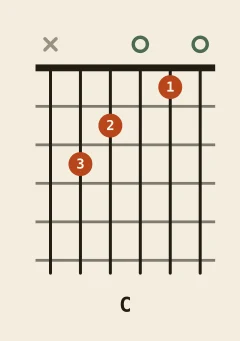
These eight cover most of what a first year of songs asks for. Everything further down the chart is a colour added to one of them, and each of these links to a full page with the fingering, the audio and the songs that use it.
CThe open C. If a song has one major chord you can already play, it is usually this one.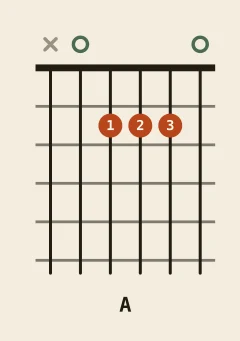 AThree fingers in a row. Move this shape up the neck and it becomes every barre chord.
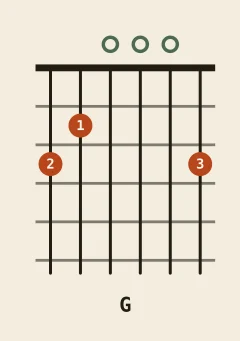 GThe widest open chord. Most strummed songs begin and end here.
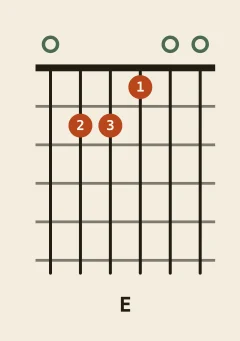 ETwo fingers and all six strings, so it is the fullest sounding open major.
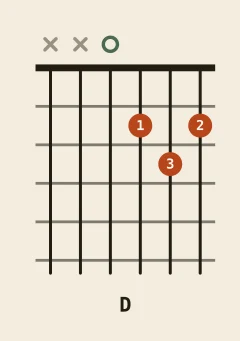 DFour strings only, which leaves the low end free for whichever chord comes next.
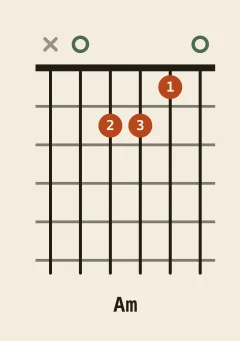 AmOpen A with the middle note flattened. The default minor chord.
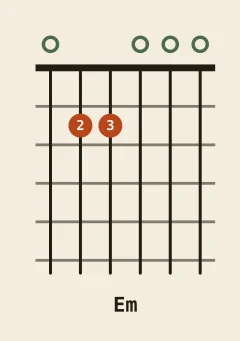 EmThe easiest chord on the guitar: two fingers, and every string rings.
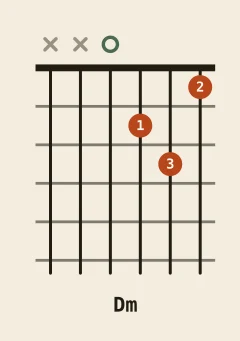 DmThe compact triangle. Usually the last of the eight to feel comfortable under the fingers.
The complete chart
166 shapes in 12 root groups, ordered from the shapes you meet first to the ones you reach for later.
How to read these diagrams
- Fretted note. The number is which finger.
- Open string. Play it without fretting.
- Muted string. Leave it out entirely.
- Barre. One finger, several strings.
65 of them have their own page with audio, fingering drills and the songs that use them. The rest live in the family pages below the chart.
C chords
C# chords
D chords
Eb chords
E chords
F chords
F# chords
G chords
Ab chords
A chords
Bb chords
B chords
Chord families
Eight pages for the chord types that are colour rather than backbone. Every root shown side by side, plus the theory that connects them.
Diminished chordsUnstable passing chords. One shape gives you four names.Augmented chordsBright and leaning forward. Repeats every four frets.Sixth chordsWarm swing and film-noir colour, and easier than they look.Suspended chordsNo third, so the chord hangs and waits to fall back.Power chord shapesOne movable shape covers all twelve roots.Add9 chordsThe shimmer that turns a plain triad into a pop chord.Extended and altered chordsm7b5, dim7, m9 and maj9: the jazz vocabulary.Slash chords and inversionsSame chord, different bass note. How to read G/B.
What the other shapes doEach root includes the plain major chord, sevenths and rarer colours. This reference explains the types available inside every root, and what each one is for.
| Chord type | What it does |
|---|---|
| MajorC | The plain three note chord. If a song names one chord you can already play, it is this one. |
| MinorCm | The middle note lowered a semitone. Same family as major, but darker. |
| SeventhC7 | A major chord with a flat seventh added. Restless, and it usually wants to move somewhere. |
| Major seventhCmaj7 | Major plus the natural seventh. Soft and settled, with no tension to resolve. |
| Minor seventhCm7 | Minor plus the flat seventh. The smooth workhorse behind soul and jazz. |
| Suspended fourthCsus4 | The third swapped for the fourth. Neither happy nor sad until it falls back to C. |
| Suspended secondCsus2 | The third swapped for the second. Open and ringing, common in fingerstyle. |
| SixthC6 | A major chord with the sixth on top. Bright, and a little old fashioned. |
| DiminishedCdim | Two stacked minor thirds. Unstable, so it usually passes between two stable chords. |
| AugmentedCaug | A major chord with the fifth raised. Bright, and leaning forward. |
| PowerC5 | Root and fifth only, no third. Neither major nor minor, which is why it survives distortion. |
| Add nineCadd9 | A plain triad with the ninth added on top. That shimmer in a lot of acoustic pop. |
| Minor ninthCm9 | A minor seventh with the ninth stacked on top. Thick and smooth. |
| SlashC/E | Not a new chord, but the same chord with a different bass note underneath it. |
Chord chart questions
How many guitar chords are there?
There are 12 roots and a dozen common chord qualities, so several hundred named chords exist on guitar. This chart covers the 166 shapes that matter in practice. 65 of them, the ones that turn up in real songs often enough to deserve it, also have their own page with fingerings, the songs that use them and practice drills. The rarer shapes are grouped into 8 family pages so you can compare them side by side.
What are all the basic guitar chords?
The basic open chords are C, A, G, E, D and their minor forms Am, Em, Dm, plus the F and B barre shapes. All of them are in the chart below with full diagrams, and each one links to a page with a step-by-step fingering and the songs that use it.
How do I use a guitar chord chart?
Choose the root you want in the bar above the chart; the browser shows one root group at a time. Inside that root, shapes run from the plain major chord through the sevenths to the rarer colours. Tap a diagram to open its page, or search for a chord by name if you would rather type it.
Why do some chords not have their own page?
Because a page per shape is not the same as a useful library. The chords here that people actually search for have full pages. The rarer shapes, which means most diminished, augmented and sixth chords, are collected into 8 family pages where every root is shown together with the theory that connects them. That is more useful than 166 near-identical pages, and it is the honest way to build a reference.