Chord builder
Tap two or more notes and this calculator names every chord they can build, with the diagram, the sound and the interval recipe.
- notes
- 12 pitch classes
- minimum
- 2 notes
- library
- 166 chords
- runs in
- your browser
Tap at least two notes above to start building a chord.
Your chord matches will appear here. Exact matches come first, then chords your notes fit inside, then close matches that need one more note.
What is a chord builder?
A chord builder is a chord calculator that works backwards from a chord finder. Instead of naming a chord and drawing its shape, you tap the notes you are holding and it works out which chords those notes can form. This one starts from the twelve pitch classes, so any combination of two to six notes is available, and it reads your selection from every note in turn, because the same three notes can be a major triad from one root and a minor triad from another. Each answer shows the interval recipe, the scale degrees and the chord symbol, so the result teaches the formula rather than just the label. It covers major and minor triads, suspended, sixth, seventh, ninth and slash chords, and every name it prints links to the full page for that chord.
Learn & referenceExamples, charts and deeper explanation
The recipe behind every chord
Every chord name is shorthand for an interval recipe measured from the root. The same twelve recipes cover almost everything in a song sheet, and the builder above prints the degrees it matched so you can check the answer against this table.
| Chord quality | Scale degrees | Semitones from root | At C | What it adds |
|---|---|---|---|---|
| Major triad | 1 3 5 | 0 4 7 | C E G | bright, the home chord of most songs |
| Minor triad | 1 ♭3 5 | 0 3 7 | C E♭ G | darker, the third lowered one semitone |
| Diminished triad | 1 ♭3 ♭5 | 0 3 6 | C E♭ G♭ | unstable, wants to move somewhere |
| Augmented triad | 1 3 ♯5 | 0 4 8 | C E G♯ | floating and ambiguous |
| Suspended 4th | 1 4 5 | 0 5 7 | C F G | open and unresolved, no third at all |
| Suspended 2nd | 1 2 5 | 0 2 7 | C D G | airy and modern, no third at all |
| Dominant 7th | 1 3 5 ♭7 | 0 4 7 10 | C E G B♭ | tense, pulls back to the home chord |
| Major 7th | 1 3 5 7 | 0 4 7 11 | C E G B | soft and jazzy |
| Minor 7th | 1 ♭3 5 ♭7 | 0 3 7 10 | C E♭ G B♭ | smooth, the workhorse of funk and soul |
| Sixth | 1 3 5 6 | 0 4 7 9 | C E G A | warm and vintage |
| Add 9 | 1 3 5 9 | 0 4 7 14 | C E G D | a major triad with the ninth on top |
| Power chord | 1 5 | 0 7 | C G | two notes, no third, all attitude |
A C major chord is 1 3 5, an A minor chord is 1 ♭3 5, and the difference between them is one semitone in the third. Working out the rest of the shapes is easier once the open chords are under your fingers: the beginner chord guide walks through them.
Three triads, three different recipes
The same three-note recipe produces all three shapes below. Nothing about the fretboard changes: move the root, keep the intervals, and the chord moves with it.
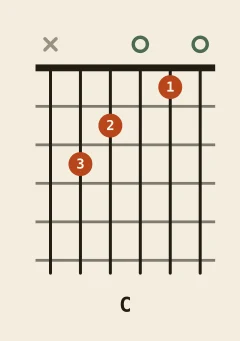
Every one of those diagrams opens a real chord page with alternate voicings up the neck: the D major page is a good next stop, because its shape only uses the top four strings.
How to build a chord
Four moves take you from a blank fretboard to a named chord. Read them once, then try the quick recipe buttons in the builder above and watch the interval breakdown change.
- Pick the root. The root is the note the chord is named after: C for a C chord, G for a G chord. Tap it first; it is the 1 in every recipe in the table.
- Add the third to set the mood. The third decides major or minor. Four semitones above the root gives a bright major chord, three semitones gives a darker minor one. C plus E is major; C plus E♭ is minor.
- Add the fifth, then colour. The perfect fifth (7 semitones) completes the triad. A minor 7th (10 semitones) gives a bluesy dominant chord, a major 7th (11 semitones) a soft jazzy one. Watch the builder name each step as you tap.
- Read the other roots. The interval breakdown reads the same notes from every note in the set, so a shape you thought was one chord may also be a slash or an inversion. That is the part a static chord chart cannot show you.
Why one semitone changes everything
A major triad is 1 3 5: root, major third, perfect fifth. A minor triad is 1 ♭3 5, the same recipe with the third lowered one semitone. That single note is the entire difference between happy and sad, and it is why the builder reports the third of every match instead of hiding it behind a name.
Stack one more note and the flavours multiply. A dominant 7th is 1 3 5 ♭7, the tense sound that pulls a song back home, while a major 7th is 1 3 5 7, smooth and jazzy. Once you can read a recipe, a handful of notes stops being a mystery and becomes a formula you can reuse anywhere on the neck. If you would rather go the other way, from a name to a shape, the chord finder and the full chord chart cover that direction.