Radiohead
Creep chords
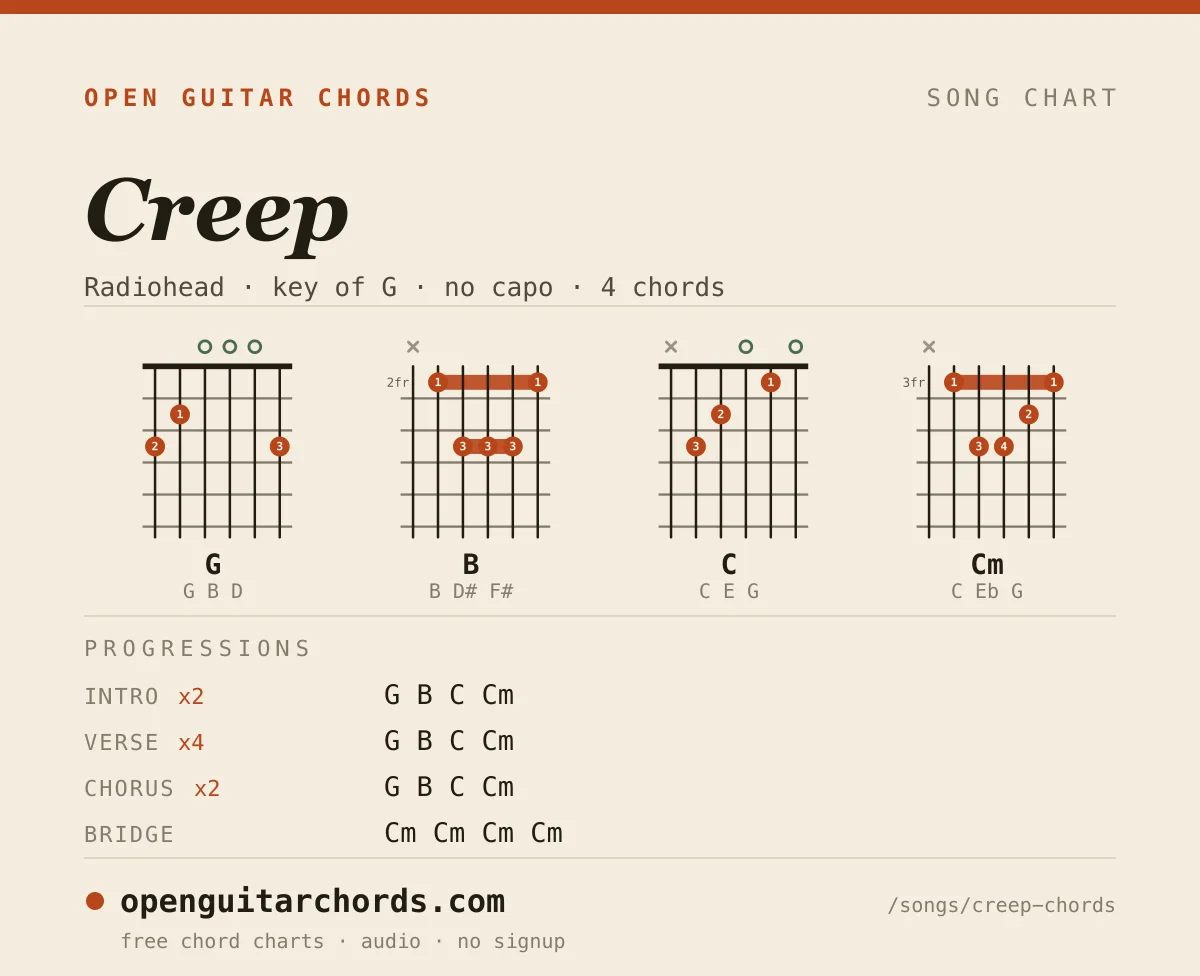
Creep by Radiohead is a beginner song in G, played with no capo. The whole sheet is 4 chords (G, B, C, Cm) across 4 sections: Intro ×2 → Verse ×4 → Chorus ×2 → Bridge. 2 of the 4 shapes are open chords. Shapes that use a barre: B, Cm. It sits at roughly 92 BPM.
Simplified practice arrangement. Section repetitions are practice cues rather than a verified transcription of the recording.
By Chiye · Updated
Hardest change in the sheet: B → C, 3 times.
- Difficulty
- Beginnerbarre shape B
- Key
- Gwith no capo
- Tempo
- 92BPM
- Tuning
- Standard (E A D G B E)low to high
- Chords
- 42 open, 2 with a barre
- Sections
- 4each with its own progression
Chords in Creep
Frets read low E to high E, x means leave that string out.
Chord sheet
One chord per bar in this practice sheet. Follow the time signature shown beside each section; dots mark the remaining counts in the bar. Tap a bar to hear its chord, or loop the section to practise the changes.
Intro× 2 · 4/4 · ♩=92
G… B… C… Cm…
Verse× 4 · 4/4 · ♩=92
Gbefore Beyes Cangel Cmcry
Gfeather Bworld Cspecial Cmspecial
Chorus× 2 · 4/4 · ♩=92
Cm… Gcreep Bweirdo Chere
Bridge4/4 · ♩=92
Cmrunning Cmrun Cmrun Cmrun
Printable one-page chord chart
How to play Creep
Start with Creep’s main G–B–C–Cm progression. B major contains D#, an outside note in G major; C minor then lowers C major’s E to Eb. Hearing those two changes is more useful than treating G, B and C as one diatonic group. Cm recurs within the main loop, including the verse.
This chart is a simplified accompaniment practice arrangement. Its section repetitions and held-Cm bridge are practice cues, not a verified full-song transcription of the recording. For a published guitar arrangement in G, see Musicnotes’ Creep score.
Practise the loop quietly with separate picked notes, then use fuller strums for a louder contrast. Keep the chord changes steady as you change dynamics.
The only real challenge is the B major barre at fret 2. If it’s not clean yet, play B as a two-finger power-ish shape (x-2-4-4-x-x) and it will pass; keep working toward the full barre as your hand strength grows. Strum the chorus with all downstrokes to get that wall-of-sound feel.
How to practise Creep
Four steps computed from this sheet: the order the shapes are easiest to learn in, the changes that really occur in the progressions above, where each chord turns up, and the tempo ladder up to the speed marked here.
Learn the shapes easiest first
G (3-2-0-0-0-3, beginner) → C (x-3-2-0-1-0, beginner) → Cm (x-3-5-5-4-3, intermediate, needs a barre) → B (x-2-4-4-4-2, intermediate, needs a barre)
2 of the 4 shapes are open chords, so start there and leave B until the others change cleanly.
Drill the changes this sheet actually uses
B → C3×C → Cm3×G → B3×
These counts come from the progressions on this page, so they are the changes you will actually play, not a generic list of pairs to practise.
Know where each chord turns up
- GIntro, Verse, Chorus
- BIntro, Verse, Chorus
- CIntro, Verse, Chorus
- Cmevery section
Climb the tempo ladder
Start at 55 BPM and move up only when a full pass is clean: 55 → 69 → 83 → 92 BPM. The tempo marked on this sheet is 92 BPM, and the last step is the one that always feels like a jump. Stay at 83 for longer than feels necessary.
Practise each section's chord changes slowly, then play the sheet through at a steady tempo without pausing between sections.
Playing Creep with a capo
This sheet needs no capo. Each card shows what you would finger at that capo position so the song still sounds exactly as written. Useful when the shapes above are awkward, or when you want to sing it higher without learning new chords.
No capoas written
G B C Cm
2 of 4 stay open
Fret 1
F# Bb B Bm
no open shapes left, all barre
Fret 2
F A Bb Bbm
1 of 4 stay open
Fret 3
E Ab A Am
3 of 4 stay open
Fret 4
Eb G Ab Abm
1 of 4 stay open
Fret 5
D F# G Gm
2 of 4 stay open
Fret 6
C# F F# F#m
no open shapes left, all barre
Fret 7
C E F Fm
2 of 4 stay open
Working out a different key? The capo calculatordoes the same arithmetic for any chord set.
More songs built on the same chords
If Creep clicks, these use the closest set of shapes, so the chords you just learned keep working.
More beginner songs to learn after this one: Sweater Weather, Payphone, The Scientist, 505.
These chords across the songbookHow often each chord in Creep turns up across all 104 songs on this site, and what it most often moves to next. The counts come from the sheet library itself, not from theory.
509bars of this chord across the songbook
77songs use this shape
Most often followed by D, 89×.
420bars of this chord across the songbook
70songs use this shape
Most often followed by G, 115×.
9bars of this chord across the songbook
2songs use this shape
Most often followed by Dm7b5, 2×.