Coldplay
The Scientist chords
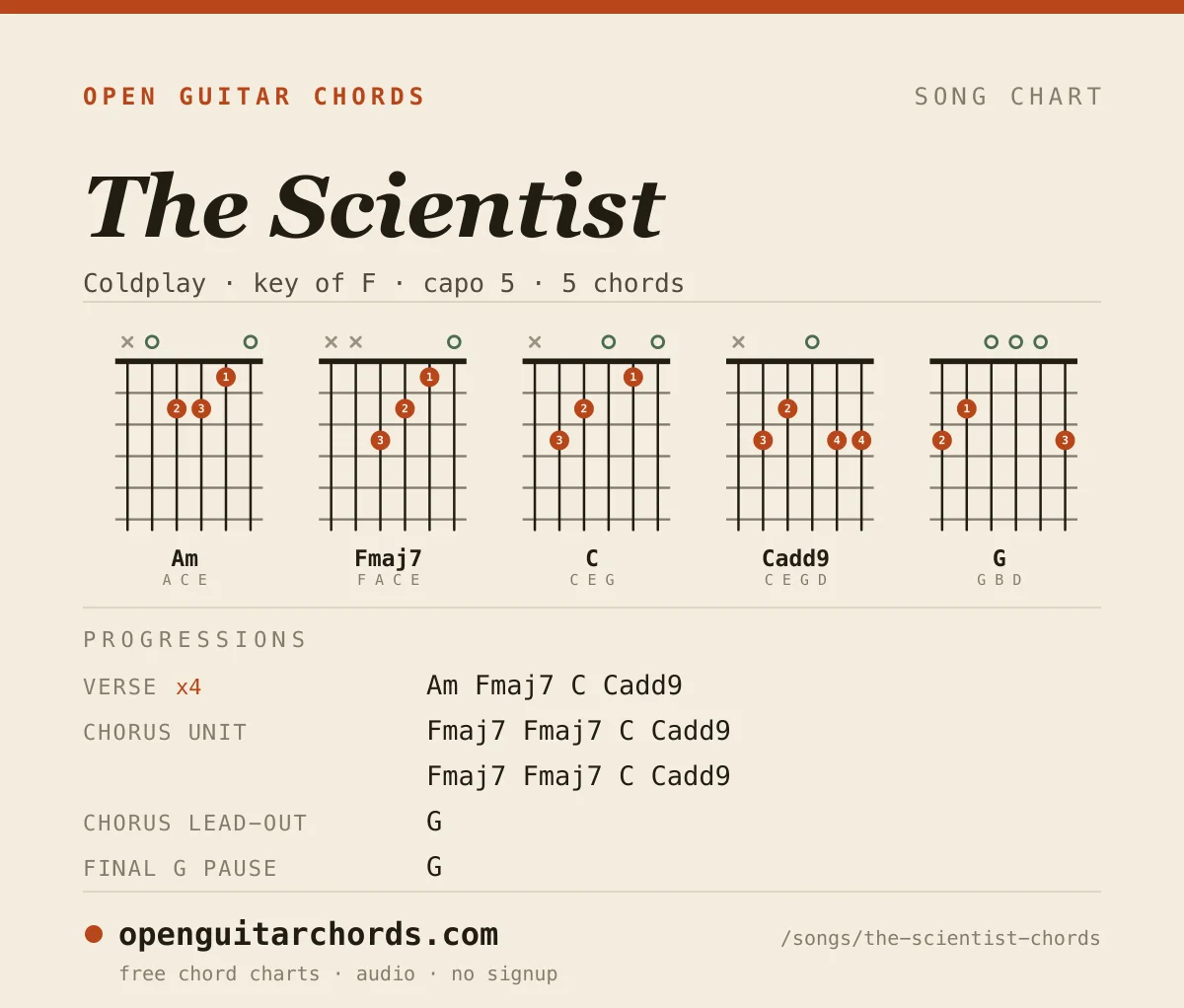
The Scientist by Coldplay is a beginner song in F, played with a capo on fret 5. The whole sheet is 5 chords (Am, Fmaj7, C, Cadd9, G) across 4 sections: Verse ×4 → Chorus unit → Chorus lead-out → Final G pause. Every shape is an open chord, so nothing here needs barre strength.
By Chiye · Updated
Hardest change in the sheet: C → Cadd9, 3 times.
- Difficulty
- Beginnerno barre needed
- Key
- Fwith a capo on fret 5
- Tuning
- Standard (E A D G B E)low to high
- Chords
- 5all open shapes
- Sections
- 4each with its own progression
Chords in The Scientist
Frets read low E to high E, x means leave that string out.
Chord sheet
One chord per bar in this practice sheet. Follow the time signature shown beside each section; dots mark the remaining counts in the bar. Tap a bar to hear its chord, or loop the section to practise the changes.
Lyrics are not reproduced for this song: they are still in copyright and this site has no licence to publish them. The chords, structure, strumming and sing-along timing are all here. Songs whose words are public domain →
Verse× 4 · 4/4 · ♩=90
One four-beat bar per box; catalog voicings retain the major third in Cadd9
Chorus unit4/4 · ♩=90
Chorus lead-out4/4 · ♩=90
Final G pause4/4 · ♩=90
Printable one-page chord chart
How to play The Scientist
Play The Scientist with Am, Fmaj7, C, Cadd9 and G shapes at capo 5, using standard tuning. This open-chord practice arrangement sounds in F. The verse changes once per bar, while the chorus holds Fmaj7 longer. The separate final G box gives you a place to practise the pause before moving on, without mistaking the section list for the complete song.
Match the capo to the chord names
The symbols above the boxes describe the shapes relative to the capo. Am sounds as Dm, Fmaj7 as Bbmaj7, C as F, Cadd9 as Fadd9, and G as C. Fit the capo close behind fret 5 and check the tuning again. A string pulled sideways or clamped too hard can go sharp even when the open guitar was in tune.
Removing the capo while keeping these shapes lowers the whole arrangement by five semitones. It does not preserve the F-centred pitch. Choose a comfortable singing key by moving the entire arrangement together. These diagrams are for standard E–A–D–G–B–E tuning; the separate fourths-tuning lesson linked by the teacher needs different fingerings.
Keep the third in the added-note chord
Our Cadd9 diagram is x-3-2-0-3-3. Its notes include C, E, G and D. The D is an added ninth, while E remains the major third. A Csus2 chord would remove that E, so the two names do not describe the same note set.
Justin’s easy lesson writes Cadd2 for x-3-0-0-1-0. That grip also contains C, D, E and G, so it belongs to the added-ninth family. This page uses its own catalog Cadd9 voicing, with a different distribution of the same chord tones. Do not assume the two diagrams should have identical frets. Both retain the third; neither becomes Csus2 merely because the added D sits close to a C in one grip.
Read the longer holds and the final pause
The verse practice line is Am–Fmaj7–C–Cadd9, one bar per chord. The indicated four repeats follow the easy lesson’s verse exercise. In the chorus, play Fmaj7–Fmaj7–C–Cadd9 twice. The repeated Fmaj7 symbol means another full four-beat bar of the same chord, not a quicker change or a new grip.
After that chorus unit, the next two boxes are G. Keep the first bar steady. In the final bar, the grid D . . . . . . . asks for one downstroke on beat one, then space for the remaining counts. Count the silent positions rather than shortening the bar. The player’s default 90 BPM is a practice setting here, not a claim about the recording. These section exercises do not map every instrumental passage and vocal repeat.
Compare the smaller Fmaj7 grips
The page’s Fmaj7 is x-x-3-2-1-0: four strings, with an open high E supplying the major seventh. Start the sweep on the fourth string and keep the first string clear. A plain F triad would lose that E, so treat it as an intentional colour change rather than the same chord under a shorter name.
The teaching lesson uses Fmaj7/C, x-3-3-2-1-0. It adds a C bass below the same F–A–C–E harmony. Our smaller grip has F as its lowest note, so the bass differs. Compare them slowly if you want to explore that change; begin with the diagram actually printed here. For Am, use x-0-2-2-1-0 and keep the low sixth string silent as well.
The capo, chord-family choices, section holds and final-bar pause were checked against JustinGuitar’s easy The Scientist lesson. The note-set comparison above explains how this page adapts those grips to its own diagrams.
How to practise The Scientist
Four steps computed from this sheet: the order the shapes are easiest to learn in, the changes that really occur in the progressions above, where each chord turns up, and the tempo ladder up to the recorded speed.
Learn the shapes easiest first
Am (x-0-2-2-1-0, beginner) → Fmaj7 (x-x-3-2-1-0, beginner) → C (x-3-2-0-1-0, beginner) → Cadd9 (x-3-2-0-3-3, beginner) → G (3-2-0-0-0-3, beginner)
5 of the 5 shapes are open chords, so nothing here needs barre strength yet.
Drill the changes this sheet actually uses
C → Cadd93×Fmaj7 → C3×Am → Fmaj71×
These counts come from the progressions on this page, so they are the changes you will actually play, not a generic list of pairs to practise.
Know where each chord turns up
- AmVerse
- Fmaj7Verse, Chorus unit
- CVerse, Chorus unit
- Cadd9Verse, Chorus unit
- GChorus lead-out, Final G pause
Climb the tempo ladder
This sheet does not list a tempo, so pick one where every change is clean and use the metronome to move up in 4 BPM steps.
Every section here uses the same set of shapes, so there is no section to single out. Whatever you can play once, you can play all the way through.
Playing The Scientist with a capo
This sheet is written with a capo on fret 5. Each card shows what you would finger at that capo position so the song still sounds exactly as written. Useful when the shapes above are awkward, or when you want to sing it higher without learning new chords.
No capo
Dm Bbmaj7 F Fadd9 C
3 of 5 stay open
Fret 1
C#m Amaj7 E Eadd9 B
3 of 5 stay open
Fret 3
Bm Gmaj7 D Dadd9 A
4 of 5 stay open
Fret 5as written
Am Fmaj7 C Cadd9 G
5 of 5 stay open
Working out a different key? The capo calculatordoes the same arithmetic for any chord set.
More songs built on the same chords
If The Scientist clicks, these use the closest set of shapes, so the chords you just learned keep working.
More beginner songs to learn after this one: 505, Linger, Teardrops on My Guitar, Wonderwall.
These chords across the songbookHow often each chord in The Scientist turns up across all 90 songs on this site, and what it most often moves to next. The counts come from the sheet library itself, not from theory.
117bars of this chord across the songbook
27songs use this shape
Most often followed by G, 27×.
13bars of this chord across the songbook
4songs use this shape
Most often followed by Bb7, 3×.
384bars of this chord across the songbook
59songs use this shape
Most often followed by G, 122×.
11bars of this chord across the songbook
3songs use this shape
Most often followed by D, 3×.
458bars of this chord across the songbook
67songs use this shape
Most often followed by C, 80×.