Taylor Swift
Teardrops on My Guitar chords
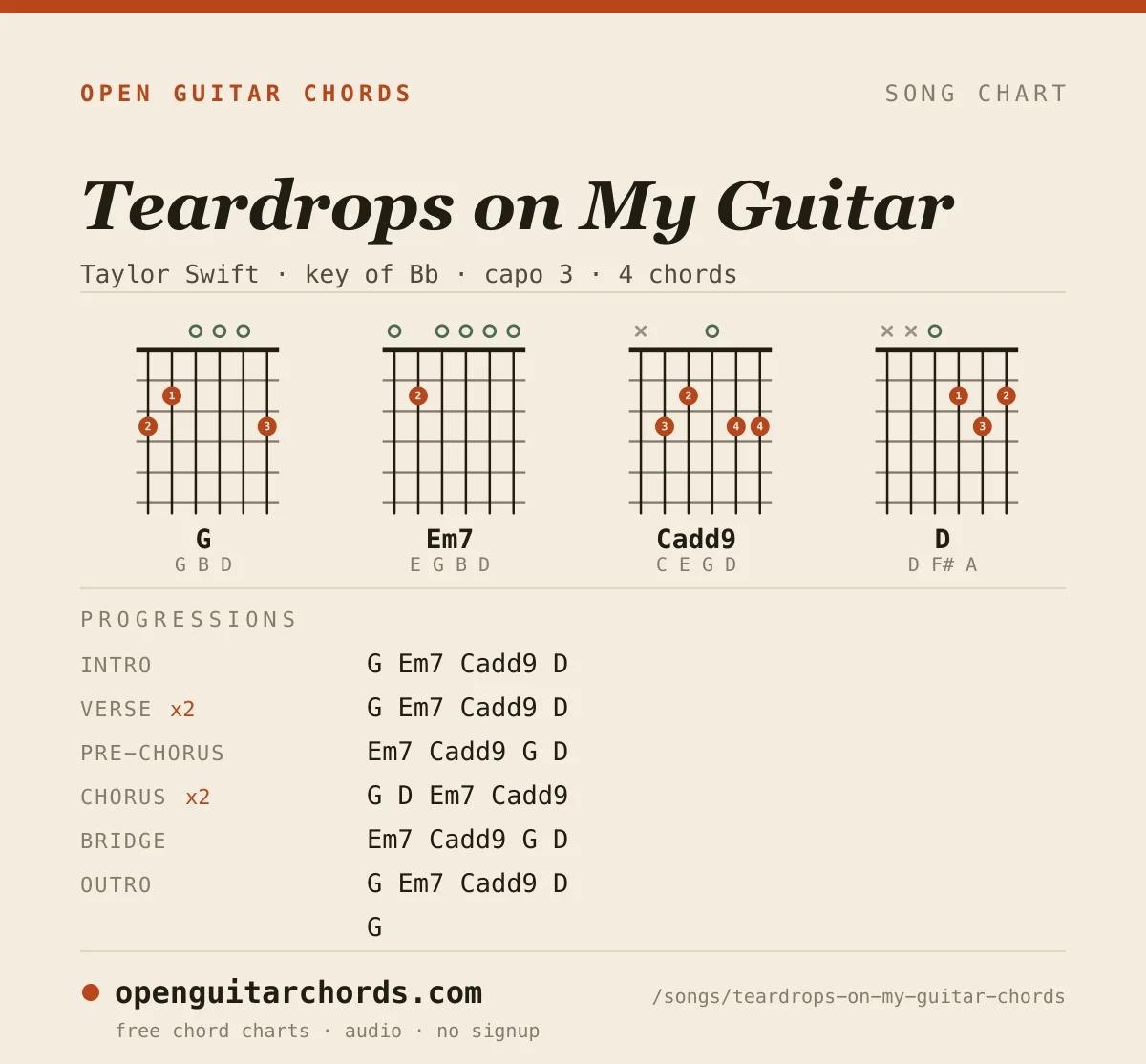
Teardrops on My Guitar by Taylor Swift is a beginner song in Bb, played with a capo on fret 3. The whole sheet is 4 chords (G, Em7, Cadd9, D) across 6 sections: Intro → Verse ×2 → Pre-chorus → Chorus ×2 → Bridge → Outro. Every shape is an open chord, so nothing here needs barre strength.
By Chiye · Updated
Hardest change in the sheet: Em7 → Cadd9, 6 times.
- Difficulty
- Beginnerno barre needed
- Key
- Bbwith a capo on fret 3
- Tuning
- Standard (E A D G B E)low to high
- Chords
- 4all open shapes
- Sections
- 6each with its own progression
Chords in Teardrops on My Guitar
Frets read low E to high E, x means leave that string out.
Chord sheet
One chord per bar in this practice sheet. Follow the time signature shown beside each section; dots mark the remaining counts in the bar. Tap a bar to hear its chord, or loop the section to practise the changes.
Lyrics are not reproduced for this song: they are still in copyright and this site has no licence to publish them. The chords, structure, strumming and sing-along timing are all here. Songs whose words are public domain →
Intro4/4 · ♩=90
Practice arrangement, one bar per chord; begin with quiet downstrokes
Verse× 2 · 4/4 · ♩=90
Pre-chorus4/4 · ♩=90
Chorus× 2 · 4/4 · ♩=90
Bridge4/4 · ♩=90
Outro4/4 · ♩=90
Printable one-page chord chart
How to play Teardrops on My Guitar
This Teardrops on My Guitar practice arrangement uses G, Em7, Cadd9 and D with a capo at fret 3. In standard tuning those shapes sound in Bb. Learn the verse order first, then notice that the chorus changes the same four shapes into G–D–Em7–Cadd9. Memorising the chord collection alone will not tell you which change comes next.
Set the capo and count from it
Place the capo just behind the third fret and check the tuning again. All fret numbers in the diagrams are relative to that new starting point. An open string means a string stopped by the capo. A G shape therefore sounds as Bb, Em7 as Gm7, Cadd9 as Ebadd9, and D as F. Removing the capo while keeping the shapes lowers this arrangement by three semitones to G.
Use the chord rack to check each grip before starting a loop. Our basic Em7 diagram is 0-2-0-0-0-0; it does not require the anchored top fingers used in some acoustic versions. Both grips can produce Em7, but they distribute the notes differently. Follow the diagram you have chosen consistently rather than combining half of one grip with half of another.
Separate the verse and chorus changes
The verse line runs G–Em7–Cadd9–D. Practise it twice, then stop. The chorus line runs G–D–Em7–Cadd9. Its first change is directly to D, so isolate G to D a few times before joining the whole chorus. The pre-chorus and bridge exercises begin on Em7 and move through Cadd9, G and D.
The boxes here use one four-beat bar per chord for steady practice. They give you the main section progressions, rather than a timed transcription of every vocal phrase or a complete performance itinerary. Use the section loops to learn the changes, then check phrase lengths against the particular acoustic performance you want to accompany. Do not automatically play every section once in the order it appears on the page.
Keep the strumming hand moving
The displayed eight-slot pattern is D . D U . U D U. Count “one and two and three and four and.” Strike down on one and two, up after two, up after three, then down-up on four. On the empty slots, keep the hand moving without touching the strings. This is the familiar down-down-up-up-down-up pattern used in the acoustic lesson linked below.
First play only the four numbered beats with downstrokes. Add the upstrokes after the fretting hand can change without a pause. If the final upstroke makes you late for the next chord, reduce the tempo rather than cutting the new chord’s first beat short. Let the chorus become a little louder by brushing more strings, while keeping the same pulse.
Clear the bass strings on D
The D grip starts at the open fourth string. Aim the pick there instead of sweeping all six strings on every stroke. Cadd9 begins on the fifth string, while G and the open Em7 grip can use the sixth. A consistent right-hand starting point helps the progression sound deliberate even before you add rhythmic detail.
Capo position, chord choices and the basic strum were checked against Nena Shelby’s live acoustic lesson. The evenly spaced section exercises above use our own practice layout.
How to practise Teardrops on My Guitar
Four steps computed from this sheet: the order the shapes are easiest to learn in, the changes that really occur in the progressions above, where each chord turns up, and the tempo ladder up to the recorded speed.
Learn the shapes easiest first
G (3-2-0-0-0-3, beginner) → Em7 (0-2-0-0-0-0, beginner) → Cadd9 (x-3-2-0-3-3, beginner) → D (x-x-0-2-3-2, beginner)
4 of the 4 shapes are open chords, so nothing here needs barre strength yet.
Drill the changes this sheet actually uses
Em7 → Cadd96×Cadd9 → D3×G → D3×G → Em73×
These counts come from the progressions on this page, so they are the changes you will actually play, not a generic list of pairs to practise.
Know where each chord turns up
- Gevery section
- Em7every section
- Cadd9every section
- Devery section
Climb the tempo ladder
This sheet does not list a tempo, so pick one where every change is clean and use the metronome to move up in 4 BPM steps.
Every section here uses the same set of shapes, so there is no section to single out. Whatever you can play once, you can play all the way through.
Playing Teardrops on My Guitar with a capo
This sheet is written with a capo on fret 3. Each card shows what you would finger at that capo position so the song still sounds exactly as written. Useful when the shapes above are awkward, or when you want to sing it higher without learning new chords.
Fret 1
A F#m7 Dadd9 E
3 of 4 stay open
Fret 3as written
G Em7 Cadd9 D
4 of 4 stay open
Fret 6
E C#m7 Aadd9 B
2 of 4 stay open
Working out a different key? The capo calculatordoes the same arithmetic for any chord set.
More songs built on the same chords
If Teardrops on My Guitar clicks, these use the closest set of shapes, so the chords you just learned keep working.
More beginner songs to learn after this one: The Scientist, 505, Sailor Song, Yellow.
These chords across the songbookHow often each chord in Teardrops on My Guitar turns up across all 90 songs on this site, and what it most often moves to next. The counts come from the sheet library itself, not from theory.
458bars of this chord across the songbook
67songs use this shape
Most often followed by C, 80×.
17bars of this chord across the songbook
4songs use this shape
Most often followed by Cadd9, 6×.
11bars of this chord across the songbook
3songs use this shape
Most often followed by D, 3×.
274bars of this chord across the songbook
51songs use this shape
Most often followed by G, 41×.