Goo Goo Dolls
Iris chords
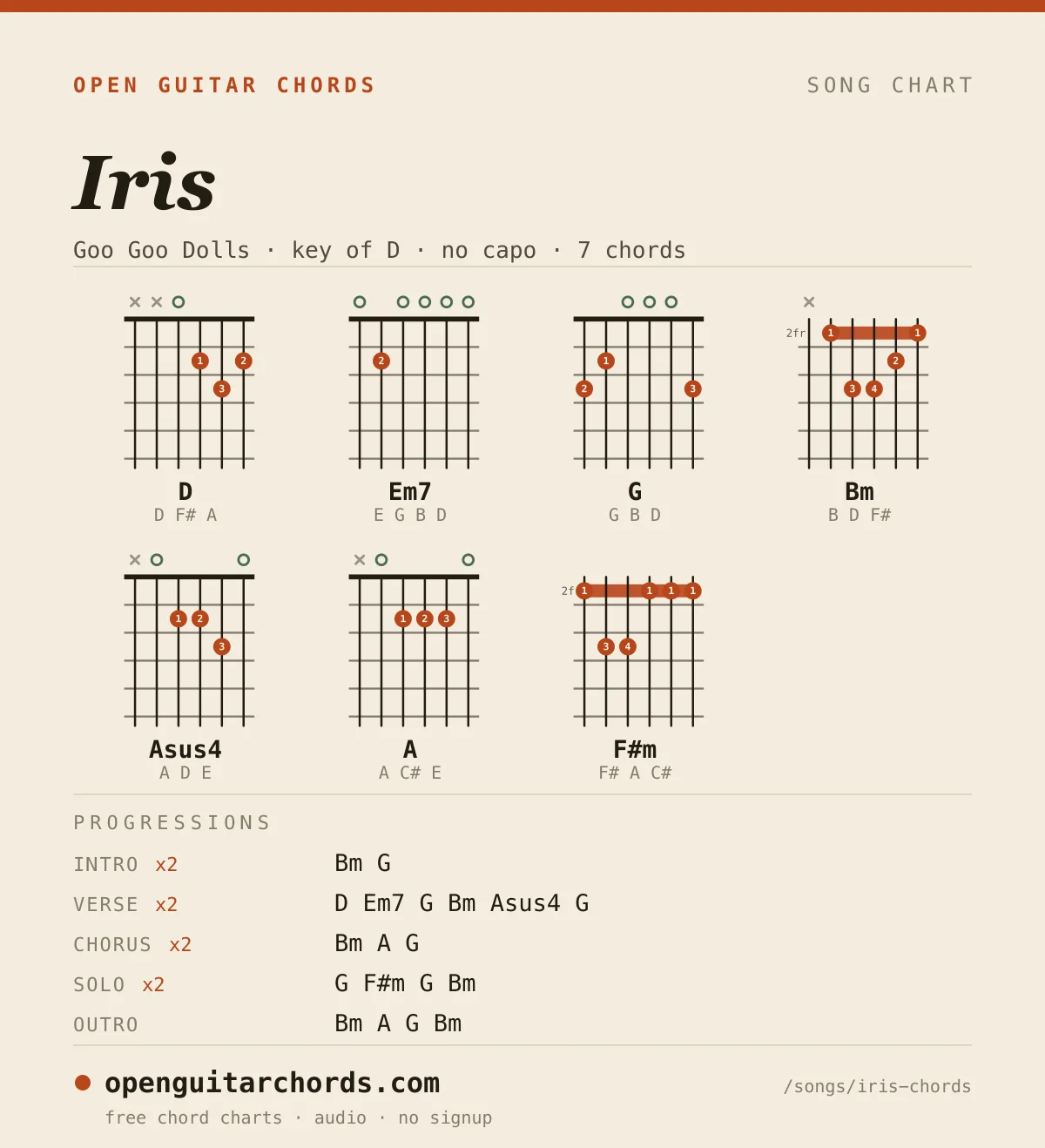
Iris by Goo Goo Dolls is an intermediate song in D, played with no capo. The whole sheet is 7 chords (D, Em7, G, Bm, Asus4, A, F#m) across 5 sections: Intro ×2 → Verse ×2 → Chorus ×2 → Solo ×2 → Outro. 5 of the 7 shapes are open chords and Bm is the one that needs a barre. It sits at roughly 77 BPM.
By Chiye · Updated
Hardest change in the sheet: G → Bm, 3 times.
- Difficulty
- Intermediatebarre shape Bm
- Key
- Dwith no capo
- Tempo
- 77BPM
- Tuning
- Standard (E A D G B E)low to high
- Chords
- 75 open, 2 with a barre
- Sections
- 58 steps in the recorded form
Chords in Iris
Frets read low E to high E, x means leave that string out.
Chord sheet
One chord per bar in this practice sheet. Follow the time signature shown beside each section; dots mark the remaining counts in the bar. Tap a bar to hear its chord, or loop the section to practise the changes.
Lyrics are not reproduced for this song: they are still in copyright and this site has no licence to publish them. The chords, structure, strumming and sing-along timing are all here. Songs whose words are public domain →
Intro× 2 · 6/8 · ♩=77
let the low strings ring, no strumming until the verse
Verse× 2 · 6/8 · ♩=77
arpeggiate, bass note first
Chorus× 2 · 6/8 · ♩=77
full strums, one chord per bar
Solo× 2 · 6/8 · ♩=77
keep the groove, this is the intro changes again
Outro6/8 · ♩=77
let the last Bm ring out
Printable one-page chord chart
How to play Iris
Iris is the 90s ballad most guitarists learn badly, and the reason is a tuning. On the record the guitars are set to a drone — five strings brought to D, the low string dropped to B — which is why the intro rings like it was struck rather than strummed. The upper strings sustain the note D, rather than a complete D major chord, underneath every change. You do not need it. In standard tuning with no capo the whole chart is in D, and that is the version printed above.
The verse is a six-chord cycle — D, Em7, G, Bm, Asus4, G — and the chorus throws three of them away and walks down Bm, A, G. That descent is the engine. Each chord drops a whole step on the neck, so the harmony slides downhill while the melody stays high, and the tension you feel in the chorus comes from those two directions pulling apart. The instrumental break then runs G–F#m–G–Bm, which is the intro re-harmonised rather than a new section.
Those two colour chords are doing more than decorating. Em7 adds the note D to E minor, and Asus4 swaps A’s C♯ for that same D, so both shapes keep the tonic of the key ringing while the bass moves underneath them. That is the closest standard tuning gets to the record’s drone, and it is why the tabbed versions that print plain Em and A sound thinner than the album.
The obstacle is Bm at the 2nd fret. The root-position barre is x-2-4-4-3-2. If your barre is not clean yet, play the shell x-2-4-4-3-x instead: root, fifth, octave and the minor third, which is every note the chord actually needs. Save the full shape for the chorus, where the song demands volume.
Rhythm is where most players oversell it. Arpeggiate the verse — bass note on beat one, then the upper strings in slow pairs — and only open into full downstrokes when the chorus arrives. This accompaniment uses 6/8: count six eighth notes in two groups of three, with the main pulses on counts 1 and 4. Set a metronome that counts dotted-quarter pulses to about 51 BPM; the chart’s quarter-note display of 77 describes approximately the same speed. Two of this site’s other 90s charts ask for the same dynamic control, Creep and Wonderwall, and both are good warm-ups for it. If you want the ringing version and are willing to retune, start by checking your string gauges — pulling the low string down to B slackens it a lot, and pushing the B string up to D is how people break one mid-song.
The key, meter and tempo reference is the licensed guitar arrangement published by Hal Leonard on Musicnotes. The chart here is a simplified standard-tuning accompaniment, not a note-for-note transcription of the recording.
How to practise Iris
Four steps computed from this sheet: the order the shapes are easiest to learn in, the changes that really occur in the progressions above, where each chord turns up, and the tempo ladder up to the recorded speed.
Learn the shapes easiest first
D (x-x-0-2-3-2, beginner) → Em7 (0-2-0-0-0-0, beginner) → G (3-2-0-0-0-3, beginner) → Asus4 (x-0-2-2-3-0, beginner) → A (x-0-2-2-2-0, beginner) → Bm (x-2-4-4-3-2, intermediate, needs a barre) → F#m (2-4-4-2-2-2, intermediate, needs a barre)
5 of the 7 shapes are open chords, so start there and leave Bm until the others change cleanly.
Drill the changes this sheet actually uses
G → Bm3×A → G2×Bm → A2×Asus4 → G1×
These counts come from the progressions on this page, so they are the changes you will actually play, not a generic list of pairs to practise.
Know where each chord turns up
- DVerse
- Em7Verse
- Gevery section
- Bmevery section
- Asus4Verse
- AChorus, Outro
- F#mSolo
Climb the tempo ladder
Start at 46 BPM and move up only when a full pass is clean: 46 → 58 → 69 → 77 BPM. The recorded feel is around 77 BPM, and the last step is the one that always feels like a jump. Stay at 69 for longer than feels necessary.
Every section here uses the same set of shapes, so there is no section to single out. Whatever you can play once, you can play all the way through.
Playing Iris with a capo
This sheet needs no capo. Each card shows what you would finger at that capo position so the song still sounds exactly as written. Useful when the shapes above are awkward, or when you want to sing it higher without learning new chords.
No capoas written
D Em7 G Bm Asus4 A F#m
5 of 7 stay open
Fret 1
C# Ebm7 F# Bbm Absus4 Ab Fm
no open shapes left, all barre
Fret 2
C Dm7 F Am Gsus4 G Em
5 of 7 stay open
Fret 3
B C#m7 E Abm F#sus4 F# Ebm
1 of 7 stay open
Fret 4
Bb Cm7 Eb Gm Fsus4 F Dm
1 of 7 stay open
Fret 5
A Bm7 D F#m Esus4 E C#m
5 of 7 stay open
Fret 6
Ab Bbm7 C# Fm Ebsus4 Eb Cm
no open shapes left, all barre
Fret 7
G Am7 C Em Dsus4 D Bm
5 of 7 stay open
Working out a different key? The capo calculatordoes the same arithmetic for any chord set.
More songs built on the same chords
If Iris clicks, these use the closest set of shapes, so the chords you just learned keep working.
More intermediate songs to learn after this one: Best Part, Hotel California, Hey Jude, Wish You Were Here.
These chords across the songbookHow often each chord in Iris turns up across all 90 songs on this site, and what it most often moves to next. The counts come from the sheet library itself, not from theory.
274bars of this chord across the songbook
51songs use this shape
Most often followed by G, 41×.
17bars of this chord across the songbook
4songs use this shape
Most often followed by Cadd9, 6×.
458bars of this chord across the songbook
67songs use this shape
Most often followed by C, 80×.
65bars of this chord across the songbook
13songs use this shape
Most often followed by A, 14×.
1bars of this chord across the songbook
1songs use this shape
Most often followed by G, 1×.
132bars of this chord across the songbook
23songs use this shape
Most often followed by D, 24×.
10bars of this chord across the songbook
4songs use this shape
Most often followed by D, 4×.