The Beatles
Let It Be chords
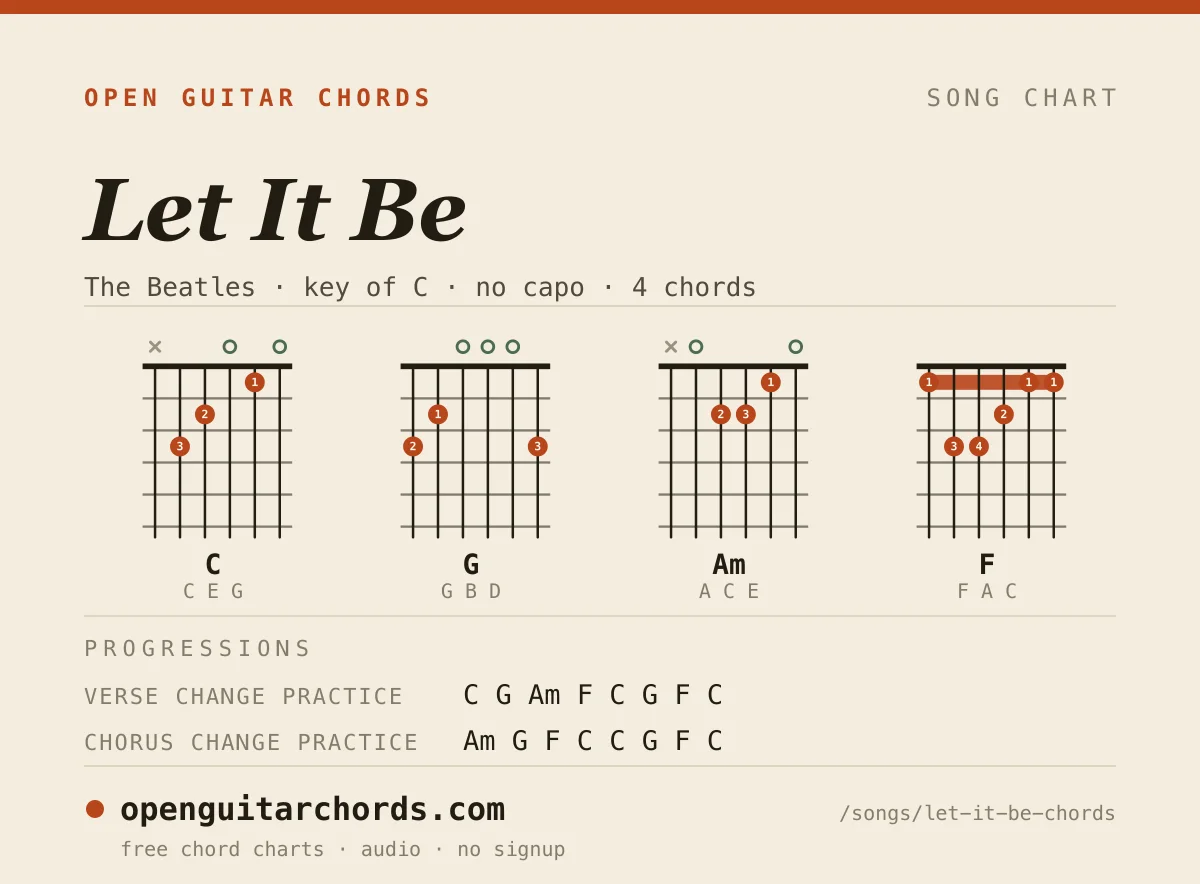
Let It Be by The Beatles is an intermediate song in C, played with no capo. The whole sheet is 4 chords (C, G, Am, F) across 2 sections: Verse change practice → Chorus change practice. 3 of the 4 shapes are open chords. Shapes that use a barre: F.
Simplified practice arrangement. Section repetitions are practice cues rather than a verified transcription of the recording.
By Chiye · Updated
Hardest change in the sheet: F → C, 4 times.
- Difficulty
- Intermediatebarre shape F
- Key
- Cwith no capo
- Tuning
- Standard (E A D G B E)low to high
- Chords
- 43 open, 1 with a barre
- Sections
- 2each with its own progression
Chords in Let It Be
Frets read low E to high E, x means leave that string out.
Chord sheet
One chord per bar in this practice sheet. Follow the time signature shown beside each section; dots mark the remaining counts in the bar. Tap a bar to hear its chord, or loop the section to practise the changes.
Chord accompaniment only. Follow the section notes for this arrangement’s timing. Songs whose words are public domain →
Verse change practice4/4 · ♩=60
Chorus change practice4/4 · ♩=60
Printable one-page chord chart
How to play Let It Be
Play Let It Be by The Beatles with C, G, Am and F, using standard tuning and no capo. The accompaniment sounds in C major. Start with the verse changes, then learn how the chorus begins on Am. The boxes expand each chord into a four-beat practice bar at 60 BPM; they give the fretting hand space to learn, rather than matching the recording’s quicker changes.
Separate the verse from the chorus
Lauren Bateman’s Let It Be chart gives the simplified verse sequence C–G–Am–F, then C–G–F–C. The chorus changes the opening to Am–G–F–C and uses the same C–G–F–C continuation. Practise these as two distinct starts: hearing the opening Am is a better cue than treating every section as the same four-chord loop.
The first row of boxes here covers the whole eight-chord verse exercise; the second section covers the chorus exercise. Two adjacent C boxes in the chorus mean two separate full practice bars. They preserve the join between its two phrases. Keep counting when the chord stays the same, so the following G arrives in its intended place.
Know which F shape you are playing
The diagram above prints the full F barre, 1-3-3-2-1-1. This is the demanding grip in this set. Check that the index finger holds the first-fret notes while the other fingers reach frets 2 and 3. Test the strings gently before adding the rhythm; a buzzing note is easier to locate with individual plucks than with a loud sweep.
A smaller F, x-x-3-2-1-1, keeps the same three chord tones and reduces the number of strings, but it still requires a mini-barre on the top two strings. Fmaj7 at x-x-3-2-1-0 leaves the high E open instead. JustinGuitar’s lesson discusses Fmaj7 as an easier option. Its E is an added seventh, so hear it as a deliberate colour choice rather than an identical F grip.
Count the changes before adding a busier strum
In Lauren Bateman’s teaching chart the main changes share measures in pairs, generally two beats per chord. Here each gets four beats at 60 BPM. Count “1, 2, 3, 4” on C before moving to G. The printed grid plays downstrokes on the four numbered beats, leaving the intervening eighth-note positions empty. It does not ask for eight downstrokes per bar.
Once the shapes feel secure, practise the source’s paired changes separately: C for two beats, G for two, then Am for two and F for two. Keep the underlying count steady as the hand moves. Changing the number of beats held is different from turning up the exercise tempo; use the version’s bar divisions when you start following another chart.
Let the harmony carry the accompaniment
Start C and Am on the fifth string, and use all six strings for the printed G and full F. Listen to the bass movement before filling every gap with a strum. The simplified return F–C provides a clear place to settle at the end of the phrase. A clean landing there is more useful initially than adding a rushed flourish.
The Beatles’ song page identifies the 1970 single and the album’s alternate mix. These exercises do not choose either mix’s complete instrumental arrangement. They omit the passing runs and solo, and no full song order is asserted. Use the chord exercises to learn the verse and chorus first, then follow a specific performance chart for its detailed timing.
How to practise Let It Be
Four steps computed from this sheet: the order the shapes are easiest to learn in, the changes that really occur in the progressions above, where each chord turns up, and the tempo ladder up to the speed marked here.
Learn the shapes easiest first
C (x-3-2-0-1-0, beginner) → G (3-2-0-0-0-3, beginner) → Am (x-0-2-2-1-0, beginner) → F (1-3-3-2-1-1, intermediate, needs a barre)
3 of the 4 shapes are open chords, so start there and leave F until the others change cleanly.
Drill the changes this sheet actually uses
F → C4×C → G3×G → F3×Am → F1×
These counts come from the progressions on this page, so they are the changes you will actually play, not a generic list of pairs to practise.
Know where each chord turns up
- Cevery section
- Gevery section
- Amevery section
- Fevery section
Climb the tempo ladder
This sheet does not list a tempo, so pick one where every change is clean and use the metronome to move up in 4 BPM steps.
Practise each section's chord changes slowly, then play the sheet through at a steady tempo without pausing between sections.
Playing Let It Be with a capo
This sheet needs no capo. Each card shows what you would finger at that capo position so the song still sounds exactly as written. Useful when the shapes above are awkward, or when you want to sing it higher without learning new chords.
No capoas written
C G Am F
3 of 4 stay open
Fret 1
B F# Abm E
1 of 4 stay open
Fret 2
Bb F Gm Eb
no open shapes left, all barre
Fret 3
A E F#m D
3 of 4 stay open
Fret 4
Ab Eb Fm C#
no open shapes left, all barre
Fret 5
G D Em C
4 of 4 stay open
Fret 6
F# C# Ebm B
no open shapes left, all barre
Fret 7
F C Dm Bb
2 of 4 stay open
Working out a different key? The capo calculatordoes the same arithmetic for any chord set.
More songs built on the same chords
If Let It Be clicks, these use the closest set of shapes, so the chords you just learned keep working.
More intermediate songs to learn after this one: Father and Son, 500 Miles, Shallow, The One That Got Away.
These chords across the songbookHow often each chord in Let It Be turns up across all 104 songs on this site, and what it most often moves to next. The counts come from the sheet library itself, not from theory.
420bars of this chord across the songbook
70songs use this shape
Most often followed by G, 115×.
509bars of this chord across the songbook
77songs use this shape
Most often followed by D, 89×.
125bars of this chord across the songbook
35songs use this shape
Most often followed by F, 23×.
114bars of this chord across the songbook
29songs use this shape
Most often followed by C, 38×.