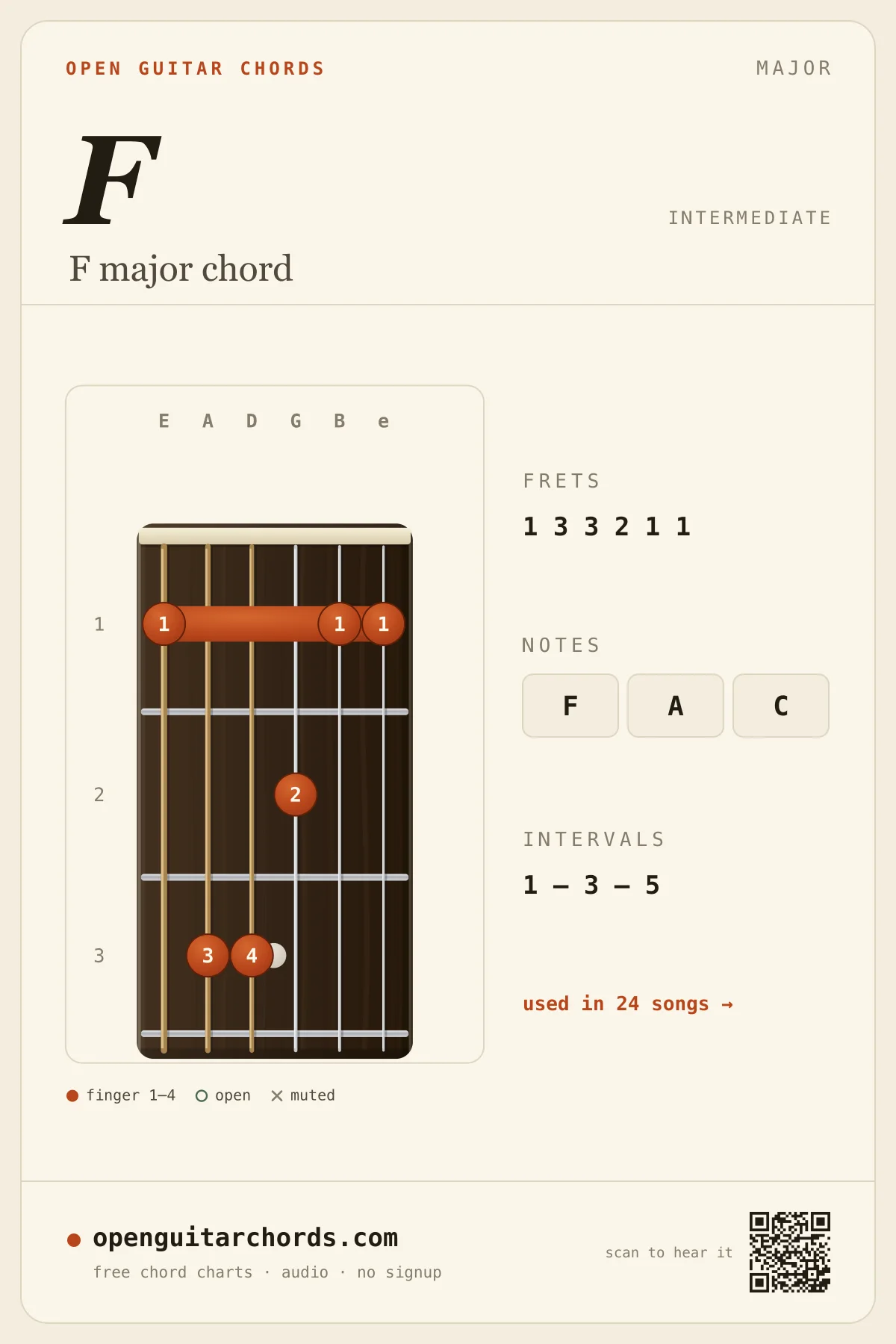
Major chord · F root
F chord
- F1
- A3
- C5
The F major chord is built from the notes F, A, C. It turns up 106 times in the 80 songs on this site, including All of Me and Bye Bye Blackbird.
By Chiye · Updated
What is the F chord?
The F chord (F major) is a major chord built from three notes: F, A, C — the 1–3–5 of the F scale, 4 semitones and 7 semitones above the root. On guitar it is most often played as a movable shape from fret 1 (1-3-3-2-1-1), so the same fingering works at any fret. It is rated intermediate. The bright, home-base sound that most songs resolve to. It is one of the most-used chords in this site's library: across the 80 song sheets charted here, F appears 106 times in 24 songs, most often in the keys of C and F, and the chord it most often moves to is C. Below you will find step-by-step fingering, 4 positions up the neck, audio of every shape, and the real progressions this chord lives inside.
How do you play the F chord on guitar?
Fret 1 barre — a movable shape, so this same fingering works for every root note.
- Lay your index finger flat across the low E to high E strings at fret 1, rolled slightly onto its bony edge.
- Press the A string at fret 3 with your ring finger.
- Press the D string at fret 3 with your pinky finger.
- Press the G string at fret 2 with your middle finger.
- Strum all six strings and let every one ring.
Drop the lowest fretted note (low E string) and play the rest as a four- or five-string shape. You lose the bass note but keep every note that gives the chord its name, and there is no barre left to fight. x-3-3-2-1-1
How do you make F sound clean?
Everyone’s first barre fails on the B and high E strings. Roll the index slightly onto its bony side, pull the elbow in, and fret closer to the wire — position beats pressure.
Do not fight full F first: play the four-string F (x-x-3-2-1-1) for a week, then add the barre for five clean seconds a day. Barres are built in seconds, not hours.
In real songs
What songs use the F chord?
- chord changes
- 106
- songs
- 24
- common keys
- C · F
Across the 80 chord sheets on this site, F appears 106 times in 24 songs — most often in the keys of C and F.
FFm7CA7
FC6FC6
FC6Dm7G7
All 24 songs that use F— key, capo and a link to every sheet
| Song | Artist | Key | Capo |
|---|---|---|---|
| All of Me | Jazz Standard | C | — |
| Bye Bye Blackbird | Jazz Standard | F | — |
| Can't Help Falling in Love | Elvis Presley | C | — |
| Georgia on My Mind | Ray Charles | C | — |
| Hallelujah | Leonard Cohen | C | — |
| Have You Ever Seen the Rain | Creedence Clearwater Revival | C | — |
| Here Comes the Sun | The Beatles | A | 7 |
| Hey Jude | The Beatles | F | — |
| Ho Hey | The Lumineers | C | — |
| House of the Rising Sun | The Animals | Am | — |
| I'm Yours | Jason Mraz | C | — |
| Imagine | John Lennon | C | — |
| Jackson | Johnny Cash & June Carter Cash | Db | 1 |
| Lean on Me | Bill Withers | C | — |
| Let It Be | The Beatles | C | — |
| Proud Mary | Creedence Clearwater Revival | D | — |
| Something | The Beatles | C | — |
| Sweet Home Alabama | Lynyrd Skynyrd | G | — |
| The Boxer | Simon & Garfunkel | C | — |
| Unchained Melody | The Righteous Brothers | C | — |
| Wake Me Up When September Ends | Green Day | G | — |
| While My Guitar Gently Weeps | The Beatles | Am | — |
| You Are My Sunshine | Traditional | C | — |
| You're Beautiful | James Blunt | Eb | 3 |
Chord flow
What chord comes after F?
Those figures are counted from the 80 chord sheets on this site, so they describe what songwriters actually played rather than what theory says should come next.
Three-chord moves
Three-chord moves are where a chord really shows its character. These are the ones that actually happen in this library, counted from the sheets:
What other ways can you play F up the neck?
3 more positions below. A chord is a set of notes, not a shape — every position below sounds like F, and each one puts your hand somewhere different, which is what makes them useful in different songs.
Position 2 · Fret 3
No open strings, so this is a movable shape: slide it up or down and the same fingering gives you a different chord name.
Position 3 · Fret 8 barre
No open strings, so this is a movable shape: slide it up or down and the same fingering gives you a different chord name.
It needs 2 separate bars, one of them a partial bar across the inner strings — the hardest part of this shape.
Position 4 · Fret 10 barre
No open strings, so this is a movable shape: slide it up or down and the same fingering gives you a different chord name.
One bar does most of the work. Roll that finger onto its bony edge and pull the elbow slightly in — a barre that buzzes is almost always a position problem, not a strength problem.
Watch the F chord
Video: JustinGuitar on YouTube — embedded with the official player; credit and views belong to the creator.
The theory behind F
F is spelled F – A – C — the 1 – 3 – 5 of the F scale, which is the root plus 4 semitones, 7 semitones. The bright, home-base sound that most songs resolve to.
The third is the note that makes it major, so it decides the character: keep it on top and F sounds bright, drop it below the fifth and the same notes sound rounder. On guitar that is a matter of which string you put it on, which is exactly what the different positions on this page do.
What key is the F chord in?
F is the I chord in the key of F major, the IV chord in C major and the V chord in Bb major — the three major keys where F appears naturally.
the home chord — songs resolve here
the subdominant — the chord that leaves home
the dominant — the chord that pulls back home
F on other instruments
2 0 1 0
The same chord on four strings in standard tuning. Because the uke is tuned higher, this shape sits at a different place on the neck than its guitar equivalent — useful when arranging for both instruments.
F – A – C — all white keys, so you can find the shape by counting up from C.
Take it to the practice room