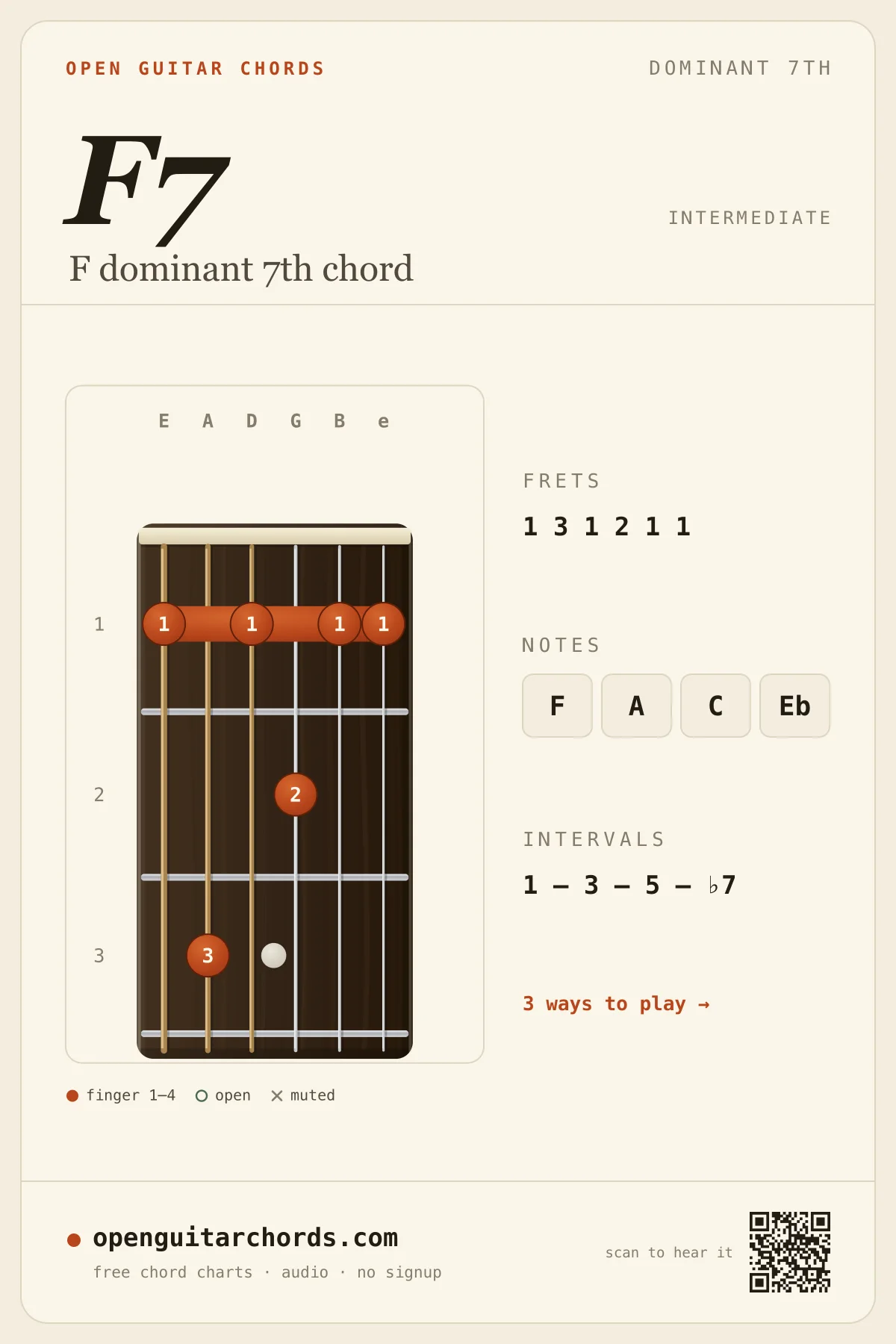
Dominant 7th chord · F root
F7 chord
- F1
- A3
- C5
- Eb♭7
The F dominant 7th chord is built from the notes F, A, C, Eb. It turns up 5 times in the 80 songs on this site, including Autumn Leaves and Hey Jude.
By Chiye · Updated
What is the F7 chord?
The F7 chord (F dominant 7th) is a dominant 7th chord built from four notes: F, A, C, Eb — the 1–3–5–♭7 of the F scale, 4 semitones and 7 semitones and 10 semitones above the root. On guitar it is most often played as a movable shape from fret 1 (1-3-1-2-1-1), so the same fingering works at any fret. It is rated intermediate. A tense, bluesy chord that wants to resolve down a fifth. It is one of the most-used chords in this site's library: across the 80 song sheets charted here, F7 appears 5 times in 2 songs, most often in the keys of Gm and F, and the chord it most often moves to is A#maj7. Below you will find step-by-step fingering, 3 positions up the neck, audio of every shape, and the real progressions this chord lives inside.
How do you play the F7 chord on guitar?
Fret 1 barre — a movable shape, so this same fingering works for every root note.
- Lay your index finger flat across the low E to high E strings at fret 1, rolled slightly onto its bony edge.
- Press the A string at fret 3 with your ring finger.
- Press the G string at fret 2 with your middle finger.
- Strum all six strings and let every one ring.
Drop the lowest fretted note (low E string) and play the rest as a four- or five-string shape. You lose the bass note but keep every note that gives the chord its name, and there is no barre left to fight. x-3-1-2-1-1
How do you make F7 sound clean?
F7 barres at the 1st fret, which is exactly where every player’s barre is weakest.
F → F7 → Bb: one finger moves off the 1st fret.
In real songs
What songs use the F7 chord?
- chord changes
- 5
- songs
- 2
- common keys
- Gm · F
Across the 80 chord sheets on this site, F7 appears 5 times in 2 songs — most often in the keys of Gm and F.
Cm7F7A#maj7D#maj7
Cm7F7A#maj7D#maj7
Cm7F7A#maj7A#maj7
Chord flow
What chord comes after F7?
Every number here is a count from the progressions in our song sheets, not a generalisation: 1560 chord changes are behind these figures.
Three-chord moves
Three-chord moves are where a chord really shows its character. These are the ones that actually happen in this library, counted from the sheets:
What other ways can you play F7 up the neck?
2 more positions below. Learn one of these well and the rest become optional. The value of a second position is practical: it keeps your fretting hand near where the song is already heading.
Position 2 · Fret 3
No open strings, so this is a movable shape: slide it up or down and the same fingering gives you a different chord name.
Position 3 · Fret 8 barre
Every note here is fretted, which means the shape transposes anywhere on the neck without changing your fingers.
The barre is the only hard part of this shape. Keep the bar finger straight and use the weight of your arm rather than the grip of your thumb.
The theory behind F7
F7 is spelled F – A – C – Eb — the 1 – 3 – 5 – ♭7 of the F scale, which is the root plus 4 semitones, 7 semitones, 10 semitones. A tense, bluesy chord that wants to resolve down a fifth.
The flat seventh is a whole tone below the octave, and it is the note that creates the pull toward the chord a fifth below F7. Mute that note by accident and the chord turns into a plain major triad.
What key is the F7 chord in?
F7 is the V7 in the key of Bb — in both Bb major and Bb minor — which is exactly why it resolves to Bb.
the dominant — the flat seventh is what pulls it home
the same dominant job in the minor key
F7 on other instruments
F – A – C – Eb — the highlighted black keys are the sharps or flats; play each note once, then move them into one hand position.
Take it to the practice room