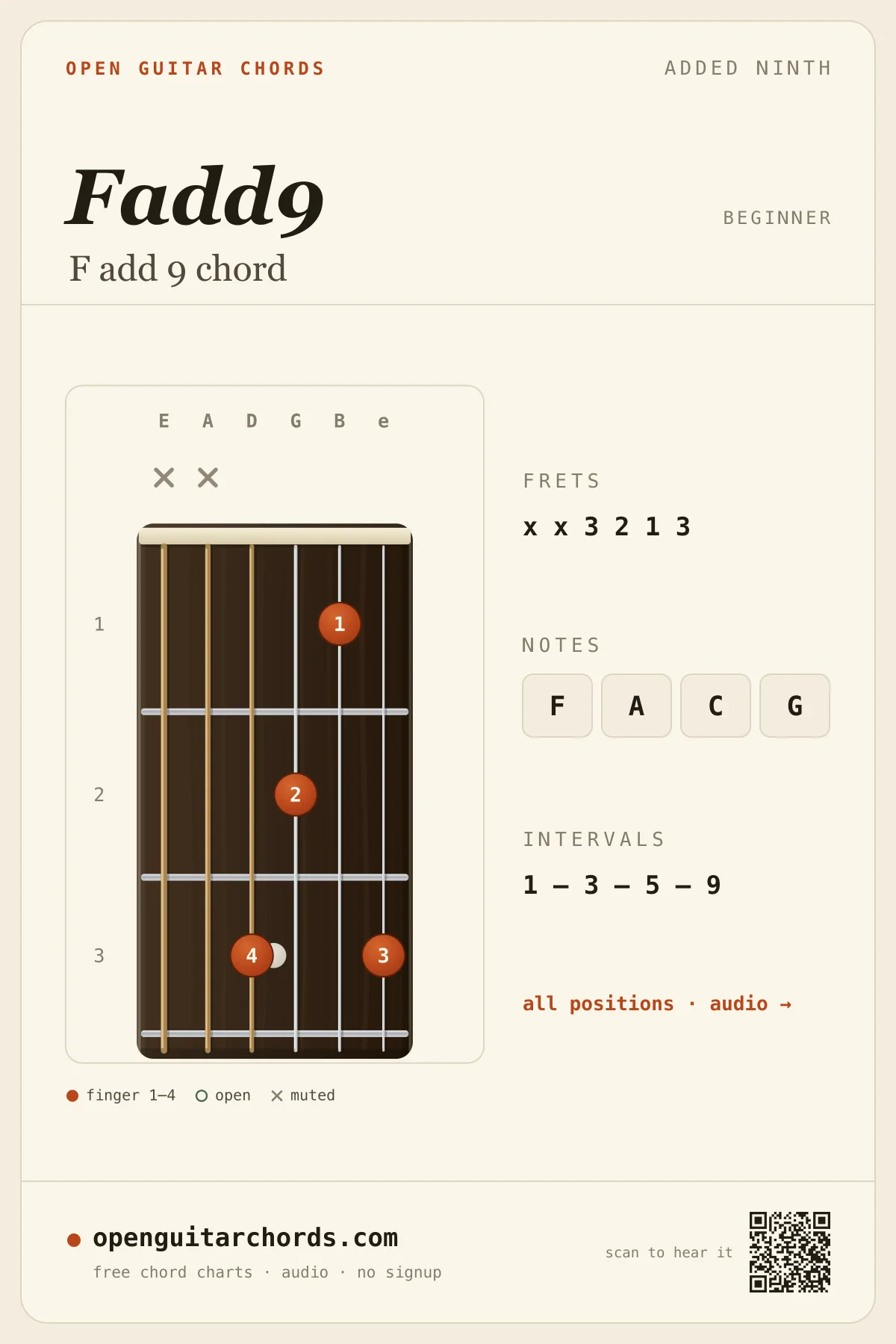
added ninth chord · F root
Fadd9 chord
- F1
- A3
- C5
- G9
More actions
The F add 9 chord is built from the notes F, A, C, G. It turns up 4 times in the 80 songs on this site, including Norwegian Wood (This Bird Has Flown) and You Are My Sunshine.
By Chiye · Updated
What is the Fadd9 chord?
The Fadd9 chord (F add 9) is an added ninth chord built from four notes: F, A, C, G — the 1–3–5–9 of the F scale, 4 semitones and 7 semitones and 14 semitones above the root. On guitar it is most often played as a movable shape from fret 1 (x-x-3-2-1-3), so the same fingering works at any fret. It is rated beginner — most players learn it in their first weeks. A major triad with the second scale degree stacked an octave up, which adds an open, ringing top note without touching the major third underneath. It is one of the most-used chords in this site's library: across the 80 song sheets charted here, Fadd9 appears 4 times in 2 songs, most often in the keys of E and C, and the chord it most often moves to is E. Below you will find step-by-step fingering, audio of every shape, and the real progressions this chord lives inside.
How do you play the Fadd9 chord on guitar?
Open position — the easiest version of Fadd9 on the guitar.
- Press the D string at fret 3 with your pinky finger.
- Press the G string at fret 2 with your middle finger.
- Press the B string at fret 1 with your index finger.
- Press the high E string at fret 3 with your ring finger.
- Start your strum on the D string and leave the low E and A strings out.
How do you make Fadd9 sound clean?
Fadd9 tempts players into a full barre when the four-string version sounds better and is easier.
F → Fadd9 → C: keep the top two strings ringing through both chords.
In real songs
What songs use the Fadd9 chord?
- chord changes
- 4
- songs
- 2
- common keys
- E · C
Across the 80 chord sheets on this site, Fadd9 appears 4 times in 2 songs — most often in the keys of E and C.
EEadd9Fadd9E
EEadd9Fadd9E
CFadd9CG7
Chord flow
What chord comes after Fadd9?
The counts come from our own song library — 1560 chord changes in total — which makes them a snapshot of real songs instead of a rule of thumb.
Three-chord moves
Three-chord moves are where a chord really shows its character. These are the ones that actually happen in this library, counted from the sheets:
The theory behind Fadd9
Fadd9 is spelled F – A – C – G — the 1 – 3 – 5 – 9 of the F scale, which is the root plus 4 semitones, 7 semitones, 14 semitones. A major triad with the second scale degree stacked an octave up, which adds an open, ringing top note without touching the major third underneath.
The ninth is the second scale degree an octave up, so Fadd9 keeps its major quality and gains an open, ringing top note. It is the difference between a plain strummed chord and the shimmer you hear on acoustic records.
What key is the Fadd9 chord in?
Fadd9 is the F major triad with the ninth added on top, so it fills the same three slots as the plain triad: the I chord in F major, the IV in C major and the V in Bb major.
the home chord — songs resolve here
the subdominant — the chord that leaves home
the dominant — the chord that pulls back home
Fadd9 on other instruments
F – A – C – G — all white keys, so you can find the shape by counting up from C.
Take it to the practice room