The Beatles
Norwegian Wood (This Bird Has Flown) chords
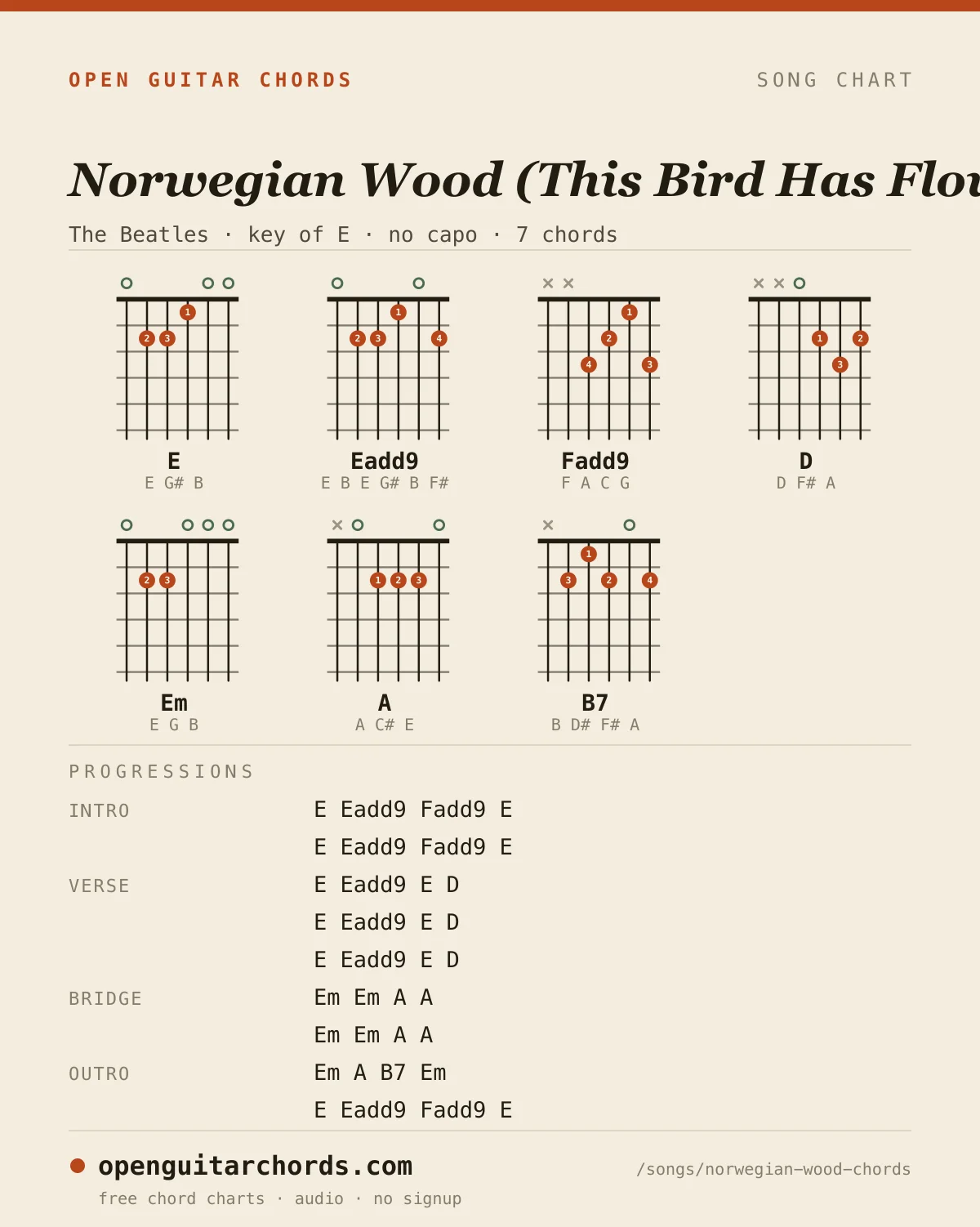
Norwegian Wood (This Bird Has Flown) by The Beatles is an intermediate song in E, played with no capo. The whole sheet is 7 chords (E, Eadd9, Fadd9, D, Em, A, B7) across 4 sections: Intro → Verse → Bridge → Outro. Every shape is an open chord, so nothing here needs barre strength. It sits at roughly 176 BPM.
By Chiye · Updated
Hardest change in the sheet: E → Eadd9, 6 times.
- Difficulty
- Intermediateno barre needed
- Key
- Ewith no capo
- Tempo
- 176BPM
- Tuning
- Standard (E A D G B E)low to high
- Chords
- 7all open shapes
- Sections
- 4each with its own progression
Chords in Norwegian Wood (This Bird Has Flown)
Frets read low E to high E, x means leave that string out.
Chord sheet
One chord per bar in this practice sheet. Follow the time signature shown beside each section; dots mark the remaining counts in the bar. Tap a bar to hear its chord, or loop the section to practise the changes.
Chord accompaniment only. Follow the section notes for this arrangement’s timing. Songs whose words are public domain →
Intro4/4 · ♩=176
Verse4/4 · ♩=176
Bridge4/4 · ♩=176
Outro4/4 · ♩=176
Printable one-page chord chart
How to play Norwegian Wood (This Bird Has Flown)
The chart above is a chord-based practice arrangement in E. Its intro uses E, Eadd9, Fadd9 and E, while the verse ends its rows on D. Work from these section grids rather than treating the page as a transcription of the sitar or guitar melody.
Eadd9 here is 0-2-2-1-0-2: add F# on the high E string at fret 2 while keeping G# on the G string. Adding a finger to the B string at fret 2 produces C#, a sixth, not the ninth. Fadd9 uses a different grip, x-x-3-2-1-3; it is not the open Eadd9 shape slid one fret with its open strings left unchanged.
The bridge changes to Em and A. Both are open-position chords, but several strings change. Practise those two grips slowly, then add the B7 in the outro. B7 is an open-position shape x-2-1-2-0-2, with the high E string fretted at 2.
Start with one quiet strum per cell. Once the changes are clear, use a gentle broken-chord accompaniment and keep the section pulse steady.
How to practise Norwegian Wood (This Bird Has Flown)
Four steps computed from this sheet: the order the shapes are easiest to learn in, the changes that really occur in the progressions above, where each chord turns up, and the tempo ladder up to the speed marked here.
Learn the shapes easiest first
E (0-2-2-1-0-0, beginner) → Eadd9 (0-2-2-1-0-2, beginner) → Fadd9 (x-x-3-2-1-3, beginner) → D (x-x-0-2-3-2, beginner) → Em (0-2-2-0-0-0, beginner) → A (x-0-2-2-2-0, beginner) → B7 (x-2-1-2-0-2, beginner)
7 of the 7 shapes are open chords, so nothing here needs barre strength yet.
Drill the changes this sheet actually uses
E → Eadd96×E → D3×Eadd9 → E3×Eadd9 → Fadd93×
These counts come from the progressions on this page, so they are the changes you will actually play, not a generic list of pairs to practise.
Know where each chord turns up
- EIntro, Verse, Outro
- Eadd9Intro, Verse, Outro
- Fadd9Intro, Outro
- DVerse
- EmBridge, Outro
- ABridge, Outro
- B7Outro
Climb the tempo ladder
Start at 106 BPM and move up only when a full pass is clean: 106 → 132 → 158 → 176 BPM. The tempo marked on this sheet is 176 BPM, and the last step is the one that always feels like a jump. Stay at 158 for longer than feels necessary.
Practise each section's chord changes slowly, then play the sheet through at a steady tempo without pausing between sections.
Playing Norwegian Wood (This Bird Has Flown) with a capo
This sheet needs no capo. At every other capo position, at least one of these chords would need a fingering our chord library does not carry, so a full chart would be incomplete. We would rather show nothing than a row with a gap in it. Play it as written, or use the transpose buttons in the toolbar above to move the song into a key whose shapes you already know.
Working out a different key? The capo calculatordoes the same arithmetic for any chord set.
More songs built on the same chords
If Norwegian Wood (This Bird Has Flown) clicks, these use the closest set of shapes, so the chords you just learned keep working.
More intermediate songs to learn after this one: Father and Son, 500 Miles, Shallow, The One That Got Away.
These chords across the songbookHow often each chord in Norwegian Wood (This Bird Has Flown) turns up across all 104 songs on this site, and what it most often moves to next. The counts come from the sheet library itself, not from theory.
69bars of this chord across the songbook
11songs use this shape
Most often followed by Eadd9, 6×.
6bars of this chord across the songbook
1songs use this shape
Most often followed by E, 3×.
4bars of this chord across the songbook
2songs use this shape
Most often followed by E, 3×.
323bars of this chord across the songbook
58songs use this shape
Most often followed by G, 52×.
155bars of this chord across the songbook
43songs use this shape
Most often followed by C, 27×.
134bars of this chord across the songbook
24songs use this shape
Most often followed by D, 19×.
10bars of this chord across the songbook
5songs use this shape
Most often followed by E, 3×.