Cat Stevens
Father and Son chords
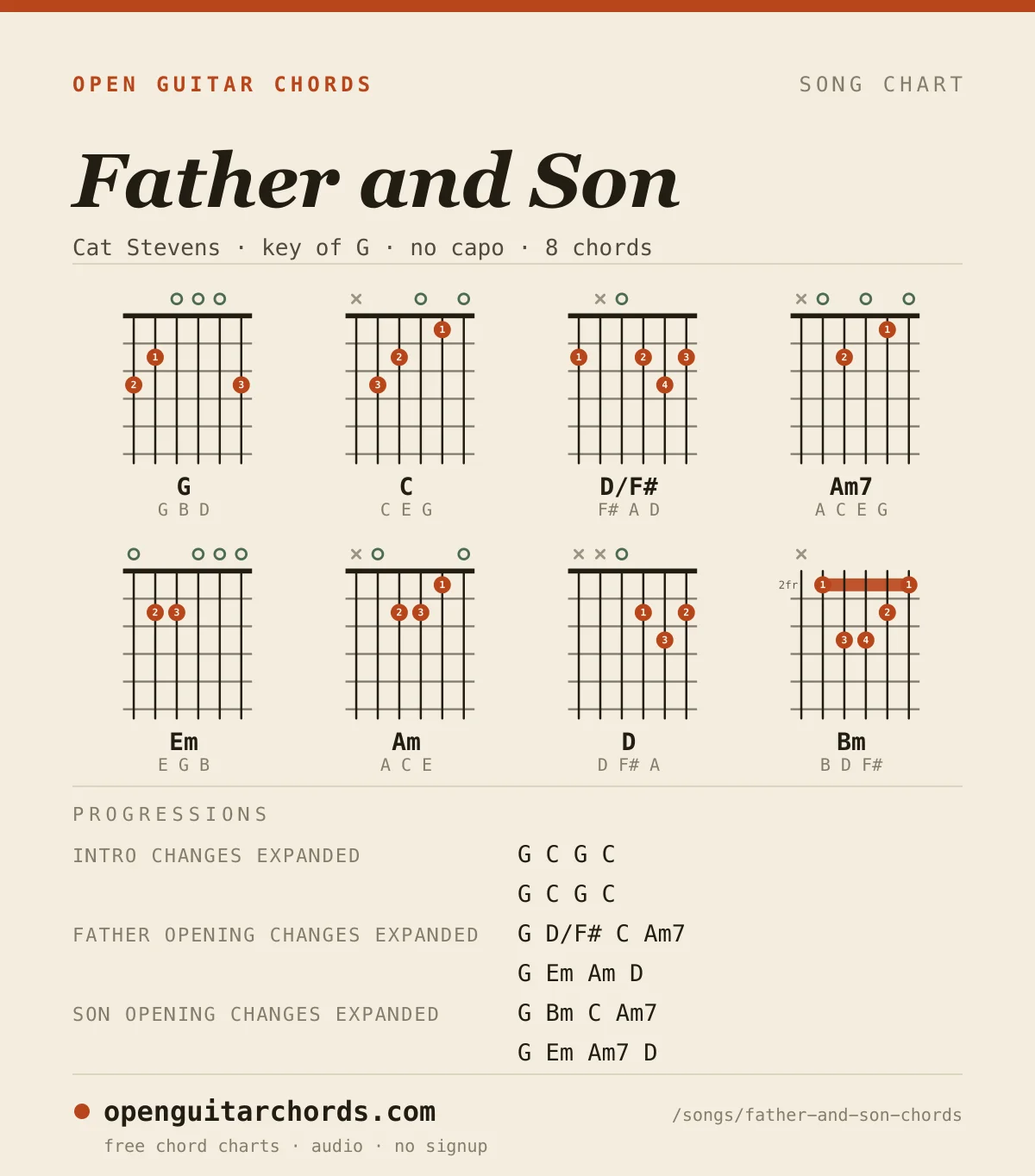
Father and Son by Cat Stevens is an intermediate song in G, played with no capo. The whole sheet is 8 chords (G, C, D/F#, Am7, Em, Am, D, Bm) across 3 sections: Intro changes expanded → Father opening changes expanded → Son opening changes expanded. 7 of the 8 shapes are open chords. Shapes that use a barre: Bm. It sits at roughly 72 BPM.
Simplified practice arrangement. Section repetitions are practice cues rather than a verified transcription of the recording.
By Chiye · Updated
Hardest change in the sheet: Bm → C, once.
- Difficulty
- Intermediatebarre shape Bm
- Key
- Gwith no capo
- Tempo
- 72BPM
- Tuning
- Standard (E A D G B E)low to high
- Chords
- 87 open, 1 with a barre
- Sections
- 3each with its own progression
Chords in Father and Son
Frets read low E to high E, x means leave that string out.
Chord sheet
One chord per bar in this practice sheet. Follow the time signature shown beside each section; dots mark the remaining counts in the bar. Tap a bar to hear its chord, or loop the section to practise the changes.
Chord accompaniment only. Follow the section notes for this arrangement’s timing. Songs whose words are public domain →
Intro changes expanded4/4 · ♩=72
Father opening changes expanded4/4 · ♩=72
Son opening changes expanded4/4 · ♩=72
Printable one-page chord chart
How to play Father and Son
Father and Son by Cat Stevens uses G-major shapes without a capo in this guitar study. Work through G, C, D/F#, Am7, Em, Am, D and Bm in standard tuning. Each displayed change receives four practice beats at 72 BPM. The three exercises cover the intro and the first two phrases of the father and son sections, giving you a manageable comparison of their harmony.
Choose the 1970 song and a bounded exercise
The official Yusuf / Cat Stevens album page places the song on the 1970 album Tea for the Tillerman. This page follows that song, rather than treating a later live date or the 2020 re-recording as its original release. Cat Stevens is credited here as both writer and performer.
Lauren Bateman’s own teaching chart supplies the changes selected for these exercises. Its intro alternates G and C. The father opening moves through G–D/F#–C–Am7, then G–Em–Am–D; the son opening begins G–Bm–C–Am7 and continues G–Em–Am7–D. Learn those short passages separately before joining them to a singer’s phrasing.
Keep the descending bass in G to D/F#
G to D/F# lets the bass move from G down one semitone to F#. The slash names the bass note, not a second chord to play after D. In the displayed grip, listen for F# as the lowest sounding note and keep any muted string silent. Check the bass alone, then add a light brush across the remaining sounding strings.
Plain D still gives D, F# and A, but its open fourth-string bass removes this particular G–F# step. It can be a temporary change exercise when you cannot reach D/F#, provided you hear what changed. Keep the original symbol visible in your reference and return to the intended bass when the hand can land without squeezing.
Hear why the son’s Bm changes the opening
Compare the second box of each opening exercise. D/F# contains D, F# and A, whereas Bm contains B, D and F#. Two notes are shared, but B replaces A and the bass changes. That difference is worth hearing slowly; the son’s section is not simply the father’s line sung louder over identical harmony.
Bm uses the full barre shown in the chord rack. Test the second string and the top string separately, then release unnecessary pressure between attempts. Am7 and Am also need separate attention: x02010 leaves the third string open as G, while x02210 produces A on that string. Both begin on the fifth string. Do not sweep the sixth string into either shape.
Separate four-beat practice from the song’s changing bars
Count one, two, three, four for every box and use one downstroke on each number. The eight-cell grid represents eight eighth notes; its blank cells are spaces between attacks. Row breaks add no pause. The intro here contains eight expanded changes, while each character exercise contains another eight.
The source sometimes puts two or more changes inside one bar and marks later passages in 5/4 and 3/4. Those passages are outside these opening studies. Our uniform four-beat boxes deliberately lengthen the changes, so they cannot be used as a recording-synchronised timeline. After the grips settle, return to the complete teaching chart to learn its phrasing and meter changes. The signature intro notes and solo are not transcribed on this page.
How to practise Father and Son
Four steps computed from this sheet: the order the shapes are easiest to learn in, the changes that really occur in the progressions above, where each chord turns up, and the tempo ladder up to the speed marked here.
Learn the shapes easiest first
G (3-2-0-0-0-3, beginner) → C (x-3-2-0-1-0, beginner) → D/F# (2-x-0-2-3-2, beginner) → Am7 (x-0-2-0-1-0, beginner) → Em (0-2-2-0-0-0, beginner) → Am (x-0-2-2-1-0, beginner) → D (x-x-0-2-3-2, beginner) → Bm (x-2-4-4-3-2, intermediate, needs a barre)
7 of the 8 shapes are open chords, so start there and leave Bm until the others change cleanly.
Drill the changes this sheet actually uses
G → C4×C → Am72×C → G2×G → Em2×
These counts come from the progressions on this page, so they are the changes you will actually play, not a generic list of pairs to practise.
Know where each chord turns up
- Gevery section
- Cevery section
- D/F#Father opening changes expanded
- Am7Father opening changes expanded, Son opening changes expanded
- EmFather opening changes expanded, Son opening changes expanded
- AmFather opening changes expanded
- DFather opening changes expanded, Son opening changes expanded
- BmSon opening changes expanded
Climb the tempo ladder
Start at 43 BPM and move up only when a full pass is clean: 43 → 54 → 65 → 72 BPM. The tempo marked on this sheet is 72 BPM, and the last step is the one that always feels like a jump. Stay at 65 for longer than feels necessary.
The section to leave until last is Son opening changes expanded (8 bars in this sheet).
Playing Father and Son with a capo
This sheet needs no capo. Each card shows what you would finger at that capo position so the song still sounds exactly as written. Useful when the shapes above are awkward, or when you want to sing it higher without learning new chords.
No capoas written
G C D/F# Am7 Em Am D Bm
7 of 8 stay open
Fret 1
F# B C#* Abm7 Ebm Abm C# Bbm
no open shapes left, all barre
Fret 2
F Bb C/E Gm7 Dm Gm C Am
4 of 8 stay open
Fret 3
E A B* F#m7 C#m F#m B Abm
2 of 8 stay open
Fret 4
Eb Ab Bb* Fm7 Cm Fm Bb Gm
no open shapes left, all barre
Fret 5
D G A* Em7 Bm Em A F#m
6 of 8 stay open
Fret 6
C# F# Ab* Ebm7 Bbm Ebm Ab Fm
no open shapes left, all barre
Fret 7
C F G/B Dm7 Am Dm G Em
6 of 8 stay open
* this position has no separate fingering for a bass-note inversion in our chord library, so the parent chord is shown. Play that shape and the inversion note is an optional bass addition.
Working out a different key? The capo calculatordoes the same arithmetic for any chord set.
More songs built on the same chords
If Father and Son clicks, these use the closest set of shapes, so the chords you just learned keep working.
More intermediate songs to learn after this one: 500 Miles, The One That Got Away, Treat You Better, Landslide.
These chords across the songbookHow often each chord in Father and Son turns up across all 104 songs on this site, and what it most often moves to next. The counts come from the sheet library itself, not from theory.
509bars of this chord across the songbook
77songs use this shape
Most often followed by D, 89×.
420bars of this chord across the songbook
70songs use this shape
Most often followed by G, 115×.
3bars of this chord across the songbook
3songs use this shape
Most often followed by C, 1×.
23bars of this chord across the songbook
6songs use this shape
Most often followed by Dm7, 4×.
155bars of this chord across the songbook
43songs use this shape
Most often followed by C, 27×.
125bars of this chord across the songbook
35songs use this shape
Most often followed by F, 23×.
323bars of this chord across the songbook
58songs use this shape
Most often followed by G, 52×.
84bars of this chord across the songbook
17songs use this shape
Most often followed by A, 13×.