One Direction
Night Changes chords
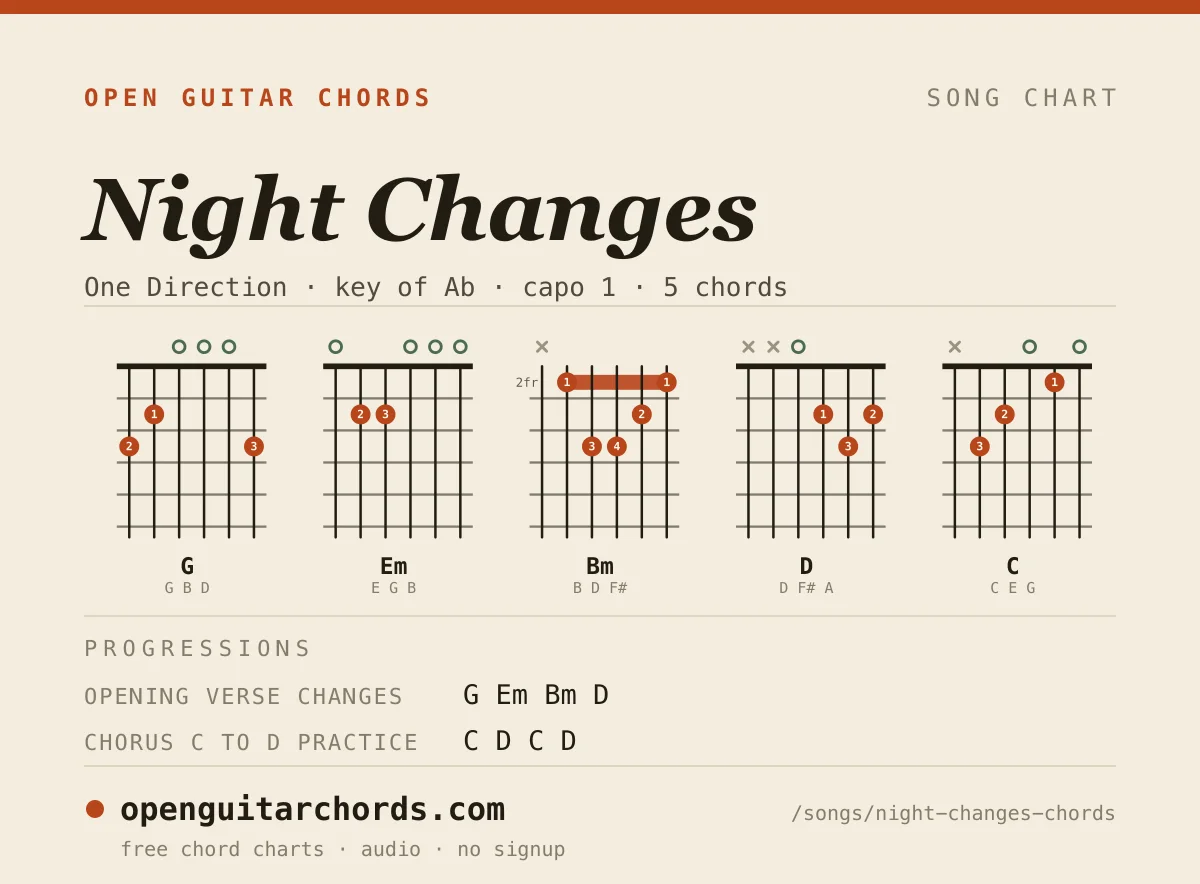
Night Changes by One Direction is an intermediate song in Ab, played with a capo on fret 1. The whole sheet is 5 chords (G, Em, Bm, D, C) across 2 sections: Opening verse changes → Chorus C to D practice. 4 of the 5 shapes are open chords. Shapes that use a barre: Bm. It sits at roughly 124 BPM.
Simplified practice arrangement. Section repetitions are practice cues rather than a verified transcription of the recording.
By Chiye · Updated
Hardest change in the sheet: Bm → D, once.
- Difficulty
- Intermediatebarre shape Bm
- Key
- Abwith a capo on fret 1
- Tempo
- 124BPM
- Tuning
- Standard (E A D G B E)low to high
- Chords
- 54 open, 1 with a barre
- Sections
- 2each with its own progression
Chords in Night Changes
Frets read low E to high E, x means leave that string out.
Chord sheet
One chord per bar in this practice sheet. Follow the time signature shown beside each section; dots mark the remaining counts in the bar. Tap a bar to hear its chord, or loop the section to practise the changes.
Chord accompaniment only. Follow the section notes for this arrangement’s timing. Songs whose words are public domain →
Opening verse changes4/4 · ♩=80
Chorus C to D practice4/4 · ♩=80
Printable one-page chord chart
How to play Night Changes
Play Night Changes by One Direction with capo 1, in standard tuning. Start with G, Em, Bm and D shapes for the opening verse changes, then isolate the chorus’s C-to-D movement. These exercises sound in Ab major and use four-beat boxes at 80 BPM. The later key change needs a separate raised version of the shapes; a loop will not make that change automatically.
Match the opening Ab-major version
The Musicnotes piano/vocal/guitar edition lists One Direction, 2014, Ab major, 4/4 and 124 BPM. Here the capo raises G to Ab, Em to Fm, Bm to Cm, D to Eb and C to Db. Check the capo position before comparing those sounding names with the shape names printed above.
Easy 2 Play Music’s own tutorial specifies capo 1 and the five-shape set G, Em, Bm, D and C. Our exercises slow the pulse to 80 BPM and use simple quarter-note downstrokes. That provides room to check the fretting hand before attempting the tutorial’s busier strumming. Read fret numbers relative to the capo, so a second-fret shape note lies at physical fret 3.
Give Bm time without losing the count
The opening drill is G–Em–Bm–D. The printed Bm is x-2-4-4-3-2, with a second-fret barre across the five playing strings. Start its strum on string 5 and keep the low E silent. The middle finger supplies the B-string third fret while the other fretted notes complete the minor grip. Test the first and fifth strings separately to check that both ends of the barre ring.
Each box here lasts four beats, even if you need more preparation for Bm. Lower the exercise speed instead of extending the preceding Em bar. In the printed Em, B and the top E are open; both become fretted notes in Bm. Lift and reshape the hand deliberately rather than trying to retain an open-string anchor that the next grip does not use.
Practise the chorus movement before adding its whole phrase
The second drill alternates C and D twice. This isolates a movement used in the chorus; it is not the entire chorus progression. Start C on string 5 and D on string 4. In shape pitch the low roots are C and D, sounding as Db and Eb with the capo. Listen for that step upward before adding a more continuous right-hand pattern.
In the printed grips, C uses x-3-2-0-1-0 and D uses x-x-0-2-3-2. There is no shared fretted position to leave anchored between them. Move the fingers as a group, keep the open D string clear and avoid catching both low strings on D. Count through all four beats of each expanded box; the recording’s vocal phrases and chord holds need their own performance timing.
Rehearse the later whole-tone lift separately
GuitarZero2Hero’s lesson explicitly covers the song’s key change. BMartinSounds’ own lesson description shows the later verse as A–F#m–C#m–E with capo 1. The whole progression rises two semitones, taking the sounding opening Ab to Bb. Do not interpret that lift as moving the capo while leaving every other instruction unchanged.
Set the transpose control to +2 to rehearse the raised verse drill: G becomes A, Em becomes F#m, Bm becomes C#m and D becomes E. The C-to-D drill becomes D-to-E. Keep capo 1 fitted and check the newly drawn barre grips before starting the loop. Reset returns to the opening key. These are separate section studies, with no automatic mid-song modulation, full chorus reconstruction or claim of complete recorded bar counts.
How to practise Night Changes
Four steps computed from this sheet: the order the shapes are easiest to learn in, the changes that really occur in the progressions above, where each chord turns up, and the tempo ladder up to the speed marked here.
Learn the shapes easiest first
G (3-2-0-0-0-3, beginner) → Em (0-2-2-0-0-0, beginner) → D (x-x-0-2-3-2, beginner) → C (x-3-2-0-1-0, beginner) → Bm (x-2-4-4-3-2, intermediate, needs a barre)
4 of the 5 shapes are open chords, so start there and leave Bm until the others change cleanly.
Drill the changes this sheet actually uses
C → D2×Bm → D1×D → C1×Em → Bm1×
These counts come from the progressions on this page, so they are the changes you will actually play, not a generic list of pairs to practise.
Know where each chord turns up
- GOpening verse changes
- EmOpening verse changes
- BmOpening verse changes
- Devery section
- CChorus C to D practice
Climb the tempo ladder
Start at 74 BPM and move up only when a full pass is clean: 74 → 93 → 112 → 124 BPM. The tempo marked on this sheet is 124 BPM, and the last step is the one that always feels like a jump. Stay at 112 for longer than feels necessary.
The section to leave until last is Opening verse changes (4 bars in this sheet).
Playing Night Changes with a capo
This sheet is written with a capo on fret 1. Each card shows what you would finger at that capo position so the song still sounds exactly as written. Useful when the shapes above are awkward, or when you want to sing it higher without learning new chords.
No capo
Ab Fm Cm Eb C#
no open shapes left, all barre
Fret 1as written
G Em Bm D C
4 of 5 stay open
Fret 2
F# Ebm Bbm C# B
no open shapes left, all barre
Fret 3
F Dm Am C Bb
3 of 5 stay open
Fret 4
E C#m Abm B A
2 of 5 stay open
Fret 5
Eb Cm Gm Bb Ab
no open shapes left, all barre
Fret 6
D Bm F#m A G
3 of 5 stay open
Fret 7
C# Bbm Fm Ab F#
no open shapes left, all barre
Working out a different key? The capo calculatordoes the same arithmetic for any chord set.
More songs built on the same chords
If Night Changes clicks, these use the closest set of shapes, so the chords you just learned keep working.
More intermediate songs to learn after this one: 500 Miles, The One That Got Away, Treat You Better, Landslide.
These chords across the songbookHow often each chord in Night Changes turns up across all 104 songs on this site, and what it most often moves to next. The counts come from the sheet library itself, not from theory.
509bars of this chord across the songbook
77songs use this shape
Most often followed by D, 89×.
155bars of this chord across the songbook
43songs use this shape
Most often followed by C, 27×.
84bars of this chord across the songbook
17songs use this shape
Most often followed by A, 13×.
323bars of this chord across the songbook
58songs use this shape
Most often followed by G, 52×.
420bars of this chord across the songbook
70songs use this shape
Most often followed by G, 115×.