The Band
The Weight chords
The Weight by The Band is an intermediate song in A, played with a capo on fret 2. The whole sheet is 6 chords (G, Bm, C, D, Em, E/G#) across 4 sections: Intro → Verse ×2 → Chorus → Instrumental tag. 5 of the 6 shapes are open chords and Bm is the one that needs a barre. It sits at roughly 72 BPM.
By Chiye · Updated
Hardest change in the sheet: Bm → C, 4 times.
- Difficulty
- Intermediatebarre shape Bm
- Key
- Awith a capo on fret 2
- Tempo
- 72BPM
- Tuning
- Standard (E A D G B E)low to high
- Chords
- 65 open, 1 with a barre
- Sections
- 4each with its own progression
Chords in The Weight
Frets read low E to high E, x means leave that string out.
Chord sheet
One chord per bar, four beats to the bar: the shape lands on beat one and the dots mark the beats after it, so you can see where the change falls without any lyrics. Where a section has no strumming pattern written, play one chord per bar. Tap a bar to hear it.
Lyrics are not reproduced for this song: they are still in copyright and this site has no licence to publish them. The chords, structure, strumming and sing-along timing are all here. Songs whose words are public domain →
Intro♩=72
Verse× 2 · ♩=72
Chorus♩=72
Instrumental tag♩=72
Printable one-page chord chart
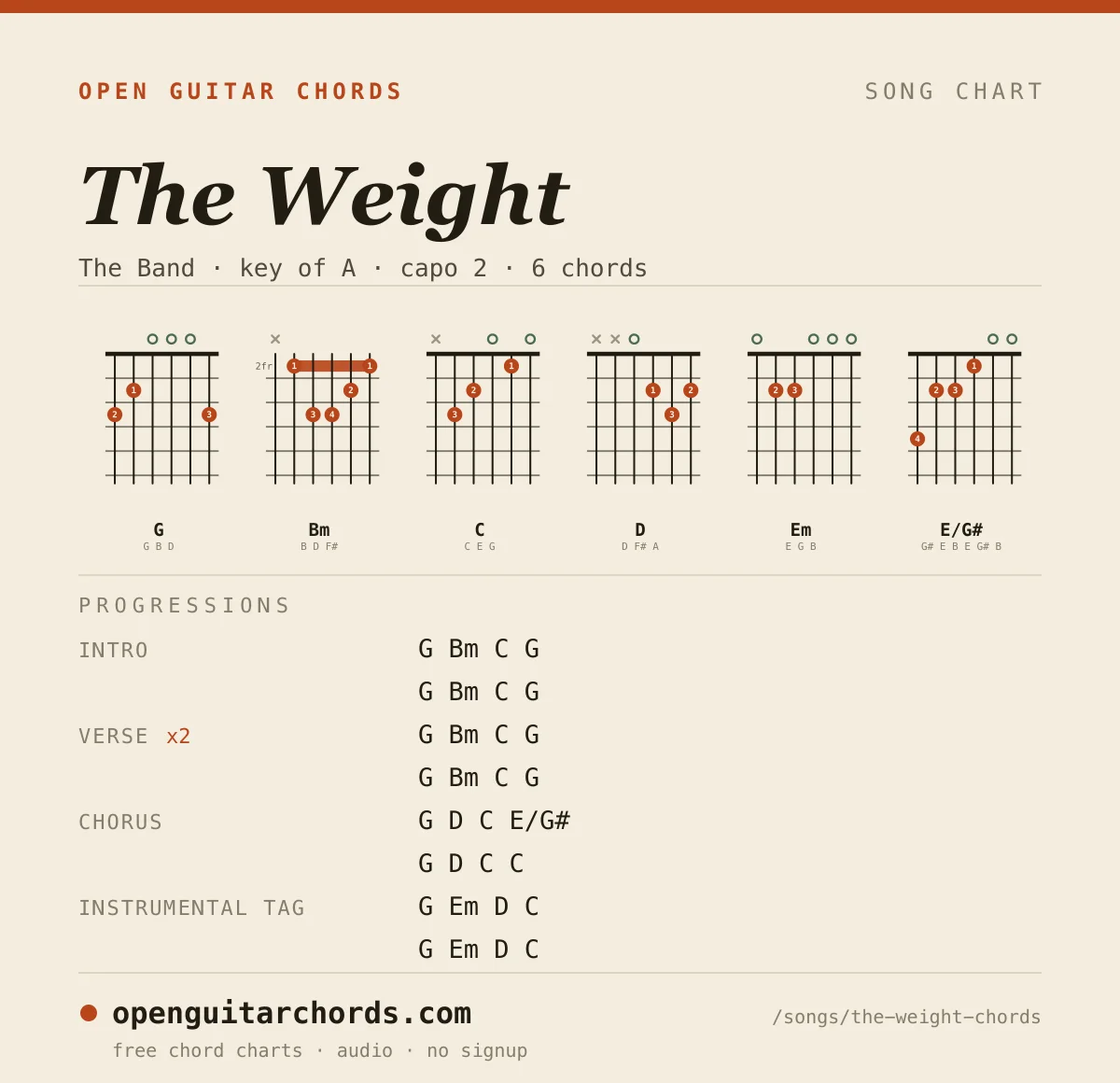
How to play The Weight
Capo on fret 2 puts this in A, and the shapes you need are G, Bm, C, D and Em — five chords, none of them exotic. The important thing is the rhythm of the changes, not the chords themselves: this song moves in two-beat chunks, so each loop of G – Bm – C – G takes two bars, not four. If you give every chord a full bar the verse drags badly and the vocal has nowhere to sit. Count in two, treat every chord as a half bar, and the song instantly sounds like the record.
Bm is the one shape that will slow you down, so build it once and leave it alone: barre at fret 2 with the index finger, ring and little fingers on the D and G strings at fret 4. Coming out of G, you only have to lift two fingers and drop the barre down. Coming out of Bm into C, keep the ring finger on the D string at fret 4 for a moment and slide it back to fret 2 — that small slide keeps the bass line moving instead of jumping.
Practise at 60 BPM with a metronome clicking in two, and loop the verse eight times without stopping, because the whole difficulty of this song is stamina and consistency rather than any single change. Then work the chorus, which is slower harmonically: G – D – C – G, with the C held for two bars at the end. Finish each practice session with the instrumental tag, G – Em – D – C, played as an even descending four, since that is the phrase everyone recognises.
How to practise The Weight
Four steps computed from this sheet: the order the shapes are easiest to learn in, the changes that really occur in the progressions above, where each chord turns up, and the tempo ladder up to the recorded speed.
Learn the shapes easiest first
G (3-2-0-0-0-3, beginner) → C (x-3-2-0-1-0, beginner) → D (x-x-0-2-3-2, beginner) → Em (0-2-2-0-0-0, beginner) → E/G# (4-2-2-1-0-0, beginner) → Bm (x-2-4-4-3-2, intermediate, needs a barre)
5 of the 6 shapes are open chords, so start there and leave Bm until the others change cleanly.
Drill the changes this sheet actually uses
Bm → C4×C → G4×D → C4×G → Bm4×
These counts come from the progressions on this page, so they are the changes you will actually play, not a generic list of pairs to practise.
Know where each chord turns up
- Gevery section
- BmIntro, Verse
- Cevery section
- DChorus, Instrumental tag
- EmInstrumental tag
- E/G#Chorus
Climb the tempo ladder
Start at 43 BPM and move up only when a full pass is clean: 43 → 54 → 65 → 72 BPM. The recorded feel is around 72 BPM, and the last step is the one that always feels like a jump. Stay at 65 for longer than feels necessary.
Every section here uses the same set of shapes, so there is no section to single out. Whatever you can play once, you can play all the way through.
Playing The Weight with a capo
This sheet is written with a capo on fret 2. Each card shows what you would finger at that capo position so the song still sounds exactly as written. Useful when the shapes above are awkward, or when you want to sing it higher without learning new chords.
No capo
A C#m D E F#m F#*
3 of 6 stay open
Fret 1
Ab Cm C# Eb Fm F/A
1 of 6 stay open
Fret 2as written
G Bm C D Em E/G#
5 of 6 stay open
Fret 3
F# Bbm B C# Ebm Eb*
no open shapes left, all barre
Fret 4
F Am Bb C Dm D*
4 of 6 stay open
Fret 5
E Abm A B C#m C#*
2 of 6 stay open
Fret 6
Eb Gm Ab Bb Cm C/E
1 of 6 stay open
Fret 7
D F#m G A Bm B*
3 of 6 stay open
* this position has no separate fingering for a bass-note inversion in our chord library, so the parent chord is shown. Play that shape and the inversion note is an optional bass addition.
Working out a different key? The capo calculatordoes the same arithmetic for any chord set.
More songs built on the same chords
If The Weight clicks, these use the closest set of shapes, so the chords you just learned keep working.
More intermediate songs to learn after this one: Hotel California, Hey Jude, Wish You Were Here, Blackbird.
These chords across the songbookHow often each chord in The Weight turns up across all 80 songs on this site, and what it most often moves to next. The counts come from the sheet library itself, not from theory.
418bars of this chord across the songbook
59songs use this shape
Most often followed by C, 80×.
53bars of this chord across the songbook
11songs use this shape
Most often followed by A, 12×.
363bars of this chord across the songbook
54songs use this shape
Most often followed by G, 115×.
248bars of this chord across the songbook
44songs use this shape
Most often followed by G, 40×.
113bars of this chord across the songbook
30songs use this shape
Most often followed by C, 27×.
1bars of this chord across the songbook
1songs use this shape
Nothing else follows it in our sheet library.