Ben E. King
Stand By Me chords
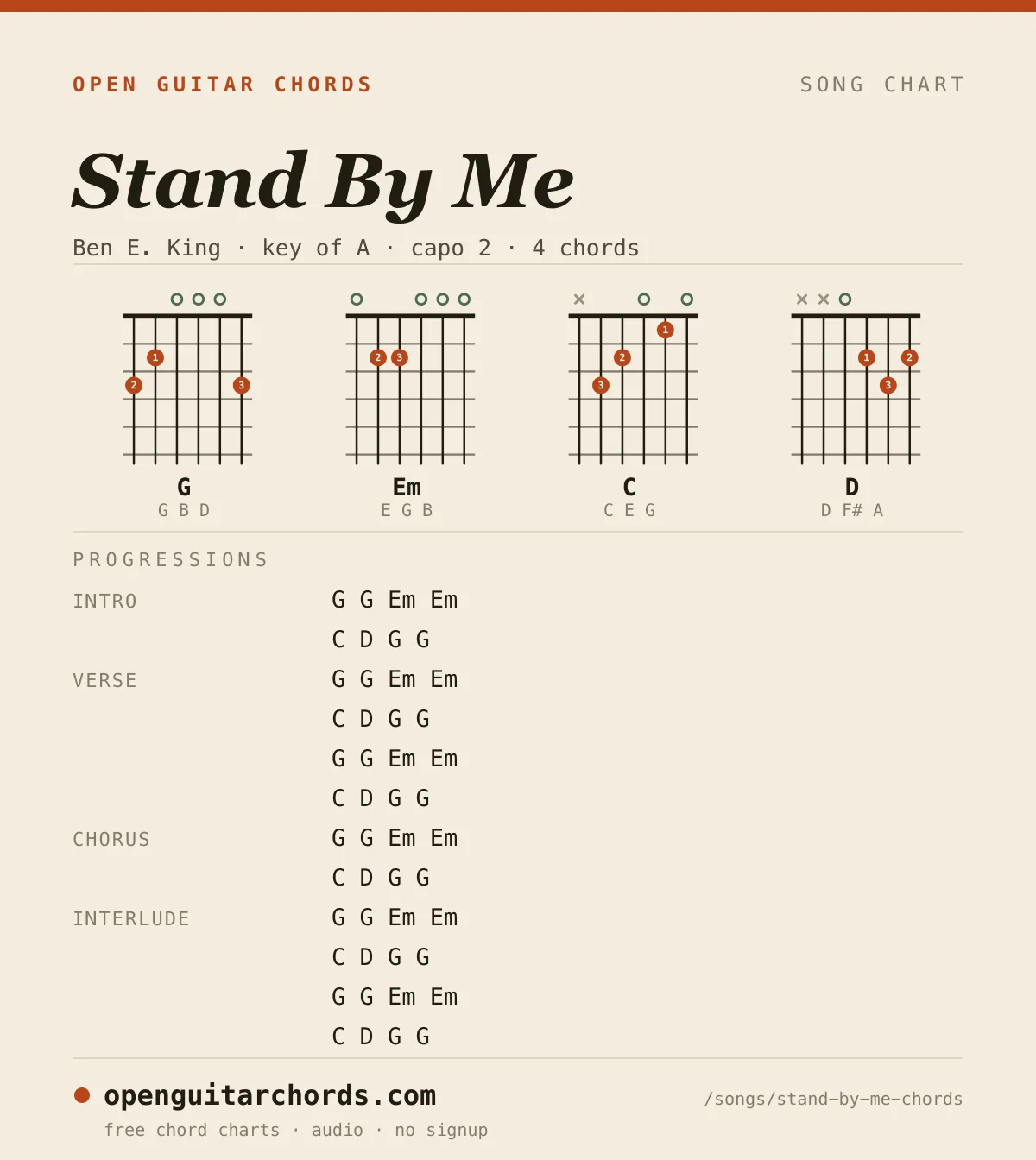
Stand By Me by Ben E. King is a beginner song in A, played with a capo on fret 2. The whole sheet is 4 chords (G, Em, C, D) across 4 sections: Intro → Verse → Chorus → Interlude. Every shape is an open chord, so nothing here needs barre strength. It sits at roughly 80 BPM.
Simplified practice arrangement. Section repetitions are practice cues rather than a verified transcription of the recording.
By Chiye · Updated
Hardest change in the sheet: C → D, 6 times.
- Difficulty
- Beginnerno barre needed
- Key
- Awith a capo on fret 2
- Tempo
- 80BPM
- Tuning
- Standard (E A D G B E)low to high
- Chords
- 4all open shapes
- Sections
- 46 steps in the song form
Chords in Stand By Me
Frets read low E to high E, x means leave that string out.
Chord sheet
One chord per bar in this practice sheet. Follow the time signature shown beside each section; dots mark the remaining counts in the bar. Tap a bar to hear its chord, or loop the section to practise the changes.
Chord accompaniment only. Follow the section notes for this arrangement’s timing. Songs whose words are public domain →
Intro4/4 · ♩=80
Verse4/4 · ♩=80
Chorus4/4 · ♩=80
Interlude4/4 · ♩=80
Printable one-page chord chart
How to play Stand By Me
Play Stand By Me by Ben E. King with G, Em, C and D shapes and capo 2. The sounding key is A major. The main cycle lasts eight bars, and the repeated chord boxes matter: two bars of G, two of Em, one of C, one of D, then two of G. Use the 80 BPM grid to keep those lengths consistent before adding more rhythm.
Count the complete eight-bar cycle
JustinGuitar’s lesson describes the same two–two–one–one–two pattern. Count four beats in every box. When G appears twice, stay on G for eight beats rather than treating the second label as a new harmonic event. The shorter C and D bars are where a player can accidentally stretch the cycle.
Try speaking the chord names only on the first beat of each new harmony while continuing to count all four beats. Keep the final two G bars separate from the first two G bars when you loop back. They make four consecutive G bars across that boundary, but belong to different passes of the cycle. A steady count prevents the return from arriving a bar early.
Keep the finger shapes and sounding key separate
Lauren Bateman’s G-shape chart places the capo at fret 2. That raises every open-shape pitch by two semitones: G becomes A, Em becomes F#m, C becomes D and D becomes E. You can play the recorded-key harmony without learning an F#m barre shape for this arrangement.
Fret numbers in the diagrams are relative to the capo. The printed Em uses 0-2-2-0-0-0; its two fretted strings sit at physical fret 4 when the capo is on 2. Leave the other strings open against the capo. Moving the capo changes all sounding pitches together, whereas changing just one chord shape changes the progression itself. Remove the capo only when you intentionally want the lower G-major version.
Make the C-to-D barline reliable
G and Em each give you two bars to settle, but C moves to D after one. The printed C starts on the fifth string; its low E string is silent. D starts on the open fourth string and leaves both lower strings out. Aim the strumming hand at the correct starting string instead of sweeping all six strings through both grips.
Practise the end of C and the beginning of D as one connected movement. Keep the fourth beat of C sounding while the fretting hand prepares its next shape, then land D on the next first beat. The grid supplies four evenly spaced downstrokes. Once that is secure, lighten beats one and three and gently emphasize two and four as a separate backbeat exercise. Keep the bar lengths unchanged when you change the accents.
Use the route as a teaching chart
The section route follows Lauren Bateman’s chart: intro, verse, chorus, verse, interlude, chorus. Here a verse and the interlude contain two full cycles; the intro and chorus contain one. The shared harmony does not mean every section has the same number of bars. Follow the selected section’s printed boxes instead of guessing from its name.
These grids use an 80 BPM practice pulse and simple chord downstrokes. They do not reproduce the famous bass riff or the original arrangement’s string part. At the end of the last chorus, stop the loop and let your final G shape ring for a deliberate ending; the last printed box still represents four counted beats. Build the rhythm around the intact cycle before trying to coordinate a vocal part with it.
How to practise Stand By Me
Four steps computed from this sheet: the order the shapes are easiest to learn in, the changes that really occur in the progressions above, where each chord turns up, and the tempo ladder up to the speed marked here.
Learn the shapes easiest first
G (3-2-0-0-0-3, beginner) → Em (0-2-2-0-0-0, beginner) → C (x-3-2-0-1-0, beginner) → D (x-x-0-2-3-2, beginner)
4 of the 4 shapes are open chords, so nothing here needs barre strength yet.
Drill the changes this sheet actually uses
C → D6×D → G6×G → Em6×
These counts come from the progressions on this page, so they are the changes you will actually play, not a generic list of pairs to practise.
Know where each chord turns up
- Gevery section
- Emevery section
- Cevery section
- Devery section
Climb the tempo ladder
Start at 48 BPM and move up only when a full pass is clean: 48 → 60 → 72 → 80 BPM. The tempo marked on this sheet is 80 BPM, and the last step is the one that always feels like a jump. Stay at 72 for longer than feels necessary.
Practise each section's chord changes slowly, then play the sheet through at a steady tempo without pausing between sections.
Playing Stand By Me with a capo
This sheet is written with a capo on fret 2. Each card shows what you would finger at that capo position so the song still sounds exactly as written. Useful when the shapes above are awkward, or when you want to sing it higher without learning new chords.
No capo
A F#m D E
3 of 4 stay open
Fret 1
Ab Fm C# Eb
no open shapes left, all barre
Fret 2as written
G Em C D
4 of 4 stay open
Fret 3
F# Ebm B C#
no open shapes left, all barre
Fret 4
F Dm Bb C
2 of 4 stay open
Fret 5
E C#m A B
2 of 4 stay open
Fret 6
Eb Cm Ab Bb
no open shapes left, all barre
Fret 7
D Bm G A
3 of 4 stay open
Working out a different key? The capo calculatordoes the same arithmetic for any chord set.
More songs built on the same chords
If Stand By Me clicks, these use the closest set of shapes, so the chords you just learned keep working.
More beginner songs to learn after this one: Sweater Weather, Payphone, The Scientist, 505.
These chords across the songbookHow often each chord in Stand By Me turns up across all 104 songs on this site, and what it most often moves to next. The counts come from the sheet library itself, not from theory.
509bars of this chord across the songbook
77songs use this shape
Most often followed by D, 89×.
155bars of this chord across the songbook
43songs use this shape
Most often followed by C, 27×.
420bars of this chord across the songbook
70songs use this shape
Most often followed by G, 115×.
323bars of this chord across the songbook
58songs use this shape
Most often followed by G, 52×.