Maroon 5 feat. Wiz Khalifa
Payphone chords
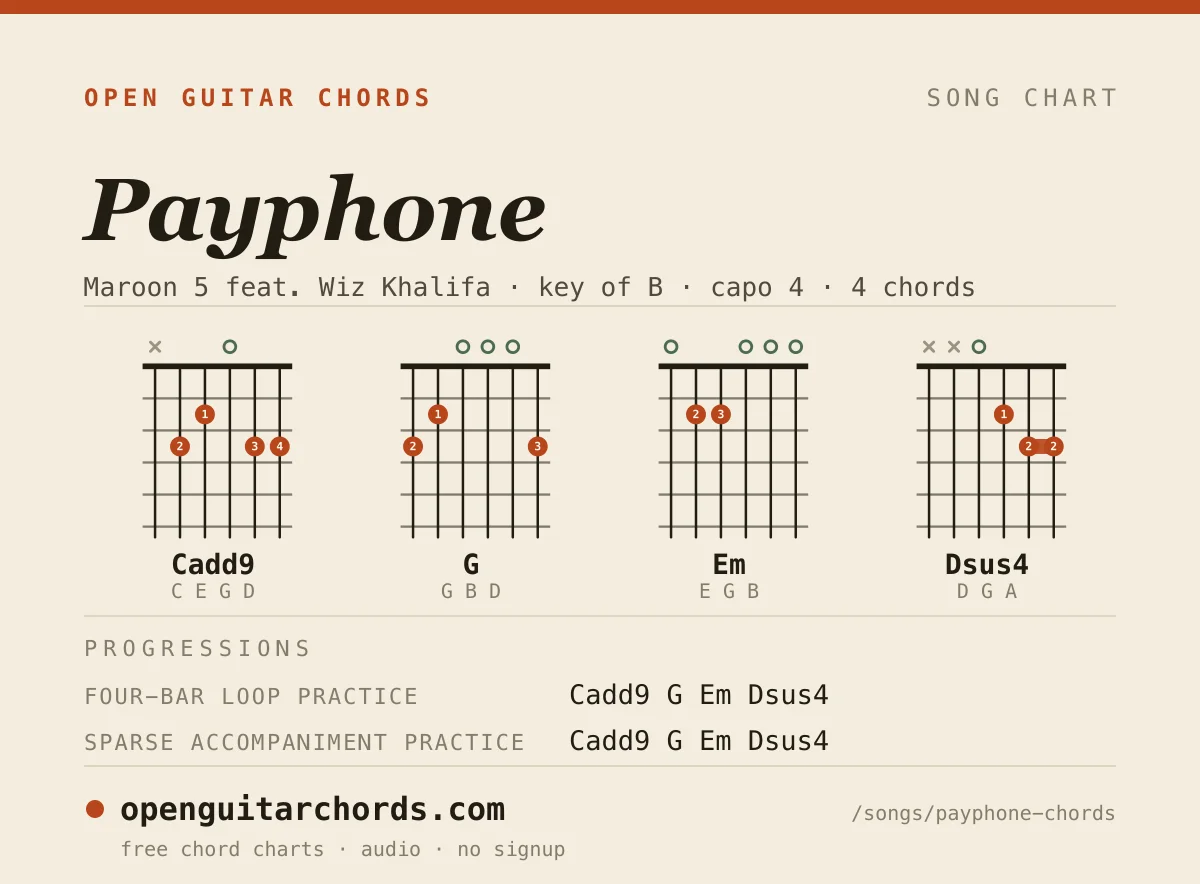
Payphone by Maroon 5 feat. Wiz Khalifa is a beginner song in B, played with a capo on fret 4. The whole sheet is 4 chords (Cadd9, G, Em, Dsus4) across 2 sections: Four-bar loop practice → Sparse accompaniment practice. 3 of the 4 shapes are open chords. Shapes that use a barre: Dsus4. It sits at roughly 108 BPM.
Simplified practice arrangement. Section repetitions are practice cues rather than a verified transcription of the recording.
By Chiye · Updated
Hardest change in the sheet: Em → Dsus4, 2 times.
- Difficulty
- Beginnerbarre shape Dsus4
- Key
- Bwith a capo on fret 4
- Tempo
- 108BPM
- Tuning
- Standard (E A D G B E)low to high
- Chords
- 43 open, 1 with a barre
- Sections
- 2each with its own progression
Chords in Payphone
Frets read low E to high E, x means leave that string out.
Chord sheet
One chord per bar in this practice sheet. Follow the time signature shown beside each section; dots mark the remaining counts in the bar. Tap a bar to hear its chord, or loop the section to practise the changes.
Chord accompaniment only. Follow the section notes for this arrangement’s timing. Songs whose words are public domain →
Four-bar loop practice4/4 · ♩=80
Sparse accompaniment practice4/4 · ♩=80
Printable one-page chord chart
How to play Payphone
Play Payphone by Maroon 5 feat. Wiz Khalifa with capo 4, using Cadd9, G, Em and Dsus4 shapes in standard tuning. The accompaniment sounds in B major. Each chord lasts one four-beat bar in the selected guitar arrangement. Learn the four changes as a loop before adding the busier feel associated with the song.
Set capo 4 and read the shape names
Alfred’s Guitar 101: Pop Songbook sample specifies capo 4 and these four shapes for Payphone. The sounding equivalents are Eadd9, B, G#m and F#sus4. A Cadd9 diagram at this capo therefore does not mean the accompaniment has moved to C major; it names the pattern under your fingers.
The Musicnotes piano/vocal/guitar edition identifies the song as Maroon 5 feat. Wiz Khalifa, dated 2012, with B major, 4/4 and a 108 BPM marking. The exercises here slow the pulse to 80 BPM. Check the tuning after fitting the capo and count diagram fret numbers from its position, not from the guitar’s nut.
Repeat one bar on each chord
The loop is Cadd9–G–Em–Dsus4. Alfred’s teaching arrangement keeps one measure per chord and repeats the order through the song. Begin on Cadd9, count four beats, and change to G on the next beat one. After four beats of Dsus4, return directly to Cadd9 without inserting a rest to set up the hand.
Both sections below practise that same four-bar sequence. The first gives four downstrokes per bar; the second attacks only beat one and lets the chord sustain. They are two ways to practise accompaniment, rather than labels for a complete verse-and-chorus performance order. Keep a tally of completed loops if you find that repeating the sequence makes you lose track of the bar.
Check the added ninth and suspended fourth
The printed Cadd9 is x-3-2-0-3-3. It includes D on the B string, alongside the C, E and G chord tones. Plain C removes that added ninth. Dsus4 is x-x-0-2-3-3: the high G supplies the suspended fourth, where a D-major grip would have F# on the first string. Let that high note ring clearly before trying the change at speed.
The printed G and Em use their own catalog fingerings. Do not assume that the two top-string fingers can stay anchored throughout the entire loop just because some Payphone tutorials use another G or Em voicing. In particular, the Em diagram has open top strings. Follow the visible positions, lift any fingers that are no longer needed, and check the ringing strings separately.
Keep the bass clean while building speed
Start Cadd9 on string 5, G and Em on string 6, and Dsus4 on string 4. Avoid sweeping the low E through Cadd9 or both low strings through Dsus4. At capo 4, listen to the bass change from E to B to G# to F#; this gives the repeated loop a clear outline even with a sparse right hand.
At 80 BPM, the first exercise places downstrokes on beats 1, 2, 3 and 4, with empty eighth-note spaces between. Keep the returning motion light. In the sparse exercise, continue counting during the sustained chord instead of waiting silently for the next change. Raise the practice speed gradually once several loops keep the same duration, and use the published tempo as a reference rather than a first-session target.
How to practise Payphone
Four steps computed from this sheet: the order the shapes are easiest to learn in, the changes that really occur in the progressions above, where each chord turns up, and the tempo ladder up to the speed marked here.
Learn the shapes easiest first
Cadd9 (x-3-2-0-3-3, beginner) → G (3-2-0-0-0-3, beginner) → Em (0-2-2-0-0-0, beginner) → Dsus4 (x-x-0-2-3-3, intermediate, needs a barre)
3 of the 4 shapes are open chords, so start there and leave Dsus4 until the others change cleanly.
Drill the changes this sheet actually uses
Cadd9 → G2×Em → Dsus42×G → Em2×
These counts come from the progressions on this page, so they are the changes you will actually play, not a generic list of pairs to practise.
Know where each chord turns up
- Cadd9every section
- Gevery section
- Emevery section
- Dsus4every section
Climb the tempo ladder
Start at 65 BPM and move up only when a full pass is clean: 65 → 81 → 97 → 108 BPM. The tempo marked on this sheet is 108 BPM, and the last step is the one that always feels like a jump. Stay at 97 for longer than feels necessary.
Practise each section's chord changes slowly, then play the sheet through at a steady tempo without pausing between sections.
Playing Payphone with a capo
This sheet is written with a capo on fret 4. Each card shows what you would finger at that capo position so the song still sounds exactly as written. Useful when the shapes above are awkward, or when you want to sing it higher without learning new chords.
No capo
Eadd9 B Abm F#sus4
1 of 4 stay open
Fret 2
Dadd9 A F#m Esus4
3 of 4 stay open
Fret 4as written
Cadd9 G Em Dsus4
3 of 4 stay open
Fret 7
Aadd9 E C#m Bsus4
2 of 4 stay open
Working out a different key? The capo calculatordoes the same arithmetic for any chord set.
More songs built on the same chords
If Payphone clicks, these use the closest set of shapes, so the chords you just learned keep working.
More beginner songs to learn after this one: Sweater Weather, The Scientist, 505, Linger.
These chords across the songbookHow often each chord in Payphone turns up across all 104 songs on this site, and what it most often moves to next. The counts come from the sheet library itself, not from theory.
13bars of this chord across the songbook
4songs use this shape
Most often followed by G, 4×.
509bars of this chord across the songbook
77songs use this shape
Most often followed by D, 89×.
155bars of this chord across the songbook
43songs use this shape
Most often followed by C, 27×.
17bars of this chord across the songbook
6songs use this shape
Most often followed by D, 5×.