Arctic Monkeys
505 chords
505 by Arctic Monkeys is a beginner song in Dm, played with no capo. The whole sheet is 2 chords (Dm, Em) across 1 sections: Main practice loop. Every shape is an open chord, so nothing here needs barre strength.
By Chiye · Updated
Hardest change in the sheet: Dm → Em, once.
- Difficulty
- Beginnerno barre needed
- Key
- Dmwith no capo
- Tuning
- Standard (E A D G B E)low to high
- Chords
- 2all open shapes
- Sections
- 1each with its own progression
Chords in 505
Frets read low E to high E, x means leave that string out.
Chord sheet
One chord per bar in this practice sheet. Follow the time signature shown beside each section; dots mark the remaining counts in the bar. Tap a bar to hear its chord, or loop the section to practise the changes.
Lyrics are not reproduced for this song: they are still in copyright and this site has no licence to publish them. The chords, structure, strumming and sing-along timing are all here. Songs whose words are public domain →
Main practice loop4/4 · ♩=90
Two bars per chord in this open-chord practice version
Printable one-page chord chart
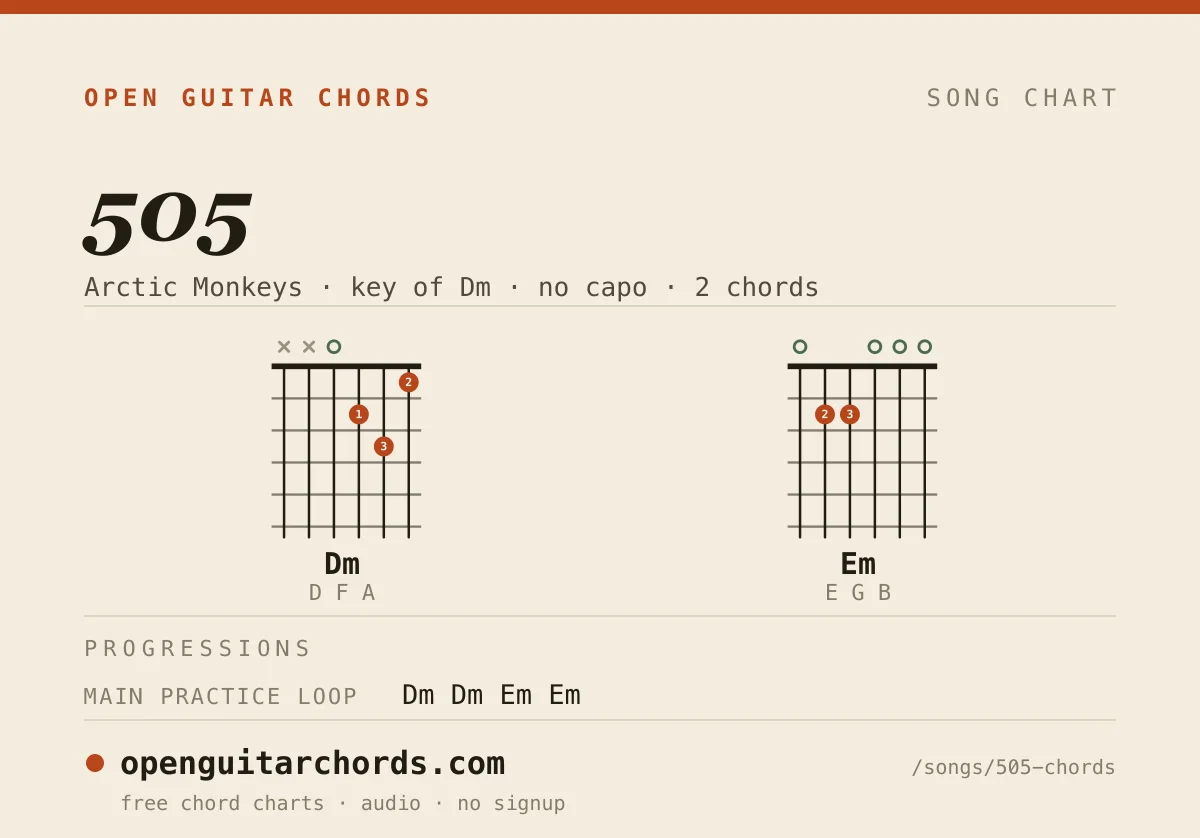
How to play 505
Play 505 with D minor and E minor, using standard tuning and no capo. This page gives you an open-chord practice version of the two-chord harmony. The four-box loop holds each chord for two four-beat bars. Start by changing on time, with one quiet attack at the beginning of a box, before trying to recreate the recording’s gradual build.
Hear both minor chords
Dm contains D, F and A. Em contains E, G and B. Keep the little m on both symbols: D major would replace F with F#, while E major would replace G with G#. Those changes would give you a different pair of chords, even if the root notes still moved from D to E.
There is a useful colour in the B natural of Em. A D natural minor scale contains Bb, so Em does not fit wholly inside that scale. Relative to D, B natural is a raised sixth and gives this two-chord exercise a Dorian colour. Listen to the actual chords rather than forcing the second one to become E diminished to fit a scale pattern. The page’s Dm key label names the minor centre of this practice arrangement.
Change the lowest string you strike
The Dm diagram is x-x-0-2-3-1, read from low E to high E. Begin the sweep at the open fourth string. Keep your index fingertip curved enough for the first-fret F to ring, without touching the adjacent second string. Pick the upper strings individually once before sweeping across the whole shape.
Em is 0-2-2-0-0-0, so all six strings can sound. Moving from Dm to Em therefore changes both hands’ jobs: the fretting hand builds a new grip, and the picking hand reaches two strings lower. On the return, narrow the sweep again. Practise that pair slowly with a clear D bass on Dm rather than accidentally leaving a low E underneath it.
Keep counting through the repeated boxes
The printed line is Dm–Dm–Em–Em. Each box is one 4/4 bar, so count eight quarter-note beats on Dm and eight on Em. The repeated symbol means another bar of the same chord. It does not ask you to release and rebuild the grip at the bar line.
The player uses a 90 BPM practice pulse here because no recording tempo is specified. Its plain downstrokes are a counting aid; they do not transcribe the organ part, every guitar accent or the recorded ending. If the change is late, practise away from the loop at a slower metronome setting. Add a fuller sweep only after you can return to Dm without an extra pause. The chart is a repeating harmony exercise, rather than a complete performance route.
Try movable grips after the open version
The diagrams on this page show the open chords. For a separate barre exercise, Dm can be played x-5-7-7-6-5 and Em x-7-9-9-8-7. These use the same minor shape, with roots on the fifth string. Move the whole shape two frets and keep the low sixth string silent. Check that every string under the barre rings before trying to slide at speed.
Both options keep the same chord qualities, but put their notes in different octaves and on different strings. Compare the open and movable versions at a similar volume. Effects can add space later; they will not correct a major third played where a minor third belongs. If you use the transpose control, reset it before comparing the result with the fret numbers above.
The Dm/Em chord pair and open-versus-barre approach were checked against Andy Guitar’s 505 lesson. The four-bar layout and counting exercises above are this page’s practice arrangement.
How to practise 505
Four steps computed from this sheet: the order the shapes are easiest to learn in, the changes that really occur in the progressions above, where each chord turns up, and the tempo ladder up to the recorded speed.
Learn the shapes easiest first
Dm (x-x-0-2-3-1, beginner) → Em (0-2-2-0-0-0, beginner)
2 of the 2 shapes are open chords, so nothing here needs barre strength yet.
Drill the changes this sheet actually uses
Dm → Em1×
These counts come from the progressions on this page, so they are the changes you will actually play, not a generic list of pairs to practise.
Know where each chord turns up
- Dmevery section
- Emevery section
Climb the tempo ladder
This sheet does not list a tempo, so pick one where every change is clean and use the metronome to move up in 4 BPM steps.
Every section here uses the same set of shapes, so there is no section to single out. Whatever you can play once, you can play all the way through.
Playing 505 with a capo
This sheet needs no capo. Each card shows what you would finger at that capo position so the song still sounds exactly as written. Useful when the shapes above are awkward, or when you want to sing it higher without learning new chords.
No capoas written
Dm Em
2 of 2 stay open
Fret 1
C#m Ebm
no open shapes left, all barre
Fret 2
Cm Dm
1 of 2 stay open
Fret 3
Bm C#m
no open shapes left, all barre
Fret 4
Bbm Cm
no open shapes left, all barre
Fret 5
Am Bm
1 of 2 stay open
Fret 6
Abm Bbm
no open shapes left, all barre
Fret 7
Gm Am
1 of 2 stay open
Working out a different key? The capo calculatordoes the same arithmetic for any chord set.
More songs built on the same chords
If 505 clicks, these use the closest set of shapes, so the chords you just learned keep working.
More beginner songs to learn after this one: The Scientist, Linger, Teardrops on My Guitar, Wonderwall.