Oasis
Wonderwall chords
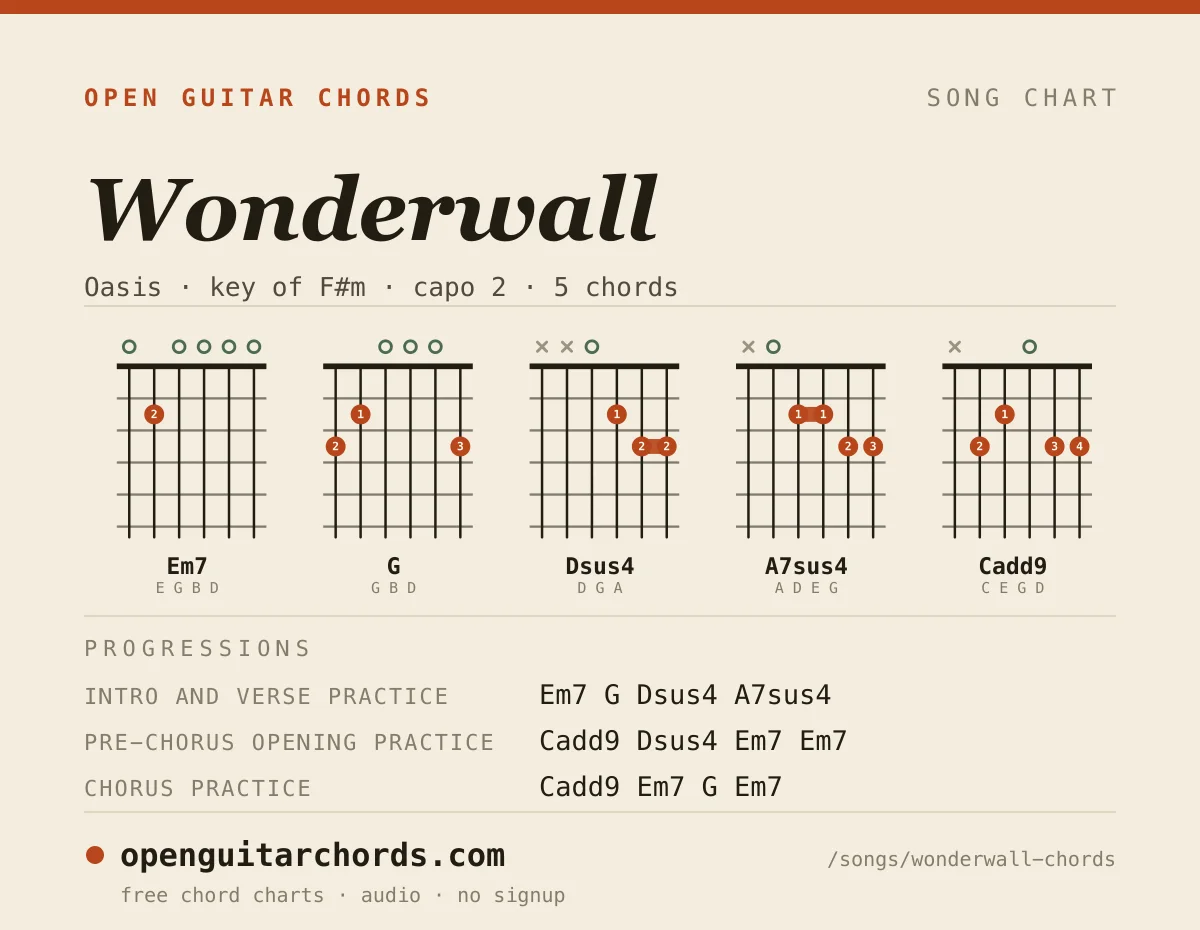
Wonderwall by Oasis is a beginner song in F#m, played with a capo on fret 2. The whole sheet is 5 chords (Em7, G, Dsus4, A7sus4, Cadd9) across 3 sections: Intro and verse practice → Pre-chorus opening practice → Chorus practice. 3 of the 5 shapes are open chords. Shapes that use a barre: Dsus4, A7sus4. It sits at roughly 87 BPM.
By Chiye · Updated
Hardest change in the sheet: Dsus4 → A7sus4, once.
- Difficulty
- Beginnerbarre shape Dsus4
- Key
- F#mwith a capo on fret 2
- Tempo
- 87BPM
- Tuning
- Standard (E A D G B E)low to high
- Chords
- 53 open, 2 with a barre
- Sections
- 3each with its own progression
Chords in Wonderwall
Frets read low E to high E, x means leave that string out.
Chord sheet
One chord per bar in this practice sheet. Follow the time signature shown beside each section; dots mark the remaining counts in the bar. Tap a bar to hear its chord, or loop the section to practise the changes.
Chord accompaniment only. Follow the section notes for this arrangement’s timing. Songs whose words are public domain →
Intro and verse practice4/4 · ♩=87
Slower harmonic exercise, one whole bar per chord; the recording often changes twice per bar
Pre-chorus opening practice4/4 · ♩=87
Opening phrase only; listen separately for the later bass descent and A7sus4 arrival
Chorus practice4/4 · ♩=87
A different chord order from the verse; practise the loop before learning the recorded ending
Printable one-page chord chart
How to play Wonderwall
Wonderwall uses Em7–G–Dsus4–A7sus4 for its main verse loop and Cadd9–Em7–G–Em7 for the chorus. With standard tuning and a capo at fret 2, the E minor shapes sound in F# minor. The symbols on this page describe the shapes your fingers play, relative to the capo.
Start with the right practice expectations
The three section loops above are chord-change exercises. Each box lasts a whole four-beat bar so you have time to prepare the next grip. The recording often puts two chord changes inside a bar, and its phrase endings need separate attention. Use these loops to learn the harmony, then follow the lesson linked below for the shorter changes, bass movement and stops.
The pre-chorus exercise gives only its opening Cadd9–Dsus4–Em7 phrase. It does not include the complete later descent or the held A7sus4 before the chorus. Likewise, the chorus exercise gives its recurring loop rather than prescribing a final ending. Treat each exercise as a separate place to practise; playing all three once does not produce a complete performance.
Choose an Em7 grip before anchoring fingers
Our basic Em7 diagram is 0-2-0-0-0-0. It contains the required E, G, B and D notes, but leaves the top strings open. The familiar anchored alternative is 0-2-2-0-3-3. In that grip, the ring finger holds the second string at fret 3 and the little finger holds the first string at fret 3. Those fret numbers start from the capo.
If you choose the anchored grip, you can retain those two high notes while changing the lower part of the chord. The ordinary G diagram here is 3-2-0-0-0-3; its anchored alternative is 3-2-0-0-3-3. Both are G major. Keep the grip choice consistent, rather than expecting the basic diagrams to preserve fingers they do not use.
Check Dsus4 and A7sus4 one string at a time
Dsus4 is x-x-0-2-3-3. Start the stroke on the fourth string. A7sus4 is x-0-2-2-3-3; start on the fifth. The latter contains A, D, E and G, with no third. You can fret the two adjacent second-fret notes with separate fingers or a small barre if it stays comfortable. Listen for the second string’s D, which makes this a suspended chord.
An alternative A7sus4 grip, x-0-2-0-3-0, also contains those four pitch classes, but removes the anchored high-string sound. It can be useful for checking the harmony slowly. It is not the same physical fingering as the anchored version, so release and rebuild the fingers that actually change.
Learn the chorus as its own loop
Start on Cadd9, move to Em7, then G, then Em7 again. Practise the final Em7 back to Cadd9 as well as the changes inside the line. The Cadd9 bass begins on the fifth string; Em7 begins on the sixth. Aim the pick at the current bass string and keep the upper strings light enough that the bass movement remains audible.
Avoid forcing the recorded strum into a single eighth-note island pattern. First let every practice box ring, then reduce the spaces between changes using JustinGuitar’s Wonderwall lesson, especially the pre-chorus and chorus chapters. Compare your timing with the chosen performance before adding singing.
How to practise Wonderwall
Four steps computed from this sheet: the order the shapes are easiest to learn in, the changes that really occur in the progressions above, where each chord turns up, and the tempo ladder up to the speed marked here.
Learn the shapes easiest first
Em7 (0-2-0-0-0-0, beginner) → G (3-2-0-0-0-3, beginner) → Cadd9 (x-3-2-0-3-3, beginner) → Dsus4 (x-x-0-2-3-3, intermediate, needs a barre) → A7sus4 (x-0-2-2-3-3, intermediate, needs a barre)
3 of the 5 shapes are open chords, so start there and leave Dsus4 until the others change cleanly.
Drill the changes this sheet actually uses
Em7 → G2×Cadd9 → Dsus41×Cadd9 → Em71×Dsus4 → A7sus41×
These counts come from the progressions on this page, so they are the changes you will actually play, not a generic list of pairs to practise.
Know where each chord turns up
- Em7every section
- GIntro and verse practice, Chorus practice
- Dsus4Intro and verse practice, Pre-chorus opening practice
- A7sus4Intro and verse practice
- Cadd9Pre-chorus opening practice, Chorus practice
Climb the tempo ladder
Start at 52 BPM and move up only when a full pass is clean: 52 → 65 → 78 → 87 BPM. The tempo marked on this sheet is 87 BPM, and the last step is the one that always feels like a jump. Stay at 78 for longer than feels necessary.
Practise each section's chord changes slowly, then play the sheet through at a steady tempo without pausing between sections.
Playing Wonderwall with a capo
This sheet is written with a capo on fret 2. Each card shows what you would finger at that capo position so the song still sounds exactly as written. Useful when the shapes above are awkward, or when you want to sing it higher without learning new chords.
Fret 2as written
Em7 G Dsus4 A7sus4 Cadd9
3 of 5 stay open
Fret 7
Bm7 D Asus4 E7sus4 Gadd9
5 of 5 stay open
Working out a different key? The capo calculatordoes the same arithmetic for any chord set.
More songs built on the same chords
If Wonderwall clicks, these use the closest set of shapes, so the chords you just learned keep working.
More beginner songs to learn after this one: Sweater Weather, 505, Linger.
These chords across the songbookHow often each chord in Wonderwall turns up across all 104 songs on this site, and what it most often moves to next. The counts come from the sheet library itself, not from theory.
31bars of this chord across the songbook
6songs use this shape
Most often followed by G, 13×.
509bars of this chord across the songbook
77songs use this shape
Most often followed by D, 89×.
17bars of this chord across the songbook
6songs use this shape
Most often followed by D, 5×.
5bars of this chord across the songbook
2songs use this shape
Most often followed by Em7, 2×.
13bars of this chord across the songbook
4songs use this shape
Most often followed by G, 4×.