The Neighbourhood
Sweater Weather chords
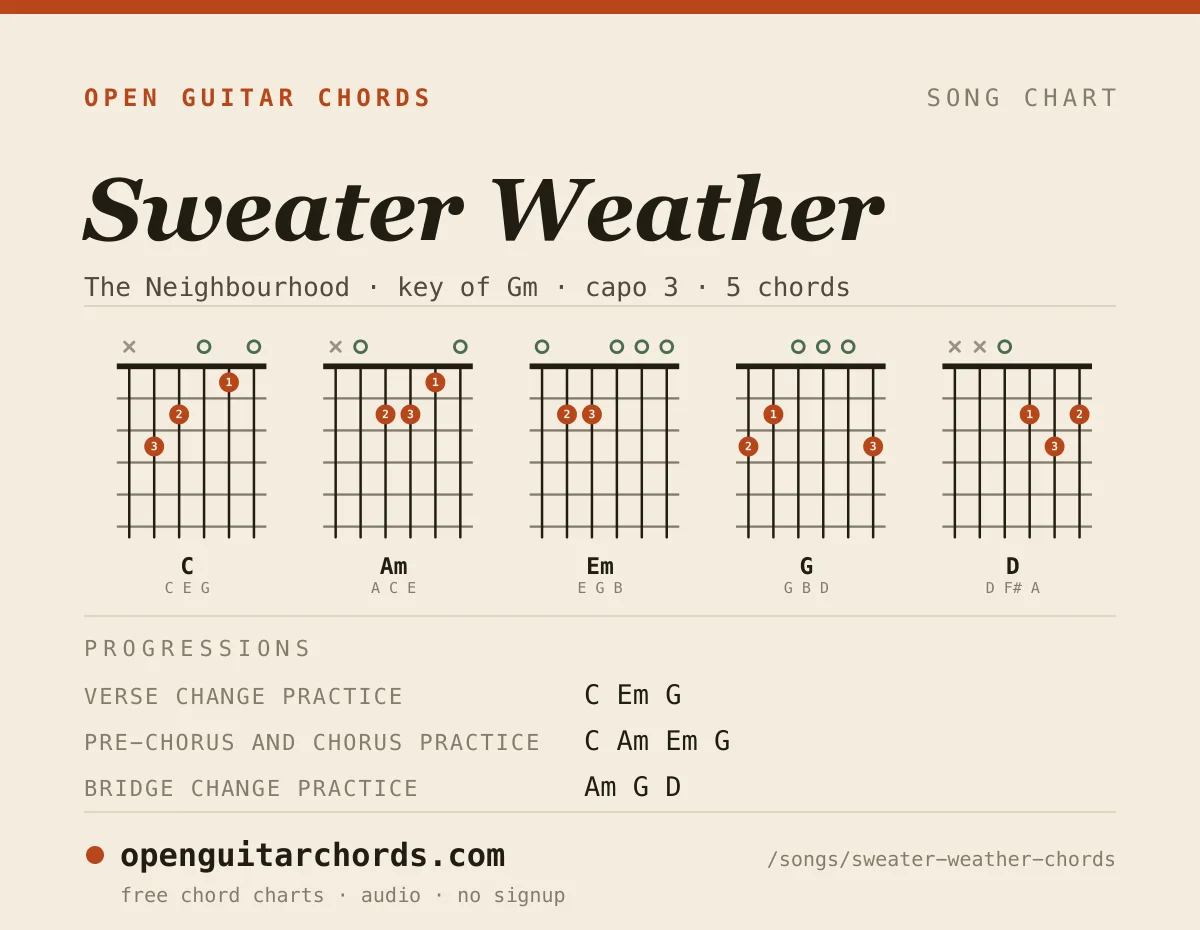
Sweater Weather by The Neighbourhood is a beginner song in Gm, played with a capo on fret 3. The whole sheet is 5 chords (C, Am, Em, G, D) across 3 sections: Verse change practice → Pre-chorus and chorus practice → Bridge change practice. Every shape is an open chord, so nothing here needs barre strength. It sits at roughly 124 BPM.
Simplified practice arrangement. Section repetitions are practice cues rather than a verified transcription of the recording.
By Chiye · Updated
Hardest change in the sheet: Em → G, 2 times.
- Difficulty
- Beginnerno barre needed
- Key
- Gmwith a capo on fret 3
- Tempo
- 124BPM
- Tuning
- Standard (E A D G B E)low to high
- Chords
- 5all open shapes
- Sections
- 3each with its own progression
Chords in Sweater Weather
Frets read low E to high E, x means leave that string out.
Chord sheet
One chord per bar in this practice sheet. Follow the time signature shown beside each section; dots mark the remaining counts in the bar. Tap a bar to hear its chord, or loop the section to practise the changes.
Chord accompaniment only. Follow the section notes for this arrangement’s timing. Songs whose words are public domain →
Verse change practice4/4 · ♩=80
Pre-chorus and chorus practice4/4 · ♩=80
Bridge change practice4/4 · ♩=80
Printable one-page chord chart
How to play Sweater Weather
Play Sweater Weather by The Neighbourhood with capo 3, using C, Am, Em, G and D shapes in standard tuning. The accompaniment sounds in G minor. The verse exercise leaves out Am; the pre-chorus and chorus add it. Learn that change in the harmony before treating the whole song as one repeating four-chord loop.
Match the artist, key and capo version
Musicnotes’ original-key edition lists G minor, 4/4 and 124 BPM. A transposed copy can show another key, so check the original-key selection when comparing charts. Easy 2 Play Music’s own guitar tutorial specifies capo 3 and the C, Am, Em, G and D shape set used for this easier guitar approach.
At capo 3, C sounds as Eb, Am as Cm, Em as Gm, G as Bb and D as F. The key field names the sounding G minor, not the first shape in a list. Put the capo behind fret 3, check the tuning, and read the diagrams relative to that position. Without the capo the same shapes sound three semitones lower.
Distinguish the verse from the chorus
GuitarTuna’s simplified chart shows Eb–Gm–Bb in the verse, and Eb–Cm–Gm–Bb for the pre-chorus and chorus. Transposed down three semitones for the capo shapes, these become C–Em–G and C–Am–Em–G. The added Am is therefore a section change, not an optional extra to scatter into every verse.
The boxes here expand each chord entry to one four-beat practice bar at 80 BPM. The three-box verse exercise and four-box chorus exercise are change drills; their lengths are not a claim about the recording’s complete phrase lengths. Count aloud through each box and restart the selected drill deliberately, rather than trying to fit a vocal line over the expanded bars.
Give the bridge its own D chord
The simplified bridge in GuitarTuna moves through Cm, Bb and F, which become Am, G and D at capo 3. Practise that three-chord order separately. The source includes longer holds and repetitions; the exercise below isolates the hand changes without reconstructing all those bar counts. Its D is not present in the chorus’s four-chord set, so prepare it before reaching the bridge.
Start D on the fourth string, leaving the fifth and sixth strings silent. Its printed high F# sounds as A with the capo, completing the sounding F-major chord. If you accidentally keep the high-string third fret from the preceding G shape, you make Dsus4 instead. Listen to the top note as well as checking that the hand has roughly the right outline.
Keep the five open shapes clear at practice speed
C and Am both start on string 5. Em and G can use all six strings, while D starts on string 4. With the printed C and Am fingerings, the index finger can stay on B-string fret 1 and the middle finger on D-string fret 2; move the remaining finger between A-string fret 3 and G-string fret 2. Release those anchors when moving to Em, whose B string is open.
All three practice grids use four quarter-note downstrokes per bar at 80 BPM. The space between strokes helps you hear muted strings and prepare the next grip. Keep the return motion loose and leave time for the chord to ring. Once the changes are reliable, study the chosen tutorial’s section-specific strumming and recording timing; a faster, busier pattern should preserve the distinction between verse, chorus and bridge.
How to practise Sweater Weather
Four steps computed from this sheet: the order the shapes are easiest to learn in, the changes that really occur in the progressions above, where each chord turns up, and the tempo ladder up to the speed marked here.
Learn the shapes easiest first
C (x-3-2-0-1-0, beginner) → Am (x-0-2-2-1-0, beginner) → Em (0-2-2-0-0-0, beginner) → G (3-2-0-0-0-3, beginner) → D (x-x-0-2-3-2, beginner)
5 of the 5 shapes are open chords, so nothing here needs barre strength yet.
Drill the changes this sheet actually uses
Em → G2×Am → Em1×Am → G1×C → Am1×
These counts come from the progressions on this page, so they are the changes you will actually play, not a generic list of pairs to practise.
Know where each chord turns up
- CVerse change practice, Pre-chorus and chorus practice
- AmPre-chorus and chorus practice, Bridge change practice
- EmVerse change practice, Pre-chorus and chorus practice
- Gevery section
- DBridge change practice
Climb the tempo ladder
Start at 74 BPM and move up only when a full pass is clean: 74 → 93 → 112 → 124 BPM. The tempo marked on this sheet is 124 BPM, and the last step is the one that always feels like a jump. Stay at 112 for longer than feels necessary.
Practise each section's chord changes slowly, then play the sheet through at a steady tempo without pausing between sections.
Playing Sweater Weather with a capo
This sheet is written with a capo on fret 3. Each card shows what you would finger at that capo position so the song still sounds exactly as written. Useful when the shapes above are awkward, or when you want to sing it higher without learning new chords.
No capo
Eb Cm Gm Bb F
no open shapes left, all barre
Fret 1
D Bm F#m A E
3 of 5 stay open
Fret 2
C# Bbm Fm Ab Eb
no open shapes left, all barre
Fret 3as written
C Am Em G D
5 of 5 stay open
Fret 4
B Abm Ebm F# C#
no open shapes left, all barre
Fret 5
Bb Gm Dm F C
2 of 5 stay open
Fret 6
A F#m C#m E B
2 of 5 stay open
Fret 7
Ab Fm Cm Eb Bb
no open shapes left, all barre
Working out a different key? The capo calculatordoes the same arithmetic for any chord set.
More songs built on the same chords
If Sweater Weather clicks, these use the closest set of shapes, so the chords you just learned keep working.
More beginner songs to learn after this one: Payphone, The Scientist, 505, Linger.
These chords across the songbookHow often each chord in Sweater Weather turns up across all 104 songs on this site, and what it most often moves to next. The counts come from the sheet library itself, not from theory.
420bars of this chord across the songbook
70songs use this shape
Most often followed by G, 115×.
125bars of this chord across the songbook
35songs use this shape
Most often followed by F, 23×.
155bars of this chord across the songbook
43songs use this shape
Most often followed by C, 27×.
509bars of this chord across the songbook
77songs use this shape
Most often followed by D, 89×.
323bars of this chord across the songbook
58songs use this shape
Most often followed by G, 52×.