Chord family · 8 shapes
Slash chords and inversions
A slash chord names two things: the chord on the left of the slash, and the single note that belongs in the bass on the right. G/B means "a G chord with B at the bottom". It is not a different chord, it is the same chord turned upside down — an inversion.
Guitarists meet them constantly in songs with descending bass lines: G → G/B → Am → C is a G chord, then the same G chord with a different bass note, then Am, then C. The top of the chord barely moves while the bass walks down a scale.
slash chord
8 shapes · 7 with their own pageHow to use slash chords and inversions in a song
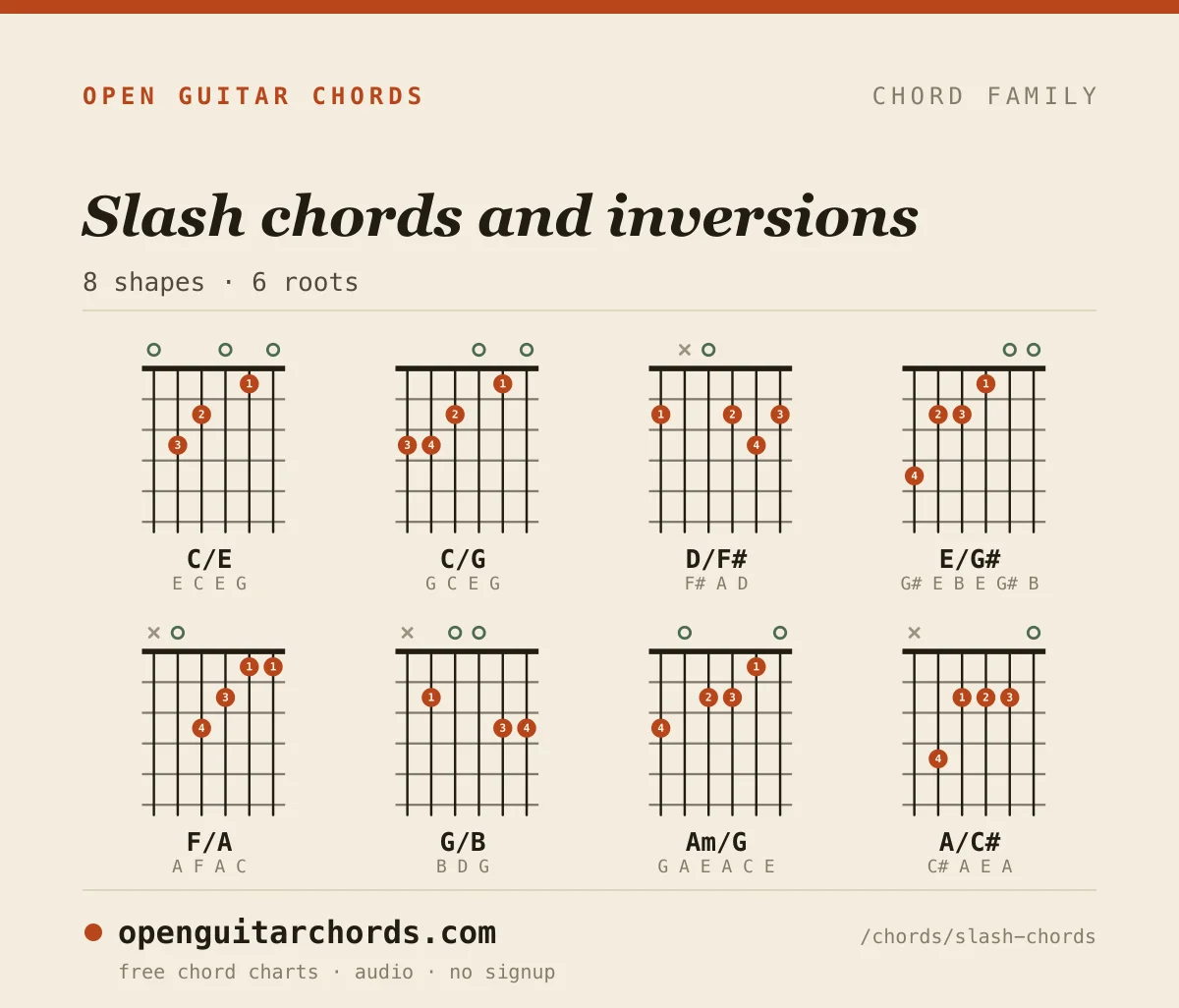
Many slash chords are just your existing shape with a different lowest string, which is the whole trick: G/B is G with the A string fretted at the 2nd fret, D/F# is D with the low E string fretted at the 2nd fret, and C/E is C with the low E string left open instead of muted.
The reason they matter is bass movement. A progression like G, G/B, Am, C only uses three chords, but the bass line walks down in steps and the music suddenly sounds composed rather than strummed. If a song sounds static, look for a place where a slash chord could keep the lowest note moving.
When you cannot reach the bass note, play the chord without it. G/B with a plain G still works in most situations, because the bass player or the piano will supply the B. Slash chords are a target, not a test, and the song does not collapse if you leave the inversion out.
This page collects 8 shapes, and only one is open-position, because slash chords are inherently about the low strings. That makes them a good first exercise in reading the bottom of a chord rather than the top, which is the opposite of how most players learn.
If you only try two of the shapes on this page, try D/F#: both can be reached from shapes you already know, so the change stays playable at speed. Listen to the chord that follows it in the loop — the resolution is the point of the chord, not the chord itself.
How to practise slash chords and inversions
- Play G, then G/B, then Am, then C. Only the bass note changes between the first two chords, and that walk down is the entire effect.
- Play C, then C/E, then C/G. Three positions of the same chord with three different bass notes. This is what an inversion sounds like from the player seat.
- Take a song with a static two-chord loop and add a slash chord between them. If the loop suddenly sounds composed rather than strummed, you have found the reason slash chords exist.
Slash chords and inversions in real songs
Slash chords appear wherever a song wants its bass line to move. Eight examples charted here:
- The Weight: E/G# is the turnaround chord, and the bass note is what makes it work
- Blackbird: G/B and the rest of the descending line are the whole point of the guitar part
- I'm Yours: G/B keeps the bass moving between G and Am
- Ain't No Sunshine: Am/G walks the bass down while the chord above stays still
- The Boxer: uses C/G and C/E, two inversions of the same chord, in one verse
- Something: C/E is the bass-note change that turns a plain C into a moving line
- Margaritaville: A/C# is the inversion that makes the chorus lift
- While My Guitar Gently Weeps: Am/G does the same job in a minor key
Printable family chart
Slash chords and inversions with their own pages
These are the ones that turn up often enough in songs to deserve a full page — fingerings in every position, real progressions, and the songs that use them.