slash chord · C root
C/G chord
- G5
- C1
- E3
- G5
More actions
The C over G chord is built from the notes G, C, E, G. It turns up 2 times in the 80 songs on this site, including The Boxer.
By Chiye · Updated
What is the C/G chord?
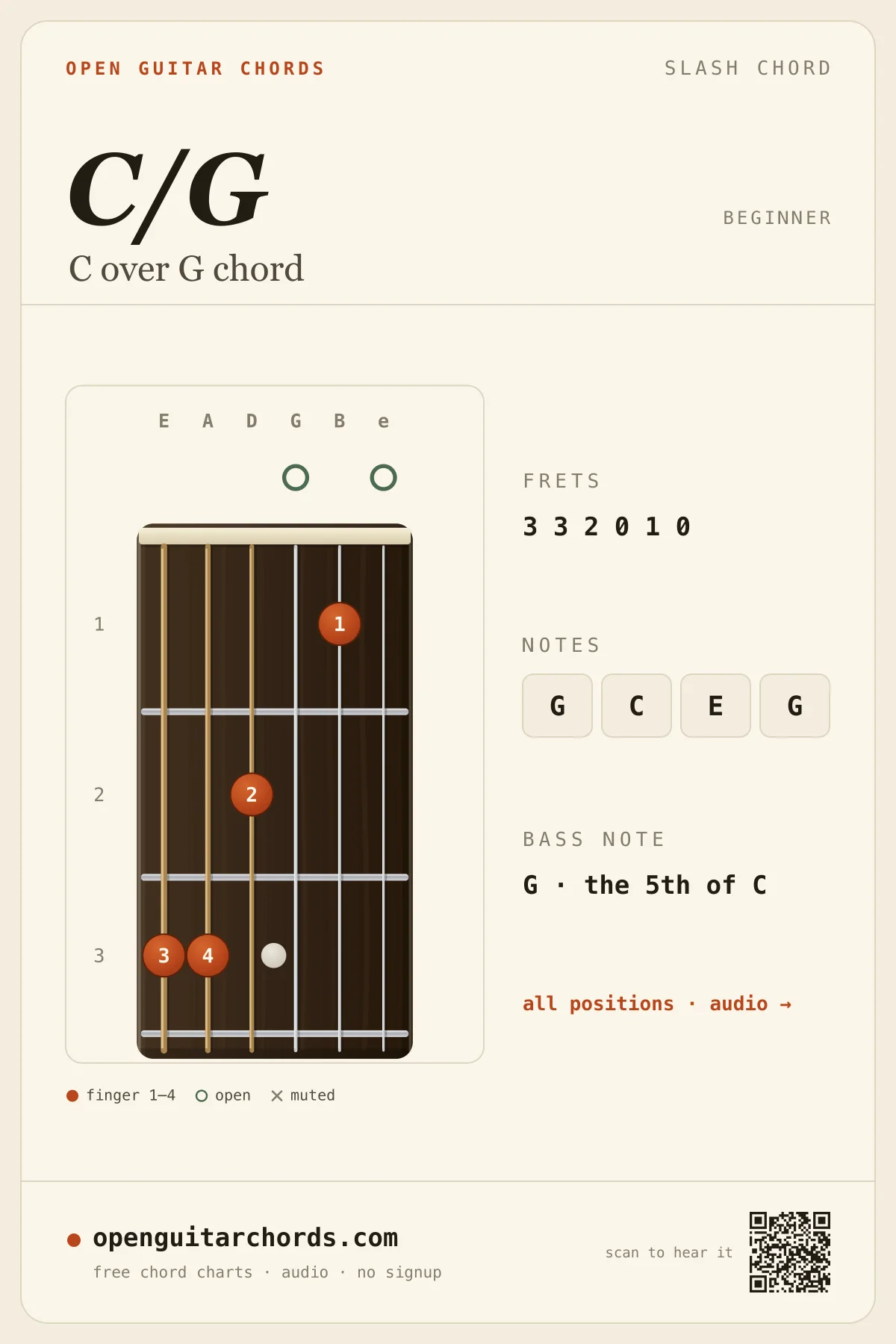
The C/G chord (C over G) is a slash chord built from four notes: G, C, E, G — the 1–3–5 of the C scale, 4 semitones and 7 semitones above the root. On guitar it is most often played in open position (3-3-2-0-1-0) with 4 fingers while 2 strings ring open. It is rated beginner — most players learn it in their first weeks. The same triad with a different note placed in the bass, so the chord keeps its identity while the lowest voice walks underneath it. It is one of the most-used chords in this site's library: across the 80 song sheets charted here, C/G appears 2 times in 1 song, most often in the key of C, and the chord it most often moves to is Am. Below you will find step-by-step fingering, audio of every shape, and the real progressions this chord lives inside.
How do you play the C/G chord on guitar?
Open position — the easiest version of C/G on the guitar.
- Press the low E string at fret 3 with your ring finger.
- Press the A string at fret 3 with your pinky finger.
- Press the D string at fret 2 with your middle finger.
- Press the B string at fret 1 with your index finger.
- Strum all six strings and let every one ring.
If it buzzes, the usual cause is a fingertip sitting in the middle of the fret space instead of just behind the wire. Move the whole hand a few millimetres toward the bridge and the buzz usually disappears without any extra pressure. 3-3-2-0-1-0
How do you make C/G sound clean?
C/G ends up as a full barre because players assume the G must ring on every string.
C → C/G → Am: one bass note changing. Keep the top three strings untouched.
In real songs
What songs use the C/G chord?
- chord changes
- 2
- songs
- 1
- common keys
- C
Across the 80 chord sheets on this site, C/G appears 2 times in 1 song — most often in the key of C.
Chord flow
What chord comes after C/G?
Those figures are counted from the 80 chord sheets on this site, so they describe what songwriters actually played rather than what theory says should come next.
Three-chord moves
Three-chord moves are where a chord really shows its character. These are the ones that actually happen in this library, counted from the sheets:
The theory behind C/G
C/G is spelled G – C – E – G — the 1 – 3 – 5 of the C scale, which is the root plus 4 semitones, 7 semitones. The same triad with a different note placed in the bass, so the chord keeps its identity while the lowest voice walks underneath it.
The letter after the slash is a bass note, not a new chord. C/G is the same C shape with one low string fretted differently, which is how a bass line walks underneath a chord that is not moving.
What key is the C/G chord in?
C/G is the C major triad with G in the bass, so it stands in for the same three chords: the I in C major, the IV in G major and the V in F major.
the home chord — songs resolve here
the subdominant — the chord that leaves home
the dominant — the chord that pulls back home
C/G on other instruments
G – C – E – G — all white keys, so you can find the shape by counting up from C.
Take it to the practice room