Billy Joel
Piano Man chords
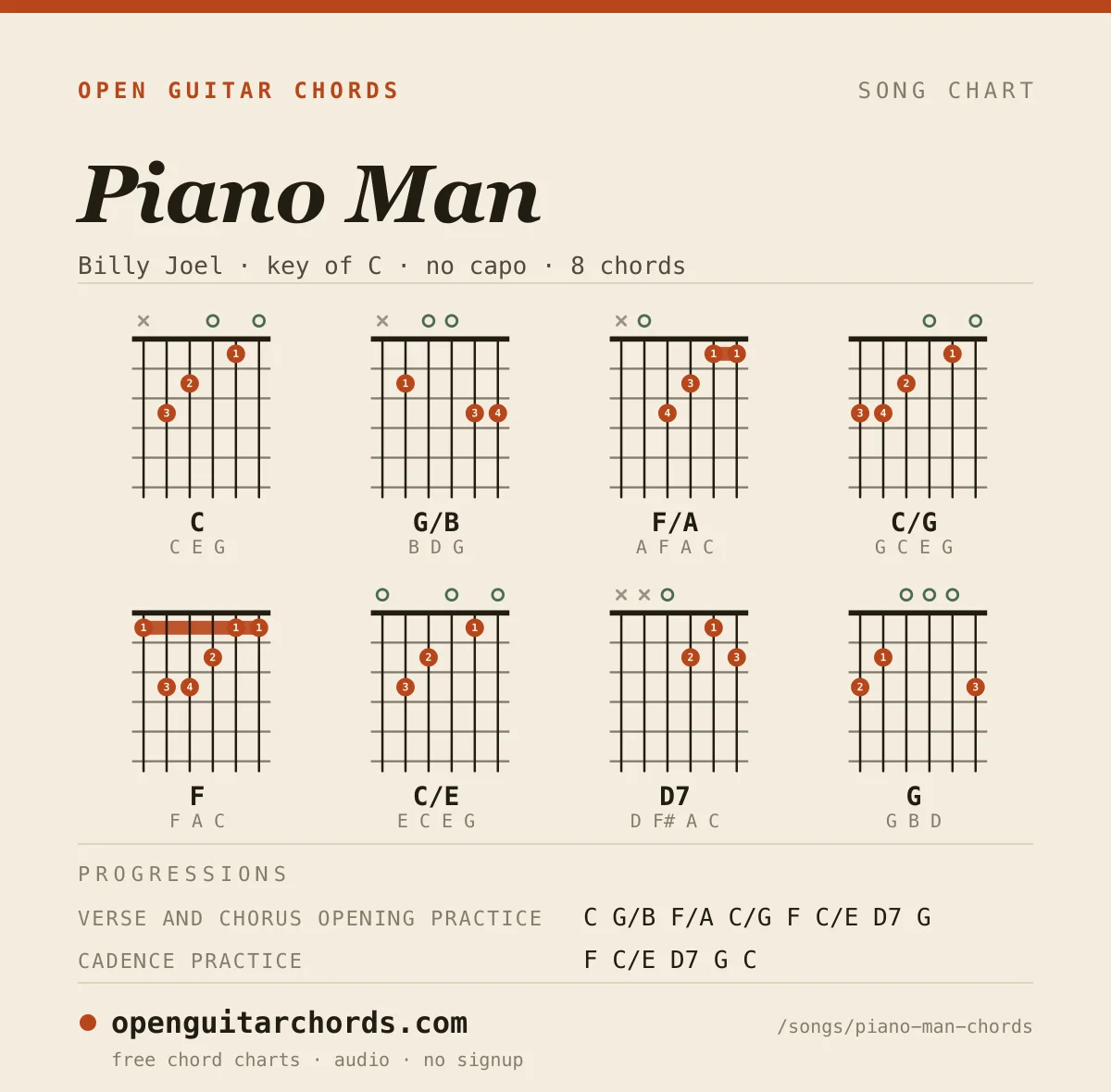
Piano Man by Billy Joel is an intermediate song in C, played with no capo. The whole sheet is 8 chords (C, G/B, F/A, C/G, F, C/E, D7, G) across 2 sections: Verse and chorus opening practice → Cadence practice. 6 of the 8 shapes are open chords. Shapes that use a barre: F/A, F. It sits at roughly 160 BPM.
Simplified practice arrangement. Section repetitions are practice cues rather than a verified transcription of the recording.
By Chiye · Updated
Hardest change in the sheet: F → C/E, 2 times.
- Difficulty
- Intermediatebarre shape F/A
- Key
- Cwith no capo
- Tempo
- 160BPM
- Tuning
- Standard (E A D G B E)low to high
- Chords
- 86 open, 2 with a barre
- Sections
- 2each with its own progression
Chords in Piano Man
Frets read low E to high E, x means leave that string out.
Chord sheet
One chord per bar in this practice sheet. Follow the time signature shown beside each section; dots mark the remaining counts in the bar. Tap a bar to hear its chord, or loop the section to practise the changes.
Chord accompaniment only. Follow the section notes for this arrangement’s timing. Songs whose words are public domain →
Verse and chorus opening practice3/4 · ♩=90
Cadence practice3/4 · ♩=90
Printable one-page chord chart
How to play Piano Man
Play Piano Man by Billy Joel in C major, with standard tuning and no capo. These guitar exercises keep the bass inversions in the opening phrase: C–G/B–F/A–C/G, then F–C/E–D7–G. Each chord entry is stretched to a three-beat bar at 90 BPM. This leaves time to hear the lowest note before changing grips.
Count three quarter-note beats
The Musicnotes piano/vocal/guitar edition lists C major, 3/4, 1973 and a quarter-note marking of 160. Jon MacLennan’s guitar lesson explains the waltz feel with three quarter-note beats. The exercises here use the same beat unit, slowed to 90 BPM. Count “1 and 2 and 3 and”, then begin the next bar.
The six grid cells are eighth-note positions. Downstrokes land on 1, 2 and 3, with the “and” spaces empty. Six cells alone do not establish 6/8: that notation normally groups its eighth notes into two larger pulses. Keep the three-beat count used here instead of accenting the fourth cell as a new large beat. A different chart can regroup the pulse, so compare its beat unit as well as its BPM number.
Follow the bass named after the slash
Lauren Bateman’s guitar chart supplies the bass-inversion sequence used for this opening phrase. G/B is x-2-0-0-3-3, placing B on the fifth string at the bottom. F/A is x-0-3-2-1-1, placing open A beneath the F chord tones. Start both on string 5 and keep the low E silent.
C/G is 3-3-2-0-1-0. Unlike ordinary C, it includes the sixth-string G as the lowest note. The next full F grip begins on sixth-string fret 1, and C/E is 0-3-2-0-1-0 with open E at the bottom. These are specific changes of bass, not alternate spellings of one identical grip. Listen to that lowest note before strumming the upper strings.
Hear where the guitar bass changes octave
The bass names across the complete opening exercise are C, B, A, G, F, E, D and G. The printed D7 starts on the open fourth string, so its D is higher than the preceding low E in C/E. The bass-name line descends through the letters, but the guitar voicings do not make one uninterrupted descending scale in a single octave. Avoid forcing a low note that the diagram does not include.
D7 is x-x-0-2-1-2, with F# as its third and C as its seventh. That F# sits outside the C-major scale and helps pull toward G. Keep the B-string first fret clear, then move to the printed G. The cadence drill F–C/E–D7–G–C adds a final C as a practice resolution, letting you hear the dominant G return to the home chord.
Practise the opening phrase before quicker changes
The first exercise joins the two halves of the selected verse/chorus opening. Its four slash shapes need attention to the starting string, while full F needs a first-fret barre. Pluck each grip once, check the bass and top note, then add the three quarter-note downstrokes. Keep the third beat as long as the first two; anticipating the next grip can make a waltz lurch forward.
Lauren Bateman’s chart uses a different metrical grouping and quicker changes within its measures. This page takes the chord order but expands every entry into a complete 3/4 practice bar. It leaves out the other phrase endings and interlude, so these two drills are not a complete performance route. They also contain no piano or harmonica melody transcription. Once the bass and three-beat pulse are secure, follow one chosen score for its exact durations.
How to practise Piano Man
Four steps computed from this sheet: the order the shapes are easiest to learn in, the changes that really occur in the progressions above, where each chord turns up, and the tempo ladder up to the speed marked here.
Learn the shapes easiest first
C (x-3-2-0-1-0, beginner) → G/B (x-2-0-0-3-3, beginner) → C/G (3-3-2-0-1-0, beginner) → C/E (0-3-2-0-1-0, beginner) → D7 (x-x-0-2-1-2, beginner) → G (3-2-0-0-0-3, beginner) → F/A (x-0-3-2-1-1, intermediate, needs a barre) → F (1-3-3-2-1-1, intermediate, needs a barre)
6 of the 8 shapes are open chords, so start there and leave F/A until the others change cleanly.
Drill the changes this sheet actually uses
C/E → D72×D7 → G2×F → C/E2×C → G/B1×
These counts come from the progressions on this page, so they are the changes you will actually play, not a generic list of pairs to practise.
Know where each chord turns up
- Cevery section
- G/BVerse and chorus opening practice
- F/AVerse and chorus opening practice
- C/GVerse and chorus opening practice
- Fevery section
- C/Eevery section
- D7every section
- Gevery section
Climb the tempo ladder
Start at 96 BPM and move up only when a full pass is clean: 96 → 120 → 144 → 160 BPM. The tempo marked on this sheet is 160 BPM, and the last step is the one that always feels like a jump. Stay at 144 for longer than feels necessary.
Practise each section's chord changes slowly, then play the sheet through at a steady tempo without pausing between sections.
Playing Piano Man with a capo
This sheet needs no capo. Each card shows what you would finger at that capo position so the song still sounds exactly as written. Useful when the shapes above are awkward, or when you want to sing it higher without learning new chords.
No capoas written
C G/B F/A C/G F C/E D7 G
6 of 8 stay open
Fret 1
B F#* E* B* E B* C#7 F#
2 of 8 stay open
Fret 2
Bb F/A Eb* Bb* Eb Bb* C7 F
1 of 8 stay open
Fret 3
A E* D* A* D A* B7 E
8 of 8 stay open
Fret 4
Ab Eb* C#* Ab* C# Ab* Bb7 Eb
no open shapes left, all barre
Fret 5
G D* C/E G* C G/B A7 D
8 of 8 stay open
Fret 6
F# C#* B* F#* B F#* Ab7 C#
no open shapes left, all barre
Fret 7
F C/E Bb* F* Bb F/A G7 C
3 of 8 stay open
* this position has no separate fingering for a bass-note inversion in our chord library, so the parent chord is shown. Play that shape and the inversion note is an optional bass addition.
Working out a different key? The capo calculatordoes the same arithmetic for any chord set.
More songs built on the same chords
If Piano Man clicks, these use the closest set of shapes, so the chords you just learned keep working.
More intermediate songs to learn after this one: Father and Son, 500 Miles, Shallow, The One That Got Away.
These chords across the songbookHow often each chord in Piano Man turns up across all 104 songs on this site, and what it most often moves to next. The counts come from the sheet library itself, not from theory.
420bars of this chord across the songbook
70songs use this shape
Most often followed by G, 115×.
12bars of this chord across the songbook
4songs use this shape
Most often followed by C, 4×.
1bars of this chord across the songbook
1songs use this shape
Most often followed by C/G, 1×.
3bars of this chord across the songbook
2songs use this shape
Most often followed by Am, 1×.
114bars of this chord across the songbook
29songs use this shape
Most often followed by C, 38×.
6bars of this chord across the songbook
3songs use this shape
Most often followed by D7, 2×.
45bars of this chord across the songbook
12songs use this shape
Most often followed by G, 22×.
509bars of this chord across the songbook
77songs use this shape
Most often followed by D, 89×.