The Beatles
While My Guitar Gently Weeps chords
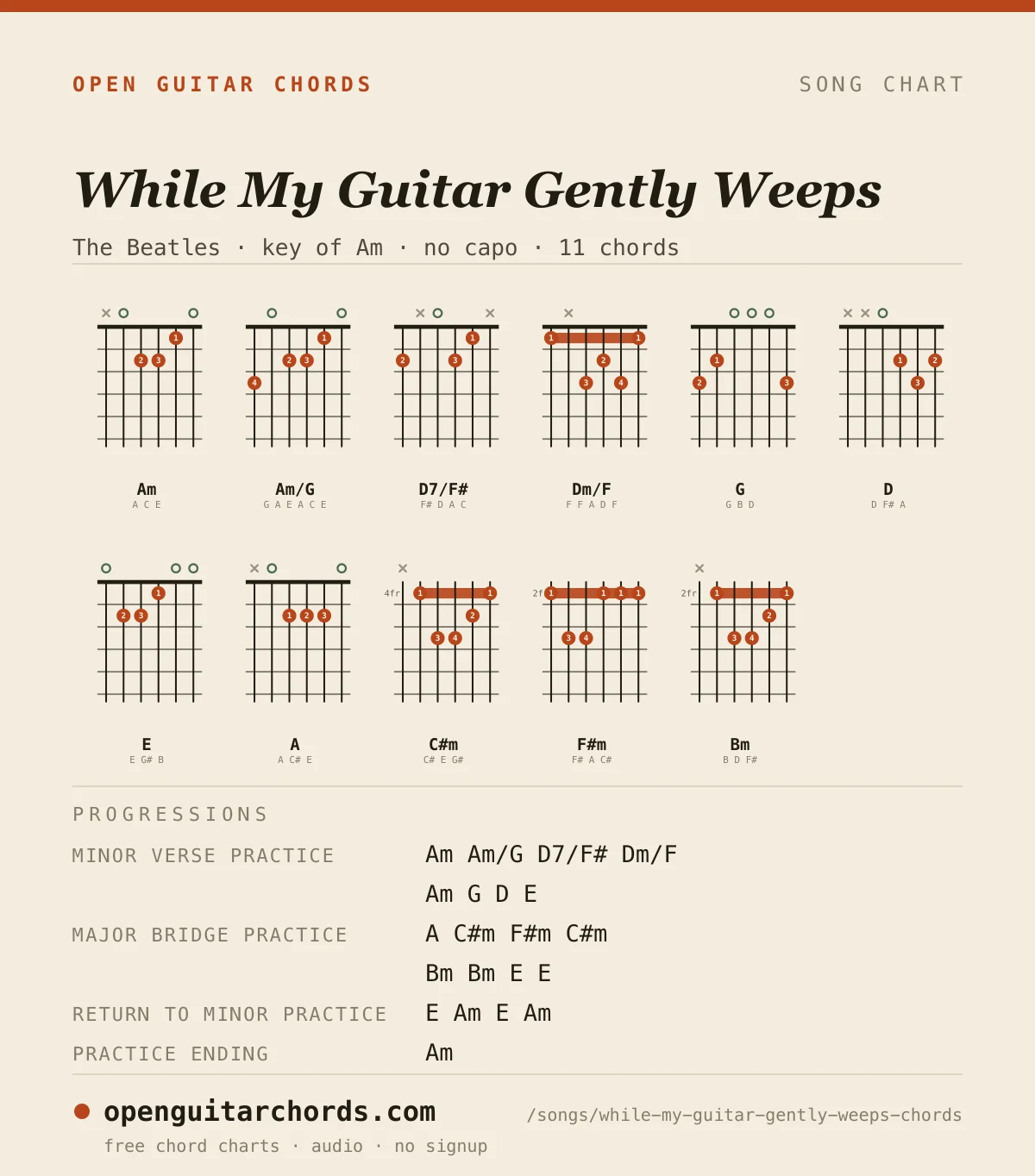
While My Guitar Gently Weeps by The Beatles is an advanced song in Am, played with no capo. The whole sheet is 11 chords (Am, Am/G, D7/F#, Dm/F, G, D, E, A, C#m, F#m, Bm) across 4 sections: Minor verse practice → Major bridge practice → Return to minor practice → Practice ending. 7 of the 11 shapes are open chords. Shapes that use a barre: Dm/F, C#m, F#m, Bm.
Simplified practice arrangement. Section repetitions are practice cues rather than a verified transcription of the recording.
By Chiye · Updated
Hardest change in the sheet: C#m → F#m, once.
- Difficulty
- Advancedbarre shape Dm/F
- Key
- Amwith no capo
- Tuning
- Standard (E A D G B E)low to high
- Chords
- 117 open, 4 with a barre
- Sections
- 4each with its own progression
Chords in While My Guitar Gently Weeps
Frets read low E to high E, x means leave that string out.
Chord sheet
One chord per bar in this practice sheet. Follow the time signature shown beside each section; dots mark the remaining counts in the bar. Tap a bar to hear its chord, or loop the section to practise the changes.
Chord accompaniment only. Follow the section notes for this arrangement’s timing. Songs whose words are public domain →
Minor verse practice4/4 · ♩=60
Major bridge practice4/4 · ♩=60
Return to minor practice4/4 · ♩=60
Practice ending4/4 · ♩=60
Printable one-page chord chart
How to play While My Guitar Gently Weeps
Play While My Guitar Gently Weeps with Am shapes, standard tuning and no capo. The two main exercises contrast a descending minor passage with a bridge in A major. Work at 60 BPM before joining them. This sheet is a counted rhythm-guitar practice arrangement: each box lasts four beats, and the list does not describe the complete recording or its lead-guitar part.
Hear the descending bass before adding strums
The first line moves through Am, Am/G, D7/F# and Dm/F. Listen to the lowest notes: A, G, F# and F. The chord above the bass also changes; these four symbols do not mean holding an identical Am grip and moving one finger throughout. The slash names the lowest sounding note of the printed voicing.
Our Am/G is 3-0-2-2-1-0. Add the little finger at low-E fret 3 while preserving the ordinary Am grip. For D7/F#, mute string 5 and play 2-x-0-2-1-x. The printed Dm/F is 1-x-3-2-3-1: its first-fret barre and fretted fourth string need a separate hand position. Pick the bass first, then check the upper notes softly. A ringing fifth string would replace the intended F# or F bass with a lower A.
Keep D major and E major in the return
The next line is Am–G–D–E. D is major: its first-string second fret supplies F#. Dm would lower that note to F and change the harmony. E is also major, with G# on the third string; leaving that string open would turn it into Em. Those two notes deserve a slow check before you increase the strumming speed.
Start D on string 4 and E on string 6. Use four light downstrokes for each practice box, counting one through four even when a finger arrives late. Repair the grip on the next repetition instead of extending a bar. The isolated E–Am exercise lets you hear the pull back into the minor passage without having to restart the entire chart.
Learn the actual A-major bridge grips
The bridge exercise goes A–C#m–F#m–C#m, then Bm–Bm–E–E. Repeated Bm and E boxes are additional four-beat practice bars. C#m has C#–E–G#, while F#m has F#–A–C#; neither should be replaced by its major namesake. Check the minor third on each grip rather than judging only by the bass fret.
Move the C#m shape down two frets to find Bm. F#m uses a different, sixth-string-root shape, so moving the whole C#m grip sideways is not the same change. Release excess pressure during the move, land the root, and then test the barre. The open A at the beginning is still A major; an E-shaped barre at fret 5 would be another A voicing, not D.
Join the sections at a steady practice speed
Play the minor exercise once, the major bridge once, and then E–Am slowly. That is a useful practice sequence, not an instruction about how often those passages occur in the recording. Finish with one Am downstroke and let the remaining three beats pass before stopping the count.
The chord selections are checked against Tomas Michaud’s two-section guitar lesson. His smaller bridge voicings and Dsus4 decoration are alternatives to the grips and plain D used here. Keep one version consistent while learning; combining the fingering of one chart with the chord name of another makes the descending bass difficult to diagnose.
How to practise While My Guitar Gently Weeps
Four steps computed from this sheet: the order the shapes are easiest to learn in, the changes that really occur in the progressions above, where each chord turns up, and the tempo ladder up to the speed marked here.
Learn the shapes easiest first
Am (x-0-2-2-1-0, beginner) → Am/G (3-0-2-2-1-0, beginner) → D7/F# (2-x-0-2-1-x, beginner) → G (3-2-0-0-0-3, beginner) → D (x-x-0-2-3-2, beginner) → E (0-2-2-1-0-0, beginner) → A (x-0-2-2-2-0, beginner) → Dm/F (1-x-3-2-3-1, intermediate, needs a barre) → C#m (x-4-6-6-5-4, intermediate, needs a barre) → F#m (2-4-4-2-2-2, intermediate, needs a barre) → Bm (x-2-4-4-3-2, intermediate, needs a barre)
7 of the 11 shapes are open chords, so start there and leave Dm/F until the others change cleanly.
Drill the changes this sheet actually uses
E → Am2×A → C#m1×Am → Am/G1×Am → E1×
These counts come from the progressions on this page, so they are the changes you will actually play, not a generic list of pairs to practise.
Know where each chord turns up
- AmMinor verse practice, Return to minor practice, Practice ending
- Am/GMinor verse practice
- D7/F#Minor verse practice
- Dm/FMinor verse practice
- GMinor verse practice
- DMinor verse practice
- EMinor verse practice, Major bridge practice, Return to minor practice
- AMajor bridge practice
- C#mMajor bridge practice
- F#mMajor bridge practice
- BmMajor bridge practice
Climb the tempo ladder
This sheet does not list a tempo, so pick one where every change is clean and use the metronome to move up in 4 BPM steps.
Practise each section's chord changes slowly, then play the sheet through at a steady tempo without pausing between sections.
Playing While My Guitar Gently Weeps with a capo
This sheet needs no capo. Each card shows what you would finger at that capo position so the song still sounds exactly as written. Useful when the shapes above are awkward, or when you want to sing it higher without learning new chords.
No capoas written
Am Am/G D7/F# Dm/F G D E A C#m F#m Bm
7 of 11 stay open
Fret 1
Abm Abm* C#7* C#m* F# C# Eb Ab Cm Fm Bbm
no open shapes left, all barre
Fret 2
Gm Gm* C7* Cm* F C D G Bm Em Am
6 of 11 stay open
Fret 3
F#m F#m* B7* Bm* E B C# F# Bbm Ebm Abm
2 of 11 stay open
Fret 4
Fm Fm* Bb7* Bbm* Eb Bb C F Am Dm Gm
3 of 11 stay open
Fret 5
Em Em* A7* Am* D A B E Abm C#m F#m
7 of 11 stay open
Fret 6
Ebm Ebm* Ab7* Abm* C# Ab Bb Eb Gm Cm Fm
no open shapes left, all barre
Fret 7
Dm Dm* G7* Gm* C G A D F#m Bm Em
8 of 11 stay open
* this position has no separate fingering for a bass-note inversion in our chord library, so the parent chord is shown. Play that shape and the inversion note is an optional bass addition.
Working out a different key? The capo calculatordoes the same arithmetic for any chord set.
More songs built on the same chords
If While My Guitar Gently Weeps clicks, these use the closest set of shapes, so the chords you just learned keep working.
More advanced songs to learn after this one: Black Orpheus, My Funny Valentine, Father and Son, 500 Miles.
These chords across the songbookHow often each chord in While My Guitar Gently Weeps turns up across all 104 songs on this site, and what it most often moves to next. The counts come from the sheet library itself, not from theory.
125bars of this chord across the songbook
35songs use this shape
Most often followed by F, 23×.
2bars of this chord across the songbook
2songs use this shape
Most often followed by D7/F#, 1×.
1bars of this chord across the songbook
1songs use this shape
Most often followed by Dm/F, 1×.
1bars of this chord across the songbook
1songs use this shape
Nothing else follows it in our sheet library.
509bars of this chord across the songbook
77songs use this shape
Most often followed by D, 89×.
323bars of this chord across the songbook
58songs use this shape
Most often followed by G, 52×.
69bars of this chord across the songbook
11songs use this shape
Most often followed by Eadd9, 6×.
134bars of this chord across the songbook
24songs use this shape
Most often followed by D, 19×.
3bars of this chord across the songbook
2songs use this shape
Most often followed by F#m, 2×.
13bars of this chord across the songbook
6songs use this shape
Most often followed by D, 4×.
84bars of this chord across the songbook
17songs use this shape
Most often followed by A, 13×.