Richard Rodgers
My Funny Valentine chords
My Funny Valentine by Richard Rodgers is an advanced song in Cm, played with no capo. The whole sheet is 7 chords (Cm, Dm7b5, Cm9, Fm7, Bb7, Ebmaj7, G7) across 3 sections: A1 → A2 → B. 1 of the 7 shapes is an open chord and Dm7b5 is the one that needs a barre. It sits at roughly 66 BPM.
By Chiye · Updated
Hardest change in the sheet: Cm9 → Dm7b5, 3 times.
- Difficulty
- Advancedbarre shape Dm7b5
- Key
- Cmwith no capo
- Tempo
- 66BPM
- Tuning
- Standard (E A D G B E)low to high
- Chords
- 71 open, 6 with a barre
- Sections
- 3each with its own progression
Chords in My Funny Valentine
Frets read low E to high E, x means leave that string out.
Chord sheet
One chord per bar, four beats to the bar: the shape lands on beat one and the dots mark the beats after it, so you can see where the change falls without any lyrics. Where a section has no strumming pattern written, play one chord per bar. Tap a bar to hear it.
Lyrics are not reproduced for this song: they are still in copyright and this site has no licence to publish them. The chords, structure, strumming and sing-along timing are all here. Songs whose words are public domain →
A1♩=66
A2♩=66
B♩=66
Printable one-page chord chart
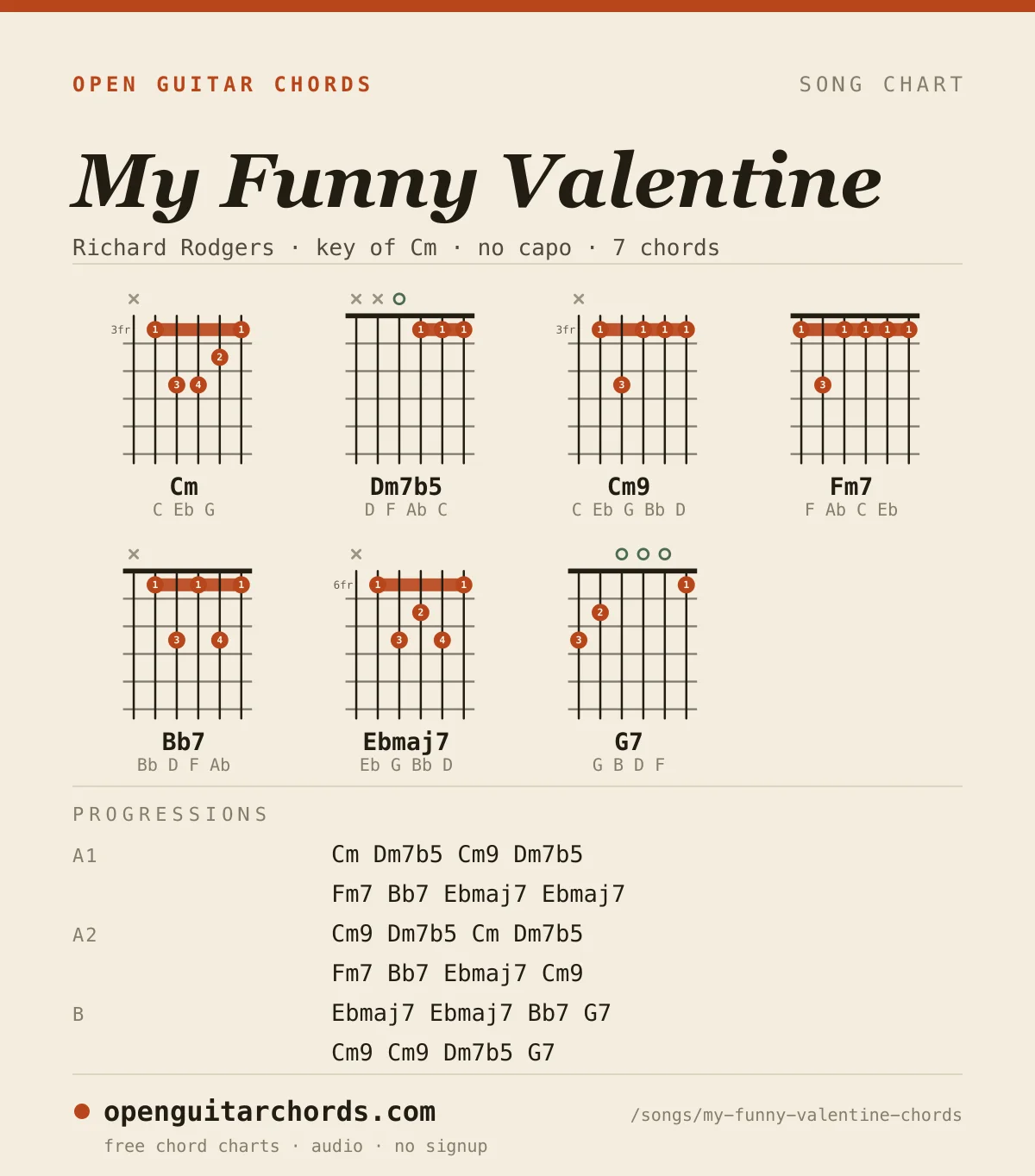
How to play My Funny Valentine
The whole opening is a line cliché: the chord stays Cm while a note inside it walks down by semitone. On guitar the practical way to play that is Cm to Dm7b5 to Cm9, which is three shapes in the same three-fret window. Cm is the barre at the 3rd fret, Dm7b5 sits two frets higher on the middle strings, and Cm9 is the Cm grip with the little finger added on the top string. Nothing in your hand travels more than two frets.
Dm7b5 is the chord that stops beginners, because the flattened fifth makes the shape look like a misprint. Play the four-string version on the D, G, B and high E strings and skip the root entirely; the bass player or your own thumb on the A string supplies the D. Half-diminished chords are ordinary in a minor key, and here it is only a passing colour, two beats long, on the way back into Cm.
From there the tune lifts into the relative major: Fm7 to Bb7 to Ebmaj7, the textbook minor two-five into the major three chord. Fm7 is the barre at the 1st fret, Bb7 the same shape two frets higher, and Ebmaj7 is a movable major seventh. Learn that three-chord cell as one unit and you have the second phrase of every A section, plus a cadence you will meet in a hundred standards.
The B section ends on G7, and that is the chord that makes the form turn around. Dm7b5 to G7 to Cm is the minor two-five-one, the same cadence that shapes every phrase here, and G7 is the one dominant in the song that demands a real grip: the barre version at the 3rd fret, with the top string fretted so the flat ninth is available if you want it. Play Dm7b5 and G7 back to back until your hand moves once instead of twice, then land on Cm9 and hold it for two full beats before the next phrase starts.
Set the metronome to 55 and play the eight bars of A1 as half notes, one chord change per two beats, with no strumming pattern at all. Ballads expose timing, so count out loud and let each chord ring into the next. When the line cliché no longer needs looking at, add the B section with its G7 turnaround, and only then start adding a simple melody on the top two strings while the chords stay underneath.
How to practise My Funny Valentine
Four steps computed from this sheet: the order the shapes are easiest to learn in, the changes that really occur in the progressions above, where each chord turns up, and the tempo ladder up to the recorded speed.
Learn the shapes easiest first
G7 (3-2-0-0-0-1, beginner) → Cm (x-3-5-5-4-3, intermediate, needs a barre) → Cm9 (x-3-5-3-3-3, intermediate, needs a barre) → Fm7 (1-3-1-1-1-1, intermediate, needs a barre) → Bb7 (x-1-3-1-3-1, intermediate, needs a barre) → Ebmaj7 (x-6-8-7-8-6, intermediate, needs a barre) → Dm7b5 (x-x-0-1-1-1, advanced, needs a barre)
1 of the 7 shapes is an open chord, so start there and leave Dm7b5 until the others change cleanly.
Drill the changes this sheet actually uses
Cm9 → Dm7b53×Bb7 → Ebmaj72×Cm → Dm7b52×Fm7 → Bb72×
These counts come from the progressions on this page, so they are the changes you will actually play, not a generic list of pairs to practise.
Know where each chord turns up
- CmA1, A2
- Dm7b5every section
- Cm9every section
- Fm7A1, A2
- Bb7every section
- Ebmaj7every section
- G7B
Climb the tempo ladder
Start at 40 BPM and move up only when a full pass is clean: 40 → 50 → 59 → 66 BPM. The recorded feel is around 66 BPM, and the last step is the one that always feels like a jump. Stay at 59 for longer than feels necessary.
Every section here uses the same set of shapes, so there is no section to single out. Whatever you can play once, you can play all the way through.
Playing My Funny Valentine with a capo
This sheet needs no capo. At every other capo position, at least one of these chords would need a fingering our chord library does not carry, so a full chart would be incomplete. We would rather show nothing than a row with a gap in it. Play it as written, or use the transpose buttons in the toolbar above to move the song into a key whose shapes you already know.
Working out a different key? The capo calculatordoes the same arithmetic for any chord set.
More songs built on the same chords
If My Funny Valentine clicks, these use the closest set of shapes, so the chords you just learned keep working.
More advanced songs to learn after this one: While My Guitar Gently Weeps, Wonderwall, Hotel California, Hey Jude.
These chords across the songbookHow often each chord in My Funny Valentine turns up across all 80 songs on this site, and what it most often moves to next. The counts come from the sheet library itself, not from theory.
9bars of this chord across the songbook
2songs use this shape
Most often followed by Dm7b5, 2×.
6bars of this chord across the songbook
2songs use this shape
Most often followed by Cm, 1×.
7bars of this chord across the songbook
2songs use this shape
Most often followed by Dm7b5, 3×.
5bars of this chord across the songbook
3songs use this shape
Most often followed by Bb7, 3×.
10bars of this chord across the songbook
3songs use this shape
Most often followed by A7, 3×.
10bars of this chord across the songbook
3songs use this shape
Most often followed by Bb7, 1×.
33bars of this chord across the songbook
13songs use this shape
Most often followed by C, 11×.