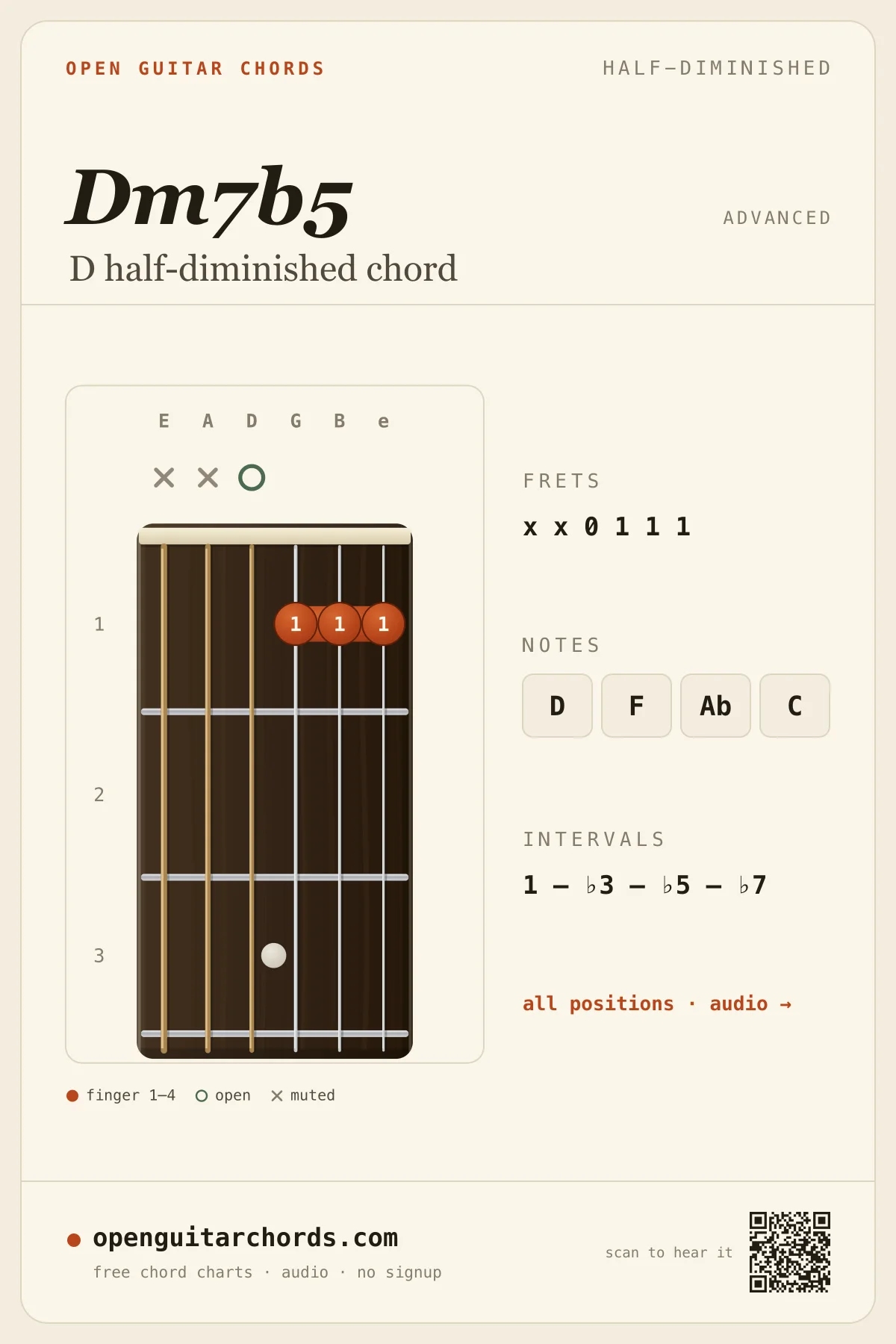
half-diminished chord · D root
Dm7b5 chord
- D1
- F♭3
- Ab♭5
- C♭7
More actions
The D half-diminished chord is built from the notes D, F, Ab, C. It turns up 6 times in the 80 songs on this site, including Black Orpheus and My Funny Valentine.
By Chiye · Updated
What is the Dm7b5 chord?
The Dm7b5 chord (D half-diminished) is a half-diminished chord built from four notes: D, F, Ab, C — the 1–♭3–♭5–♭7 of the D scale, 3 semitones and 6 semitones and 10 semitones above the root. On guitar it is most often played in open position (x-x-0-1-1-1) with 3 fingers while 1 string rings open and the low E string stays silent. It is rated advanced. A minor seventh with a flattened fifth, the shape that leans hardest toward the key it is about to resolve into. It is one of the most-used chords in this site's library: across the 80 song sheets charted here, Dm7b5 appears 6 times in 2 songs, most often in the keys of Cm and Dm, and the chord it most often moves to is Cm. Below you will find step-by-step fingering, audio of every shape, and the real progressions this chord lives inside.
How do you play the Dm7b5 chord on guitar?
Open position — a movable shape, so this same fingering works for every root note.
- Lay your index finger flat across the G to high E strings at fret 1, rolled slightly onto its bony edge.
- Start your strum on the D string and leave the low E and A strings out.
Drop the lowest fretted note (G string) and play the rest as a four- or five-string shape. You lose the bass note but keep every note that gives the chord its name, and there is no barre left to fight. x-x-0-x-1-1
How do you make Dm7b5 sound clean?
Dm7b5 is the first chord most players meet where the fifth is flattened, so the shape reads as a typo.
Dm → Dm7b5 → G7 → Cm: the ii–V–i of C minor — one finger moves from the Dm shape.
In real songs
What songs use the Dm7b5 chord?
- chord changes
- 6
- songs
- 2
- common keys
- Cm · Dm
Across the 80 chord sheets on this site, Dm7b5 appears 6 times in 2 songs — most often in the keys of Cm and Dm.
Dm7Dm7b5Gm7A7
CmDm7b5Cm9Dm7b5
Cm9Dm7b5CmDm7b5
Chord flow
What chord comes after Dm7b5?
Every number here is a count from the progressions in our song sheets, not a generalisation: 1560 chord changes are behind these figures.
Three-chord moves
Three-chord moves are where a chord really shows its character. These are the ones that actually happen in this library, counted from the sheets:
The theory behind Dm7b5
Dm7b5 is spelled D – F – Ab – C — the 1 – ♭3 – ♭5 – ♭7 of the D scale, which is the root plus 3 semitones, 6 semitones, 10 semitones. A minor seventh with a flattened fifth, the shape that leans hardest toward the key it is about to resolve into.
The flattened fifth is what makes Dm7b5 unstable: it is a diminished triad with a minor seventh stacked on it, so it sounds like it is on the way somewhere rather than at rest. It has two usual destinations — up a semitone when it acts as the leading-tone chord, or down to the dominant when it acts as the second-degree chord — which is why you almost never hear it end a phrase.
What key is the Dm7b5 chord in?
Dm7b5 is the half-diminished seventh built on D, and it turns up in two places without borrowing: as the viiø7 in Eb major, where it resolves up a semitone, and as the iiø7 in C minor, where it steps down to the dominant.
the leading-tone seventh — it resolves up a semitone
the second-degree seventh in a minor key — it steps down to the V
Dm7b5 on other instruments
D – F – Ab – C — the highlighted black keys are the sharps or flats; play each note once, then move them into one hand position.
Take it to the practice room