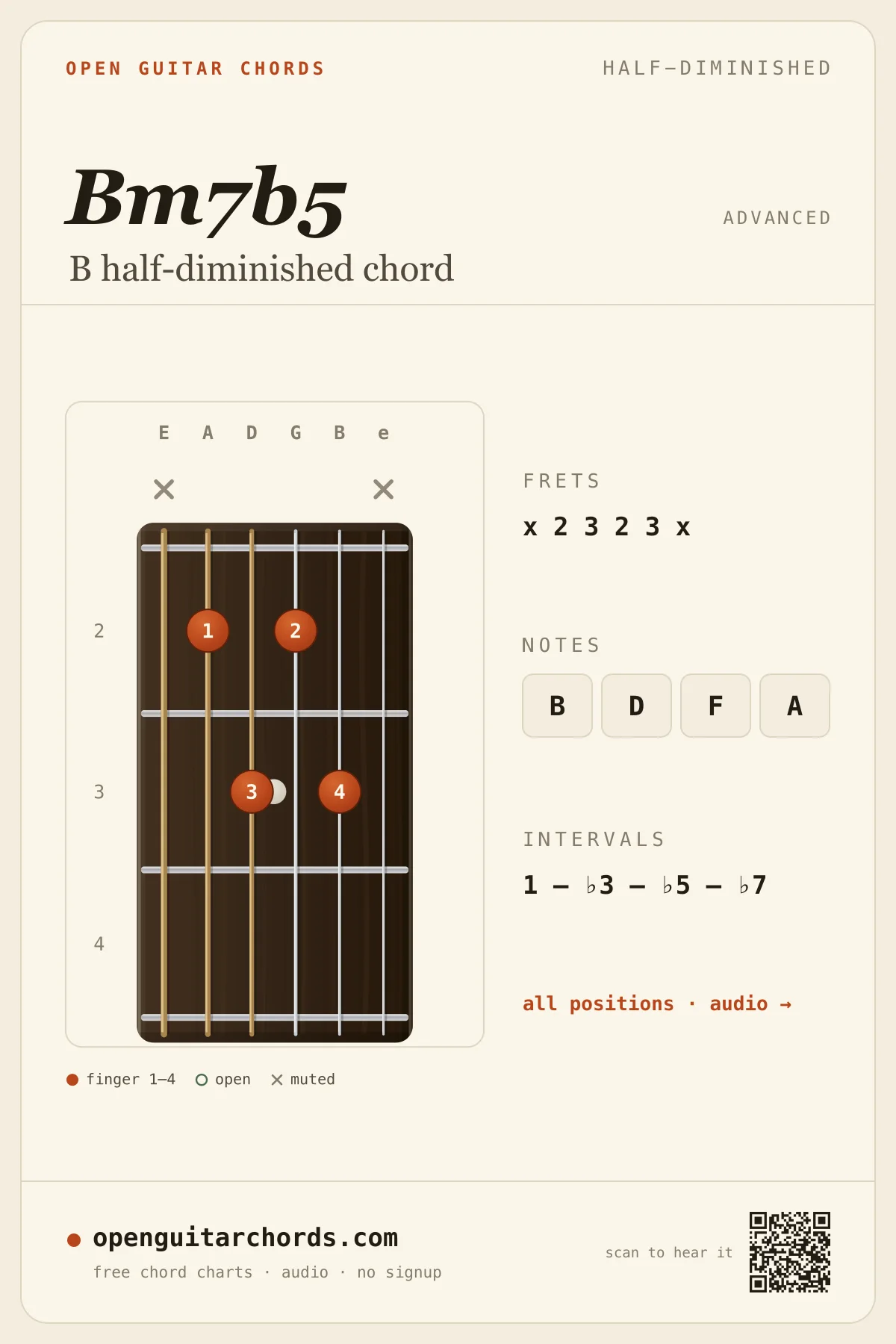
half-diminished chord · B root
Bm7b5 chord
- B1
- D♭3
- F♭5
- A♭7
More actions
The B half-diminished chord is built from the notes B, D, F, A. It turns up 3 times in the 80 songs on this site, including Fly Me to the Moon.
By Chiye · Updated
What is the Bm7b5 chord?
The Bm7b5 chord (B half-diminished) is a half-diminished chord built from four notes: B, D, F, A — the 1–♭3–♭5–♭7 of the B scale, 3 semitones and 6 semitones and 10 semitones above the root. On guitar it is most often played as a movable shape from fret 1 (x-2-3-2-3-x), so the same fingering works at any fret. It is rated advanced. A minor seventh with a flattened fifth, the shape that leans hardest toward the key it is about to resolve into. It is one of the most-used chords in this site's library: across the 80 song sheets charted here, Bm7b5 appears 3 times in 1 song, most often in the key of C, and the chord it most often moves to is E7. Below you will find step-by-step fingering, audio of every shape, and the real progressions this chord lives inside.
How do you play the Bm7b5 chord on guitar?
Open position — the easiest version of Bm7b5 on the guitar.
- Press the A string at fret 2 with your index finger.
- Press the D string at fret 3 with your ring finger.
- Press the G string at fret 2 with your middle finger.
- Press the B string at fret 3 with your pinky finger.
- Start your strum on the A string and leave the low E and high E strings out.
How do you make Bm7b5 sound clean?
Bm7b5 is the barre version of the half-diminished shape; players barre the top two strings with the wrong finger.
Bm7b5 → E7 → Am: the ii–V–i of A minor, one position, one shape.
In real songs
What songs use the Bm7b5 chord?
- chord changes
- 3
- songs
- 1
- common keys
- C
Across the 80 chord sheets on this site, Bm7b5 appears 3 times in 1 song — most often in the key of C.
Fmaj7Bm7b5E7Am7
Fmaj7Bm7b5E7A7
Fmaj7Bm7b5E7Am7
Chord flow
What chord comes after Bm7b5?
Those figures are counted from the 80 chord sheets on this site, so they describe what songwriters actually played rather than what theory says should come next.
Three-chord moves
Three-chord moves are where a chord really shows its character. These are the ones that actually happen in this library, counted from the sheets:
The theory behind Bm7b5
Bm7b5 is spelled B – D – F – A — the 1 – ♭3 – ♭5 – ♭7 of the B scale, which is the root plus 3 semitones, 6 semitones, 10 semitones. A minor seventh with a flattened fifth, the shape that leans hardest toward the key it is about to resolve into.
The flattened fifth is what makes Bm7b5 unstable: it is a diminished triad with a minor seventh stacked on it, so it sounds like it is on the way somewhere rather than at rest. It has two usual destinations — up a semitone when it acts as the leading-tone chord, or down to the dominant when it acts as the second-degree chord — which is why you almost never hear it end a phrase.
What key is the Bm7b5 chord in?
Bm7b5 is the half-diminished seventh built on B, and it turns up in two places without borrowing: as the viiø7 in C major, where it resolves up a semitone, and as the iiø7 in A minor, where it steps down to the dominant.
the leading-tone seventh — it resolves up a semitone
the second-degree seventh in a minor key — it steps down to the V
Bm7b5 on other instruments
B – D – F – A — all white keys, so you can find the shape by counting up from C.
Take it to the practice room