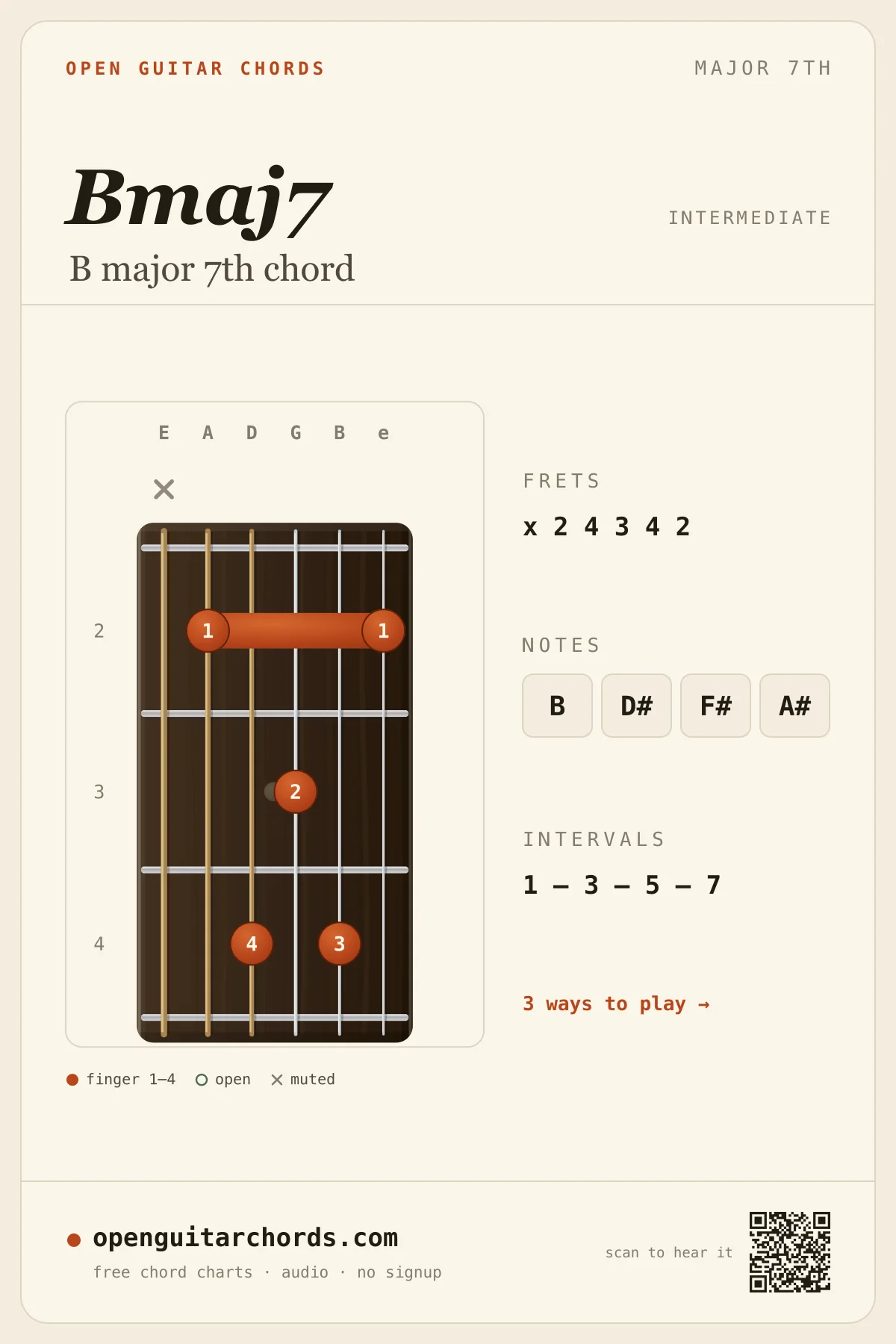
Major 7th chord · B root
Bmaj7 chord
- B1
- D#3
- F#5
- A#7
The B major 7th chord is built from the notes B, D#, F#, A#. A major 7th shape you will meet in barre-chord territory.
By Chiye · Updated
What is the Bmaj7 chord?
The Bmaj7 chord (B major 7th) is a major 7th chord built from four notes: B, D#, F#, A# — the 1–3–5–7 of the B scale, 4 semitones and 7 semitones and 11 semitones above the root. On guitar it is most often played as a movable shape from fret 2 (x-2-4-3-4-2); shift all fretted notes together to transpose it along the neck. It is rated intermediate. A soft, jazzy chord heard all over neo-soul and bossa. Below you will find step-by-step fingering, 3 positions up the neck, audio of every shape, and the real progressions this chord lives inside.
How do you play the Bmaj7 chord on guitar?
Fret 2 barre — a movable shape, so this same fingering works for every root note.
- Lay your index finger flat across the A to high E strings at fret 2, rolled slightly onto its bony edge.
- Press the D string at fret 4 with your pinky finger.
- Press the G string at fret 3 with your middle finger.
- Press the B string at fret 4 with your ring finger.
- Start your strum on the A string and do not play the low E string at all.
Leave out the lowest fretted note (A string) and practise the remaining strings. The bass changes, and the upper strings may still need a smaller barre; check that the third and other colour tones stay clear. x-x-4-3-4-2
How do you make Bmaj7 sound clean?
Bmaj7 is the A-shape major seventh at the 2nd fret, and the seventh (A#) sits one fret below the string next to it. The temptation is to slide into the shape from below instead of setting the barre and the three fingers at once.
Barre once at the 2nd fret and cycle Bm7 → Bmaj7 → B7 without resetting the hand. Three chords, one shape, two moving fingers.
In real songs
Bmaj7 in songs
None of the 104 songs charted on this site use Bmaj7 yet — it is a colour chord rather than a songwriting staple.
What other ways can you play Bmaj7 up the neck?
2 more positions below. Learn one of these well and the rest become optional. The value of a second position is practical: it keeps your fretting hand near where the song is already heading.
Position 2 · Fret 7 barre
Because nothing rings open, you can move this whole shape to any fret and it keeps the same quality — only the letter name changes.
It uses 2 separate barres. Fret each one across its marked strings, then add the other fingers without damping the ringing notes.
Position 3 · Fret 9 barre
Because nothing rings open, you can move this whole shape to any fret and it keeps the same quality — only the letter name changes.
A single bar covers the rest of the strings here. If the inside strings stay dead, move the bar a millimetre closer to the fret wire before you try pressing harder.
The theory behind Bmaj7
Bmaj7 is spelled B – D# – F# – A# — the 1 – 3 – 5 – 7 of the B scale, which is the root plus 4 semitones, 7 semitones, 11 semitones. A soft, jazzy chord heard all over neo-soul and bossa.
The major seventh sits a semitone under the octave, which is why it sounds soft rather than tense. On guitar it is usually the highest fretted note, so it is also the first note to disappear if your finger rolls off.
Bmaj7 on other instruments
B – D# – F# – A# — the highlighted black keys are the sharps or flats; play each note once, then move them into one hand position.
Take it to the practice room