Chord family · 6 shapes
Extended and altered chords
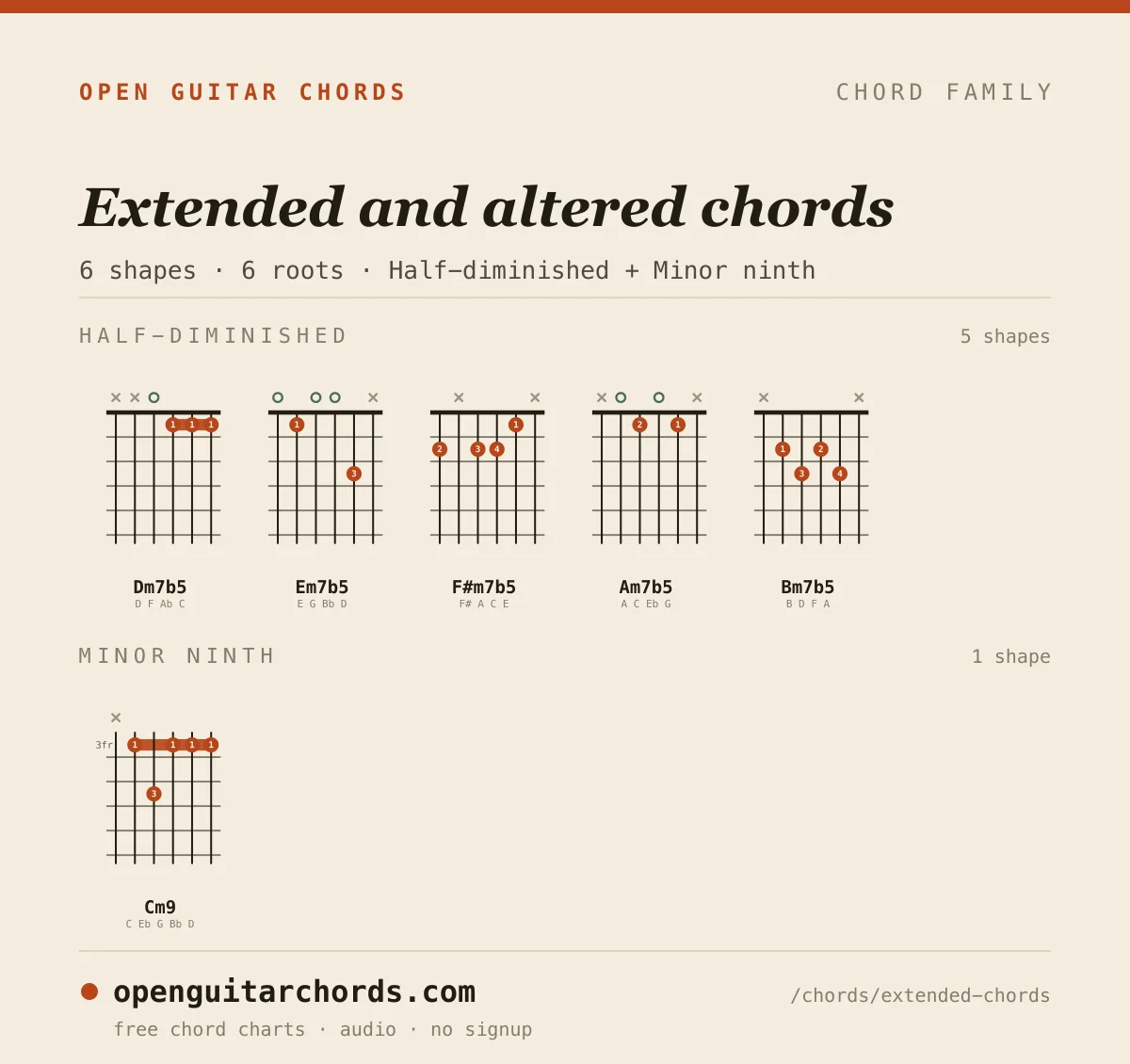
Once you add notes beyond the seventh, chords stop being pop chords and start being jazz vocabulary. Four of them do most of the work: the half-diminished (m7b5), the diminished seventh (dim7), the minor ninth (m9), and the major ninth (maj9).
The most useful of the group by a wide margin is m7b5 — the "two chord" in a minor key ii–V–i, and the shape guitarists meet first in standards like Autumn Leaves. It is a minor seventh chord with a flattened fifth, which means one finger moves from the m7 shape you already know.
half-diminished
5 shapes · 4 with their own pageminor ninth
1 shapes · 1 with their own pageHow to use extended and altered chords in a song
The half-diminished is worth learning first, because it is the standard two chord in a minor key. Where a major key uses Dm7 to G7 to C, a minor key uses Dm7b5 to G7 to Cm: one note changes in a shape you already play, and the whole progression takes on a darker colour.
The minor ninth is the other one you will meet constantly. It is an m7 with the ninth stacked on top, which makes the chord wider and softer at the same time: it sits under a vocal without fighting it, which is why soul, funk and neo-soul guitar parts rarely play a bare minor triad.
Diminished sevenths are symmetrical and repeat every three frets, exactly like plain diminished chords, so one shape gives you four names. The major ninth and the thirteenth are worth adding later, once the first two feel automatic, because they are the same shapes with one more note on top.
This is the smallest family on the site at 6 shapes, and 5 of them are half-diminished forms. That ratio is the honest picture: if you learn one chord from this page, learn m7b5, because it is the door into every minor-key standard and the rest of the family is optional colour.
If you only try two of the shapes on this page, try F#m7b5: both can be reached from shapes you already know, so the change stays playable at speed. Loop the pair with a metronome at 60 and resist the urge to fix the rhythm later: the change has to land on the beat from day one.
How to practise extended and altered chords
- Play Dm, then Dm7, then Dm7b5. One finger moves each time. That three-step walk is the two chord of a minor key in its three most common forms.
- Loop Dm7b5 → G7 → Cm slowly, then speed it up. This is the minor ii–V–i, and once it is automatic you can read most standards.
- Play Cm7 then Cm9, adding the ninth on the top string without moving anything else. The chord gets wider without getting harder.
Extended and altered chords in real songs
The half-diminished chord is the standard two chord of a minor key, so it appears in every jazz standard charted here. Five examples:
- Autumn Leaves: Am7b5 is the first chord of the tune and the one every guitarist learns the shape from
- Blue Bossa: Em7b5 leads into A7, the ii–V of the whole piece
- My Funny Valentine: uses Dm7b5 and Cm9 in the same phrase, the half-diminished and the minor ninth side by side
- Black Orpheus: Dm7b5 and Cm9 carry the opening bars of the bossa nova
- Fly Me to the Moon: Bm7b5 to E7 to Am is the minor ii–V–i in its textbook form
Printable family chart
Extended and altered chords with their own pages
These are the ones that turn up often enough in songs to deserve a full page — fingerings in every position, real progressions, and the songs that use them.