Major chord · E root
E chord
- E1
- G#3
- B5
The E major chord is built from the notes E, G#, B. It turns up 64 times in the 80 songs on this site, including Fell in Love with a Girl and Folsom Prison Blues.
By Chiye · Updated
What is the E chord?
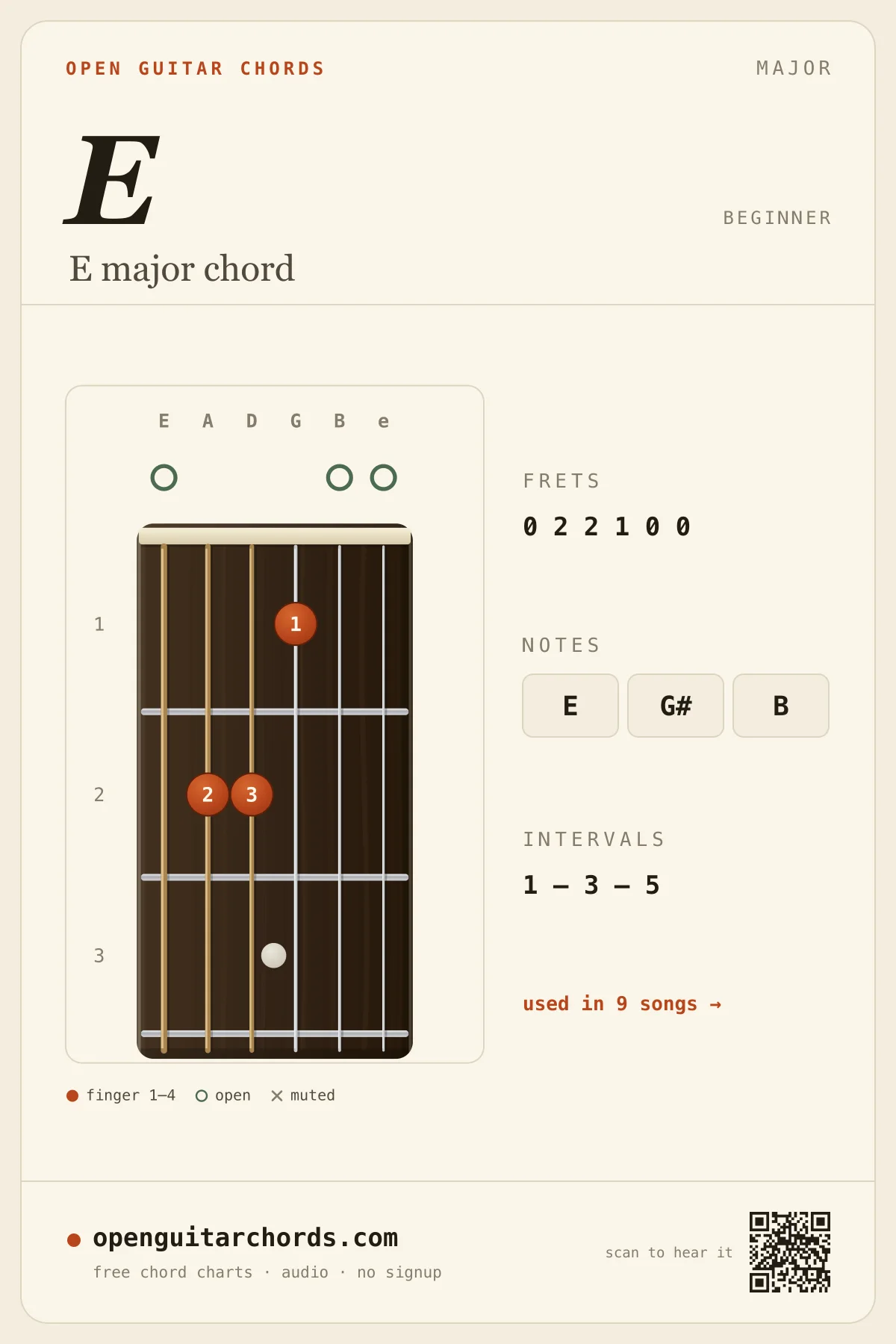
The E chord (E major) is a major chord built from three notes: E, G#, B — the 1–3–5 of the E scale, 4 semitones and 7 semitones above the root. On guitar it is most often played in open position (0-2-2-1-0-0) with 3 fingers while 3 strings ring open. It is rated beginner — most players learn it in their first weeks. The bright, home-base sound that most songs resolve to. It is one of the most-used chords in this site's library: across the 80 song sheets charted here, E appears 64 times in 9 songs, most often in the keys of E and Bm, and the chord it most often moves to is E. Below you will find step-by-step fingering, 4 positions up the neck, audio of every shape, and the real progressions this chord lives inside.
How do you play the E chord on guitar?
Open position — the easiest version of E on the guitar.
- Press the A string at fret 2 with your middle finger.
- Press the D string at fret 2 with your ring finger.
- Press the G string at fret 1 with your index finger.
- Strum all six strings and let every one ring.
If it buzzes, the usual cause is a fingertip sitting in the middle of the fret space instead of just behind the wire. Move the whole hand a few millimetres toward the bridge and the buzz usually disappears without any extra pressure. 0-2-2-1-0-0
How do you make E sound clean?
Letting the G string finger lie flat deadens the B string. Keep the index finger arched so only its tip touches.
E → A is the most common change in rock. Slide the whole shape across one string set rather than lifting finger by finger.
In real songs
What songs use the E chord?
- chord changes
- 64
- songs
- 9
- common keys
- E · Bm
Across the 80 chord sheets on this site, E appears 64 times in 9 songs — most often in the keys of E and Bm.
BADE
BADE
BADE
All 9 songs that use E— key, capo and a link to every sheet
| Song | Artist | Key | Capo |
|---|---|---|---|
| Fell in Love with a Girl | The White Stripes | B | — |
| Folsom Prison Blues | Johnny Cash | E | — |
| Hotel California | Eagles | Bm | — |
| House of the Rising Sun | The Animals | Am | — |
| I Walk the Line | Johnny Cash | F | 1 |
| Norwegian Wood (This Bird Has Flown) | The Beatles | E | — |
| Someone Like You | Adele | A | — |
| Three Little Birds | Bob Marley | A | — |
| Wicked Game | Chris Isaak | Bm | — |
Chord flow
What chord comes after E?
Every number here is a count from the progressions in our song sheets, not a generalisation: 1560 chord changes are behind these figures.
Three-chord moves
Three-chord moves are where a chord really shows its character. These are the ones that actually happen in this library, counted from the sheets:
What other ways can you play E up the neck?
3 more positions below. A chord is a set of notes, not a shape — every position below sounds like E, and each one puts your hand somewhere different, which is what makes them useful in different songs.
Position 2 · Fret 2
Because nothing rings open, you can move this whole shape to any fret and it keeps the same quality — only the letter name changes.
Position 3 · Fret 7 barre
Because nothing rings open, you can move this whole shape to any fret and it keeps the same quality — only the letter name changes.
It needs 2 separate bars, one of them a partial bar across the inner strings — the hardest part of this shape.
Position 4 · Fret 9 barre
Because nothing rings open, you can move this whole shape to any fret and it keeps the same quality — only the letter name changes.
A single bar covers the rest of the strings here. If the inside strings stay dead, move the bar a millimetre closer to the fret wire before you try pressing harder.
Watch the E chord
Video: JustinGuitar on YouTube — embedded with the official player; credit and views belong to the creator.
The theory behind E
E is spelled E – G# – B — the 1 – 3 – 5 of the E scale, which is the root plus 4 semitones, 7 semitones. The bright, home-base sound that most songs resolve to.
The third is the note that makes it major, so it decides the character: keep it on top and E sounds bright, drop it below the fifth and the same notes sound rounder. On guitar that is a matter of which string you put it on, which is exactly what the different positions on this page do.
What key is the E chord in?
E is the I chord in the key of E major, the IV chord in B major and the V chord in A major — the three major keys where E appears naturally.
the home chord — songs resolve here
the subdominant — the chord that leaves home
the dominant — the chord that pulls back home
E on other instruments
4 4 4 2
The same chord on four strings in standard tuning. Because the uke is tuned higher, this shape sits at a different place on the neck than its guitar equivalent — useful when arranging for both instruments.
E – G# – B — the highlighted black keys are the sharps or flats; play each note once, then move them into one hand position.
Take it to the practice room