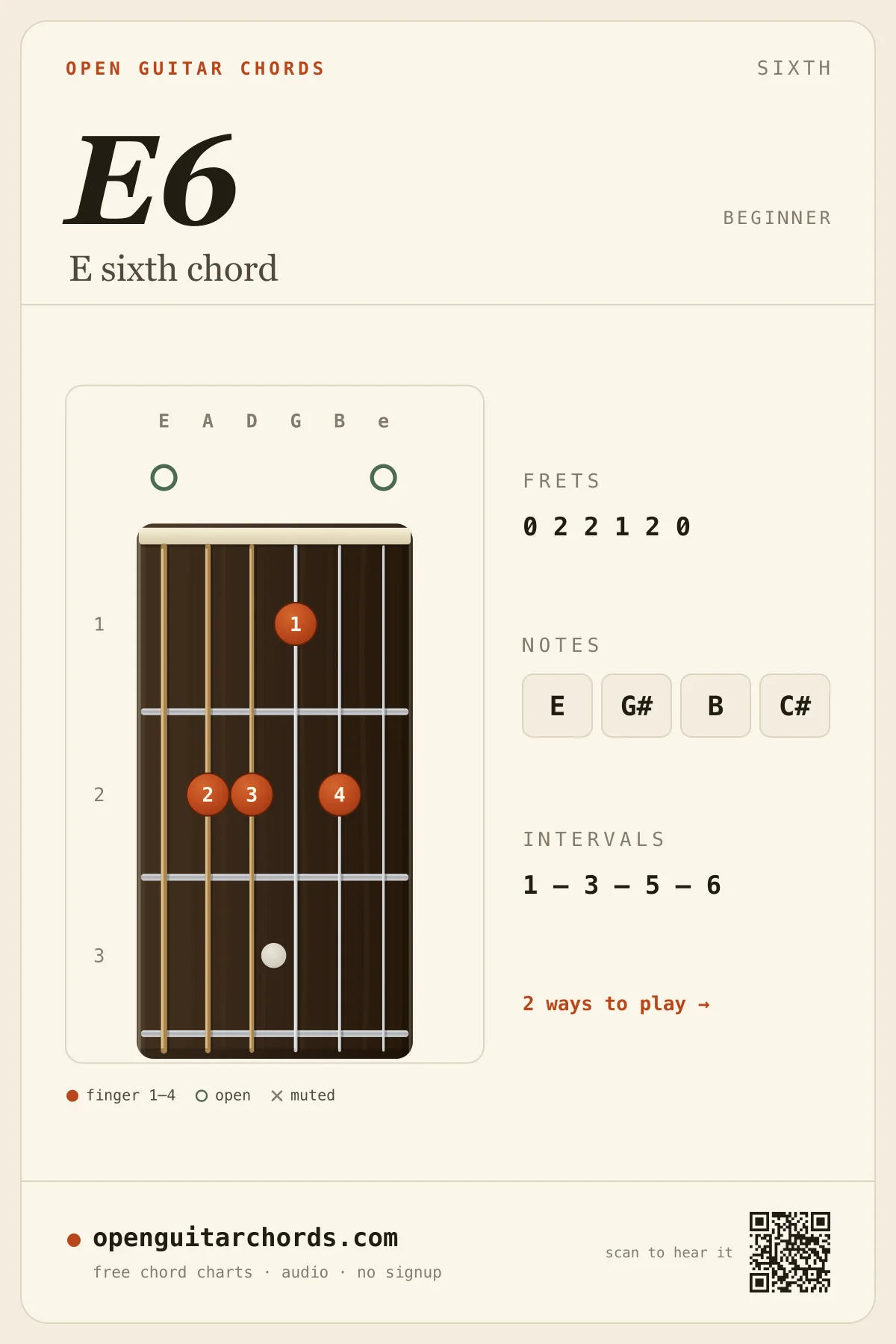
Sixth chord · E root
E6 chord
- E1
- G#3
- B5
- C#6
The E sixth chord is built from the notes E, G#, B, C#. A sixth shape you will meet in the first weeks of playing.
By Chiye · Updated
What is the E6 chord?
The E6 chord (E sixth) is a sixth chord built from four notes: E, G#, B, C# — the 1–3–5–6 of the E scale, 4 semitones and 7 semitones and 9 semitones above the root. On guitar it is most often played in open position (0-2-2-1-2-0) with 4 fingers while 2 strings ring open. It is rated beginner — most players learn it in their first weeks. A warm, vintage chord that sits between major and minor moods. Below you will find step-by-step fingering, 2 positions up the neck, audio of every shape, and the real progressions this chord lives inside.
How do you play the E6 chord on guitar?
Open position — the easiest version of E6 on the guitar.
- Press the A string at fret 2 with your middle finger.
- Press the D string at fret 2 with your ring finger.
- Press the G string at fret 1 with your index finger.
- Press the B string at fret 2 with your pinky finger.
- Strum all six strings and let every one ring.
If it buzzes, the usual cause is a fingertip sitting in the middle of the fret space instead of just behind the wire. Move the whole hand a few millimetres toward the bridge and the buzz usually disappears without any extra pressure. 0-2-2-1-2-0
How do you make E6 sound clean?
E6 players add too many fingers — it is E with one note changed on the D string.
E → E6 → E7 → A: walk the D string down one fret at a time.
In real songs
E6 in songs
None of the 80 songs charted on this site use E6 yet — it is a colour chord rather than a songwriting staple. If you want the wider picture, the sixth chords page compares every root of this family side by side.
What other ways can you play E6 up the neck?
1 more position below. Learn one of these well and the rest become optional. The value of a second position is practical: it keeps your fretting hand near where the song is already heading.
Position 2 · Fret 7 barre
Because nothing rings open, you can move this whole shape to any fret and it keeps the same quality — only the letter name changes.
It needs 2 separate bars, one of them a partial bar across the inner strings — the hardest part of this shape.
The theory behind E6
E6 is spelled E – G# – B – C# — the 1 – 3 – 5 – 6 of the E scale, which is the root plus 4 semitones, 7 semitones, 9 semitones. A warm, vintage chord that sits between major and minor moods.
The sixth is the same note a minor third below the octave, and on guitar it is often already ringing in the open position — which is why 6th chords feel easier to play than they look on paper.
E6 on other instruments
E – G# – B – C# — the highlighted black keys are the sharps or flats; play each note once, then move them into one hand position.
Take it to the practice room