Coldplay
Sparks chords
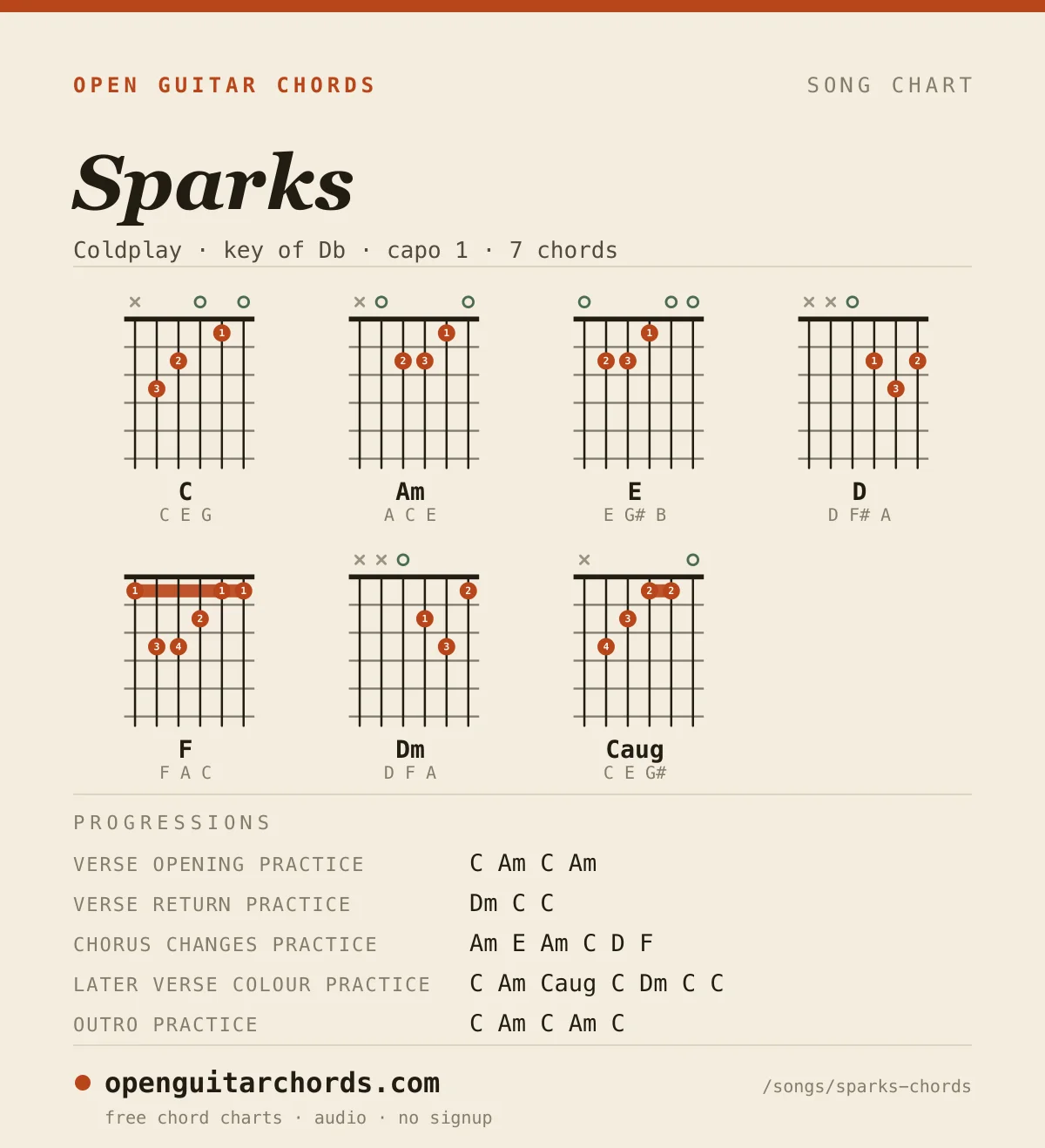
Sparks by Coldplay is an intermediate song in Db, played with a capo on fret 1. The whole sheet is 7 chords (C, Am, E, D, F, Dm, Caug) across 5 sections: Verse opening practice → Verse return practice → Chorus changes practice → Later verse colour practice → Outro practice. 5 of the 7 shapes are open chords. Shapes that use a barre: F, Caug.
Simplified practice arrangement. Section repetitions are practice cues rather than a verified transcription of the recording.
By Chiye · Updated
Hardest change in the sheet: Am → Caug, once.
- Difficulty
- Intermediatebarre shape Caug
- Key
- Dbwith a capo on fret 1
- Tuning
- Standard (E A D G B E)low to high
- Chords
- 75 open, 2 with a barre
- Sections
- 5each with its own progression
Chords in Sparks
Frets read low E to high E, x means leave that string out.
Chord sheet
One chord per bar in this practice sheet. Follow the time signature shown beside each section; dots mark the remaining counts in the bar. Tap a bar to hear its chord, or loop the section to practise the changes.
Chord accompaniment only. Follow the section notes for this arrangement’s timing. Songs whose words are public domain →
Verse opening practice6/8 · ♩=72
Two groups of three eighth notes; quarter-note BPM 72 equals dotted-quarter 48
Verse return practice6/8 · ♩=72
Chorus changes practice6/8 · ♩=72
Later verse colour practice6/8 · ♩=72
Outro practice6/8 · ♩=72
Printable one-page chord chart
How to play Sparks
This Sparks chart uses standard tuning, capo 1 and C-family shapes, sounding in Db. It is a simplified accompaniment based on the chord changes in GuitarTuna’s easy version. The boxes give each chord a full 6/8 practice bar. They are exercises for the changes, rather than a transcription of every recording bar or Chris Martin’s original guitar voicings.
Choose the standard-tuning version
Keep the guitar at E–A–D–G–B–E for the diagrams and playback here. The shapes C and Am sound as Db and Bbm with capo 1. Removing the capo lowers the accompaniment one semitone, so it will no longer sit at the same pitch as this Db-centred version.
Carl Brown’s original-style Sparks lesson uses E–A–D–G–B–D and capo 6. That lowered first string is part of a different set of voicings. Moving the capo from 1 to 6 while retaining our shapes would raise everything five more semitones; it does not convert this chart into that guitar part. Choose one setup before starting.
Count six eighth notes in two groups
Count ONE-two-three FOUR-five-six, with one gentle downstroke at the start of each group. The six grid positions are eighth notes. Empty positions still take time: D . . D . . contains two attacks across the whole bar, not two consecutive quarter-note strums followed by a pause.
The section setting is quarter-note BPM 72. Three eighth notes last one dotted-quarter pulse, giving 48 of those pulses per minute. A full practice bar lasts two of them. Musicnotes’ piano/vocal/guitar edition specifies 6/8 and a dotted-quarter marking of 48; the player setting expresses that marking in its own quarter-note unit. Other versions may use another speed or grouping, so compare the beat unit as well as the number.
Keep D major and D minor distinct
Both appear in this simplified chart. The chorus-change exercise uses D major, while the verse-return exercise uses D minor. The printed D grip is x-x-0-2-3-2; Dm is x-x-0-2-3-1. The high E note changes from F# to F, and the fingers need repositioning. With capo 1 these chords sound as Eb major and Eb minor.
Start both sweeps on the fourth string. Letting the low E or A ring adds a different bass note. In the chorus exercise, also keep E major distinct from Am: E’s G# makes it a major chord, not another spelling of the A minor harmony. Practise each pair separately before connecting Am–E–Am–C–D–F.
Practise the Caug passing colour
The catalog Caug grip is x-3-2-1-1-0, compared with C at x-3-2-0-1-0. The open G moves to G# while C and E remain. In the shown fingering, the middle finger makes a small barre across G1 and B1; the ring finger holds D2 and the little finger holds A3. Keep the high E open and pluck each string to check that it rings.
At capo 1 the resulting chord is Dbaug. It differs from C major by its raised fifth, not by a change to a minor third. The later-verse exercise includes C–Am–Caug–C–Dm–C–C; isolate the Caug-to-C release if that change interrupts the pulse. The ending exercise returns to C after the C–Am alternation. Chord choices and the capo-1 setup follow GuitarTuna’s simplified Sparks chart; the even bar lengths here are for practice, not a complete song form.
How to practise Sparks
Four steps computed from this sheet: the order the shapes are easiest to learn in, the changes that really occur in the progressions above, where each chord turns up, and the tempo ladder up to the speed marked here.
Learn the shapes easiest first
C (x-3-2-0-1-0, beginner) → Am (x-0-2-2-1-0, beginner) → E (0-2-2-1-0-0, beginner) → D (x-x-0-2-3-2, beginner) → Dm (x-x-0-2-3-1, beginner) → F (1-3-3-2-1-1, intermediate, needs a barre) → Caug (x-3-2-1-1-0, advanced, needs a barre)
5 of the 7 shapes are open chords, so start there and leave Caug until the others change cleanly.
Drill the changes this sheet actually uses
C → Am5×Am → C4×Dm → C2×Am → Caug1×
These counts come from the progressions on this page, so they are the changes you will actually play, not a generic list of pairs to practise.
Know where each chord turns up
- Cevery section
- AmVerse opening practice, Chorus changes practice, Later verse colour practice, Outro practice
- EChorus changes practice
- DChorus changes practice
- FChorus changes practice
- DmVerse return practice, Later verse colour practice
- CaugLater verse colour practice
Climb the tempo ladder
This sheet does not list a tempo, so pick one where every change is clean and use the metronome to move up in 4 BPM steps.
The section to leave until last is Later verse colour practice (7 bars in this sheet).
Playing Sparks with a capo
This sheet is written with a capo on fret 1. Each card shows what you would finger at that capo position so the song still sounds exactly as written. Useful when the shapes above are awkward, or when you want to sing it higher without learning new chords.
No capo
C# Bbm F Eb F# Ebm C#aug
no open shapes left, all barre
Fret 1as written
C Am E D F Dm Caug
5 of 7 stay open
Fret 2
B Abm Eb C# E C#m Baug
1 of 7 stay open
Fret 3
Bb Gm D C Eb Cm Bbaug
2 of 7 stay open
Fret 4
A F#m C# B D Bm Aaug
3 of 7 stay open
Fret 5
Ab Fm C Bb C# Bbm Abaug
1 of 7 stay open
Fret 6
G Em B A C Am Gaug
6 of 7 stay open
Fret 7
F# Ebm Bb Ab B Abm F#aug
no open shapes left, all barre
Working out a different key? The capo calculatordoes the same arithmetic for any chord set.
More songs built on the same chords
If Sparks clicks, these use the closest set of shapes, so the chords you just learned keep working.
More intermediate songs to learn after this one: Father and Son, Shallow, The One That Got Away, Treat You Better.
These chords across the songbookHow often each chord in Sparks turns up across all 104 songs on this site, and what it most often moves to next. The counts come from the sheet library itself, not from theory.
420bars of this chord across the songbook
70songs use this shape
Most often followed by G, 115×.
125bars of this chord across the songbook
35songs use this shape
Most often followed by F, 23×.
69bars of this chord across the songbook
11songs use this shape
Most often followed by Eadd9, 6×.
323bars of this chord across the songbook
58songs use this shape
Most often followed by G, 52×.
114bars of this chord across the songbook
29songs use this shape
Most often followed by C, 38×.
23bars of this chord across the songbook
9songs use this shape
Most often followed by F, 5×.
1bars of this chord across the songbook
1songs use this shape
Most often followed by C, 1×.