John Lennon
Imagine chords
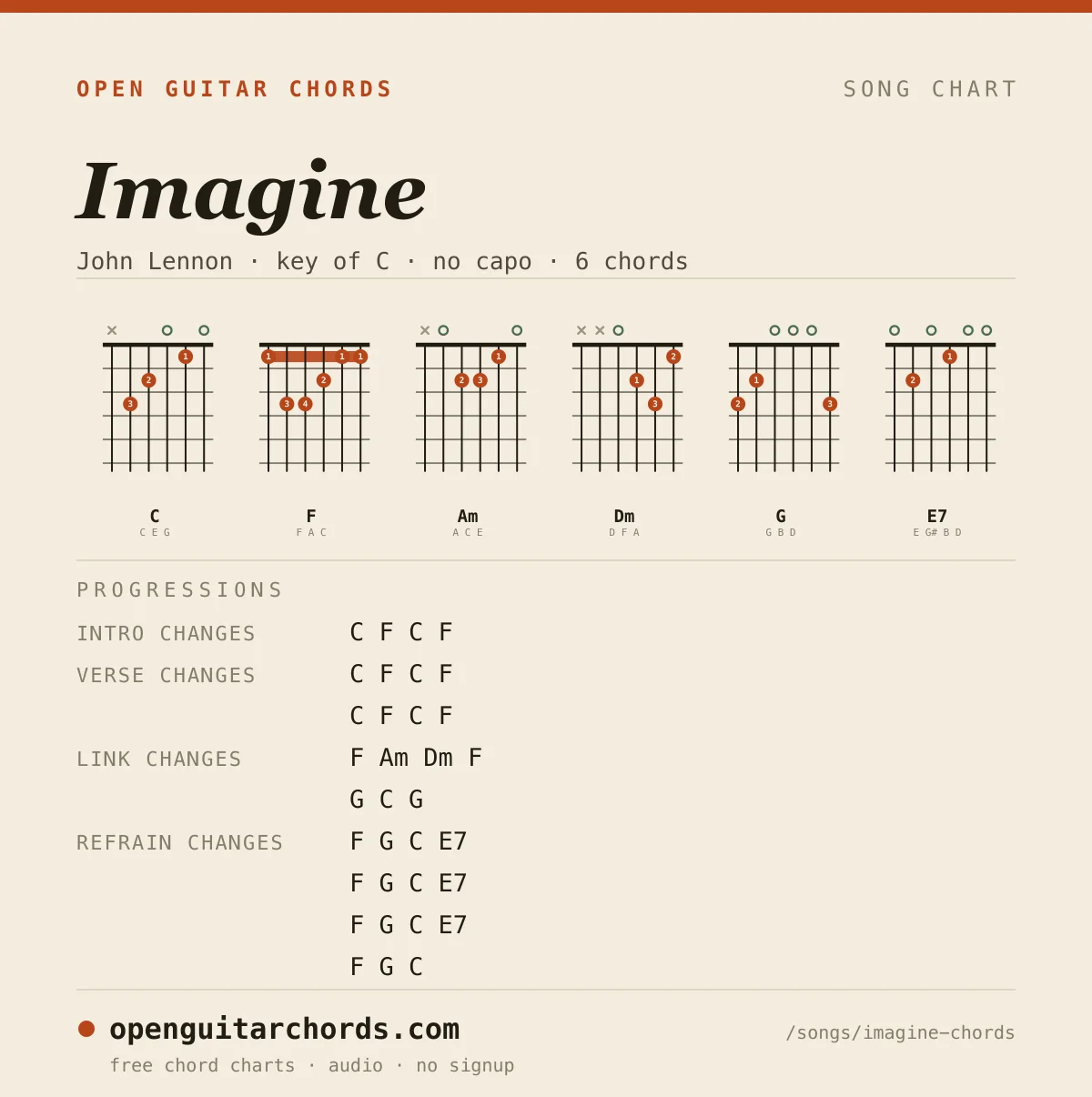
Imagine by John Lennon is an intermediate song in C, played with no capo. The whole sheet is 6 chords (C, F, Am, Dm, G, E7) across 4 sections: Intro changes → Verse changes → Link changes → Refrain changes. 5 of the 6 shapes are open chords. Shapes that use a barre: F. It sits at roughly 68 BPM.
Simplified practice arrangement. Section repetitions are practice cues rather than a verified transcription of the recording.
By Chiye · Updated
Hardest change in the sheet: C → F, 6 times.
- Difficulty
- Intermediatebarre shape F
- Key
- Cwith no capo
- Tempo
- 68BPM
- Tuning
- Standard (E A D G B E)low to high
- Chords
- 65 open, 1 with a barre
- Sections
- 49 steps in the song form
Chords in Imagine
Frets read low E to high E, x means leave that string out.
Chord sheet
One chord per bar in this practice sheet. Follow the time signature shown beside each section; dots mark the remaining counts in the bar. Tap a bar to hear its chord, or loop the section to practise the changes.
Chord accompaniment only. Follow the section notes for this arrangement’s timing. Songs whose words are public domain →
Intro changes4/4 · ♩=68
Verse changes4/4 · ♩=68
Link changes4/4 · ♩=68
Refrain changes4/4 · ♩=68
Printable one-page chord chart
How to play Imagine
Imagine uses C, F, Am, Dm, G and E7 in this simplified C-major guitar arrangement. Play in standard tuning without a capo. Each harmonic change is expanded to four beats at a practice tempo of 68 BPM. The verse, link and refrain have different jobs, so learn their endings before following the complete teaching route. The displayed F is a full barre chord.
Keep the two writers separate from the recording artist
The official John Lennon release page credits John Lennon and Yoko Ono as the songwriters. Both are retained in this page’s composition data. John Lennon remains the artist named for the selected song; a composer credit does not automatically mean that person sang or played the guitar part you are learning.
Lauren Bateman’s own guitar chart provides the simplified harmony used here. Its intro is C–F–C–F, and the verse contains eight chord events: four C–F pairs. The piano recording has details beyond this six-chord accompaniment. Start with the displayed version before adding a colour chord from a different arrangement.
Follow the link into the refrain without skipping its last G
The link is F–Am–Dm–F–G–C–G. Its final G leads toward what comes next; do not stop at C merely because it sounds like home. The refrain uses F–G–C–E7 three times, then F–G–C. That last line settles on C without adding a fourth E7. Practise the two different endings until you can choose either without losing the count.
Our route is Intro, Verse, Link, Verse, Link, Refrain, Verse, Link, Refrain. These names distinguish the connecting section from the main refrain; the source calls them chorus and bridge. The route preserves that teaching chart’s section order, while our boxes lengthen its internal changes. It is not a claim that each chord occupies a full bar in the piano recording.
Change C to Cmaj7 by releasing a finger, not sliding
The open C shape x32010 becomes Cmaj7 x32000 when the B string’s first fret is released to the open string. That changes C to B on that string. A slide moves a fretted note along the neck; releasing to an open string is a different action. The other fingers can stay in place while you compare the two sounds slowly.
Cmaj7 is not required by the selected six-chord chart. Use that comparison as an optional listening exercise, then return to C when following this page. Similarly, Fmaj7 introduces E into F–A–C. It may suit another accompaniment, but it is not an identical replacement for F. A smaller F voicing such as xx3211 keeps the triad if you mute both bass strings, though it differs from the full diagram.
Prepare F and hear the G-sharp inside E7
For the displayed F, check the barre one string at a time before strumming. Move from C with a relaxed wrist and keep counting while the new shape settles. If the top string buzzes, isolate that contact rather than pressing every finger harder. This is why the page is marked intermediate despite having several familiar open chords.
E7 contains E, G#, B and D; Em would replace G# with G and change its colour. Here E7 returns to F at the next refrain line, so listen to G# moving toward A and E toward F instead of assuming every dominant seventh must immediately reach Am. Use four quiet downstrokes per box. The eight-cell grid marks eighth-note positions and does not reproduce the source’s alternating-bass pattern or the recording’s piano figure.
How to practise Imagine
Four steps computed from this sheet: the order the shapes are easiest to learn in, the changes that really occur in the progressions above, where each chord turns up, and the tempo ladder up to the speed marked here.
Learn the shapes easiest first
C (x-3-2-0-1-0, beginner) → Am (x-0-2-2-1-0, beginner) → Dm (x-x-0-2-3-1, beginner) → G (3-2-0-0-0-3, beginner) → E7 (0-2-0-1-0-0, beginner) → F (1-3-3-2-1-1, intermediate, needs a barre)
5 of the 6 shapes are open chords, so start there and leave F until the others change cleanly.
Drill the changes this sheet actually uses
C → F6×G → C5×F → G4×C → E73×
These counts come from the progressions on this page, so they are the changes you will actually play, not a generic list of pairs to practise.
Know where each chord turns up
- Cevery section
- Fevery section
- AmLink changes
- DmLink changes
- GLink changes, Refrain changes
- E7Refrain changes
Climb the tempo ladder
Start at 41 BPM and move up only when a full pass is clean: 41 → 51 → 61 → 68 BPM. The tempo marked on this sheet is 68 BPM, and the last step is the one that always feels like a jump. Stay at 61 for longer than feels necessary.
Practise each section's chord changes slowly, then play the sheet through at a steady tempo without pausing between sections.
Playing Imagine with a capo
This sheet needs no capo. Each card shows what you would finger at that capo position so the song still sounds exactly as written. Useful when the shapes above are awkward, or when you want to sing it higher without learning new chords.
No capoas written
C F Am Dm G E7
5 of 6 stay open
Fret 1
B E Abm C#m F# Eb7
1 of 6 stay open
Fret 2
Bb Eb Gm Cm F D7
1 of 6 stay open
Fret 3
A D F#m Bm E C#7
3 of 6 stay open
Fret 4
Ab C# Fm Bbm Eb C7
1 of 6 stay open
Fret 5
G C Em Am D B7
6 of 6 stay open
Fret 6
F# B Ebm Abm C# Bb7
no open shapes left, all barre
Fret 7
F Bb Dm Gm C A7
3 of 6 stay open
Working out a different key? The capo calculatordoes the same arithmetic for any chord set.
More songs built on the same chords
If Imagine clicks, these use the closest set of shapes, so the chords you just learned keep working.
More intermediate songs to learn after this one: Father and Son, Shallow, The One That Got Away, Landslide.
These chords across the songbookHow often each chord in Imagine turns up across all 104 songs on this site, and what it most often moves to next. The counts come from the sheet library itself, not from theory.
420bars of this chord across the songbook
70songs use this shape
Most often followed by G, 115×.
114bars of this chord across the songbook
29songs use this shape
Most often followed by C, 38×.
125bars of this chord across the songbook
35songs use this shape
Most often followed by F, 23×.
23bars of this chord across the songbook
9songs use this shape
Most often followed by F, 5×.
509bars of this chord across the songbook
77songs use this shape
Most often followed by D, 89×.
31bars of this chord across the songbook
10songs use this shape
Most often followed by A7, 4×.