Chord family · 6 shapes
Add9 chords
An add9 chord takes a plain triad and adds the ninth (the second scale degree, an octave up) while keeping the third. The result still sounds major, but with a shimmer that a plain major chord cannot produce — this is the sound of acoustic pop, worship music and a large amount of 1990s and 2000s songwriting.
The shapes are small edits of chords you already know, which is why add9 chords show up in beginner songbooks even though their names look complicated: Cadd9 is C with one finger moved, Eadd9 adds a note to E, and Fadd9 is a four-string shape with no barre at all.
added ninth
6 shapes · 4 with their own pageHow to use add9 chords in a song
In songwriting they are what you reach for when a plain triad sounds too plain. They keep the major quality, so they work anywhere a major chord works — swap C for Cadd9 in almost any progression and the song still functions, it just sounds more open. That substitutability is the whole appeal: no new harmonic rules, a different texture.
The difference between an add9 and a plain major chord is one note, and that note is usually the highest one you play. It is also the first note to vanish if a finger rolls flat, so check the top string separately before you blame the whole shape.
Do not confuse add9 with sus2. A sus2 replaces the third; an add9 keeps it and stacks the ninth on top. That is why a sus2 sounds unresolved and an add9 sounds like a finished major chord wearing a brighter coat.
The family is small — 6 shapes, 2 of them open — because add9 chords are a colour rather than a system. Learn Cadd9 first: it is the one you will meet most often, and it appears in one of the most-played acoustic songs ever written.
If you only try two of the shapes on this page, try Gadd9 and Aadd9: both can be reached from shapes you already know, so the change stays playable at speed. Play them slowly enough that you hear the added note arrive, then speed the loop up without changing anything else.
How to practise add9 chords
- Play C, then Cadd9, then C again. The ninth is usually the top note, so listen there: if the shimmer vanishes, a finger has rolled flat.
- Swap Cadd9 in for C in a progression you already play. The song still works, it just sounds more open, and that substitutability is the whole point of the family.
- Play Cadd9 then Csus2 back to back. One keeps the third and one replaces it, and hearing that difference is how you stop confusing the two names.
Add9 chords in real songs
Four songs charted on this site use add9 chords, and in every case the added ninth is doing the same job: keeping a plain major chord from sounding plain.
- Wonderwall: the bridge turns on Cadd9, and the shape is one finger away from the C the rest of the song implies
- A Horse with No Name: Dadd9 is one of only two chords in the whole song, alternating with D6 for two and a half minutes
- Norwegian Wood: uses Eadd9 and Fadd9 as the opening pair, which is why the song sounds modal rather than major
- You Are My Sunshine: adds Fadd9 to a three-chord folk tune, and the last line changes colour completely
Printable family chart
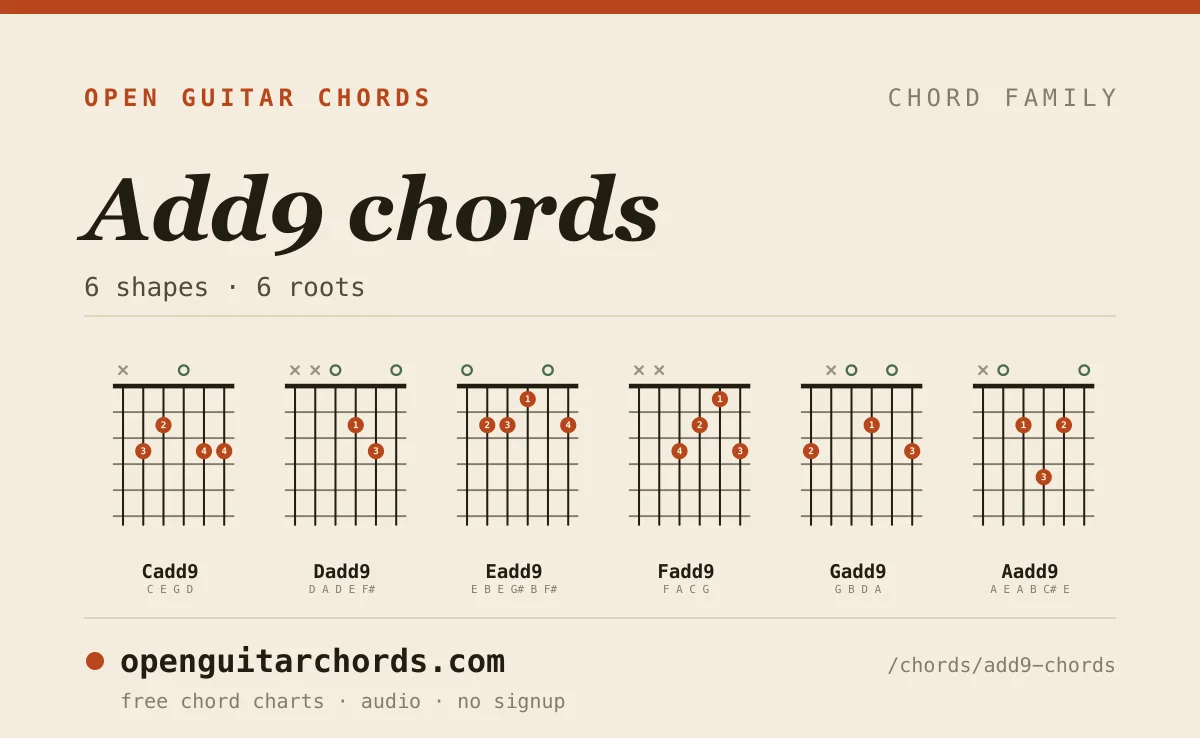
Add9 chords with their own pages
These are the ones that turn up often enough in songs to deserve a full page — fingerings in every position, real progressions, and the songs that use them.